Provisions must be made for the storage of solvents in flame-proof cabinets and personnel
must wear protective clothing and eye protection at all times.
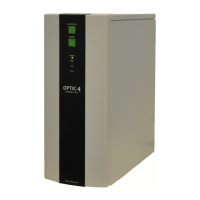
3. The OPTIC-4 controller must be powered from an earthed (grounded) mains outlet.
Power Requirements: AC Single Phase 100-240V, Frequency 50-60 Hz
Typical power consumption: 150VA
Maximum power consumption: 450 VA
4. Both the OPTIC-4 controller and the host GC must be disconnected from the mains power
outlet until installation of the equipment is completed.
5. The Optic-4 controller power switch is located at the rear of the instrument. Leave enough
space behind the controller to ensure unrestricted access to the power switch.
6. Do not use power cords others than those supplied with the instrument as this may cause
fire or electric shock.
7. It is important that a good electrical connection is made between the inlet power cable and
the inlet power terminals. A bad connection can result in poor operation and the
connection(s) can become excessively hot.
Ambient Environment: Temperature range: 18 - 40C
Humidity: 40 - 70%
5. The OPTIC-4 EFC’s are not designed for operation with explosive (besides Hydrogen),
corrosive or toxic gases.
Carrier Gases: Helium, Nitrogen or Hydrogen
Supply Pressure: 300 - 700 kPa
Purity: 99.995% or greater
6. The use of Hydrogen as a GC carrier gas is potentially dangerous. It is potentially explosive.
Take extreme care when using Hydrogen as the GC carrier gas in a GC or GC/MS system.
7. OPTIC-4 inlet is cooled using compressed air. A cooling valve will be damaged when the
source pressure exceeds specification. Do not exceed maximum source pressure of 700 kPa.
Cooling Air: Oil- and water-free compressed air
Supply Pressure: 700 kPa
1.3 Operation Precautions and Warnings
1. Most organic solvents are toxic to some degree. Substantial amounts of solvent vapor may
emerge from the exhaust port. It is highly recommended that these vapors are ducted to a
fume hood, or an active carbon trap is fitted to the exhaust port. However, the flow through
this port should not be restricted as this might impede normal functioning of the instrument.


 To Next Page