gives rise to approximately 1 ml of vapor, the total amount of sample that can be injected into a split
or splitless inlet is around 2 l.
When an injection is made into a PTV inlet, the evaporation of the solvent is a controllable process
and therefore restrictions on the volume of solvent that can be injected are much less severe.
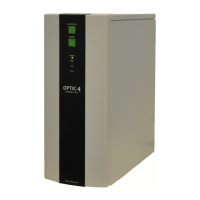
The OPTIC-4 large volume method is designed to implement the rapid large volume injection (LVI)
technique. This enables injections up to 100 l to be made routinely, at-once, and with a minimum
of optimization. The technique is compatible with most auto-samplers and is very robust, making it
suitable for routine applications. Other large volume sampling techniques, such as speed
programmed injection, may also be accommodated.
In large volume injection, the sample is introduced with the inlet at near ambient temperature. The
solvent is allowed to evaporate into the carrier stream and pass out through the split line. At an
appropriate point, the split line is closed and the inlet is heated. The sample is then transferred onto
the column. Simple optimization of the parameters enables components with a very wide volatility
range to be analyzed by this technique.
The advantages of this method are very significant:
• An improvement in detection limits of up to 100 times that of conventional splitless
injection.
• Much greater flexibility in the design of sample preparation procedures.
• Easier on-line interfacing with sample preparation accessories (such as automated solid
phase extraction instruments).
7.2.4 LINEX Method
OPTIC-4 can be used for an automated thermal desorption analysis of gas and solid samples and also
real world samples with complex dirty matrixes.
Gas phase samples can be collected off-line using GL Sciences TD liners or adsorption tubes packed
with a suitable sorbent. Alternatively, on-line analysis is possible with the sample being collected
directly into the liner placed in the inlet.
DMI enables sample introduction into GC column to be performed from a disposable container
(sample insert) placed inside the inlet liner. This has a great advantage over traditional injection
because large volumes (up to 30 μl) of dirty sample extracts or even row samples can be introduced
directly into GC or GC/MS. Using the principle of selective exclusion, the volatiles and semi-volatiles
are thermally desorbed and transferred onto the column, while non-volatile residues are retained in
the sample insert, which is disposed after analysis. The DMI method permits also the use of the
built-in solvent monitor, facilitating the optimization of the solvent vent time.
Thermal desorption using the OPTIC-4 TD or DMI methods is distinguished from conventional
thermal desorption by the way the liner with the sample or the adsorption tube is closely coupled to
the column. This has the following advantages:


 To Next Page