General
1-26
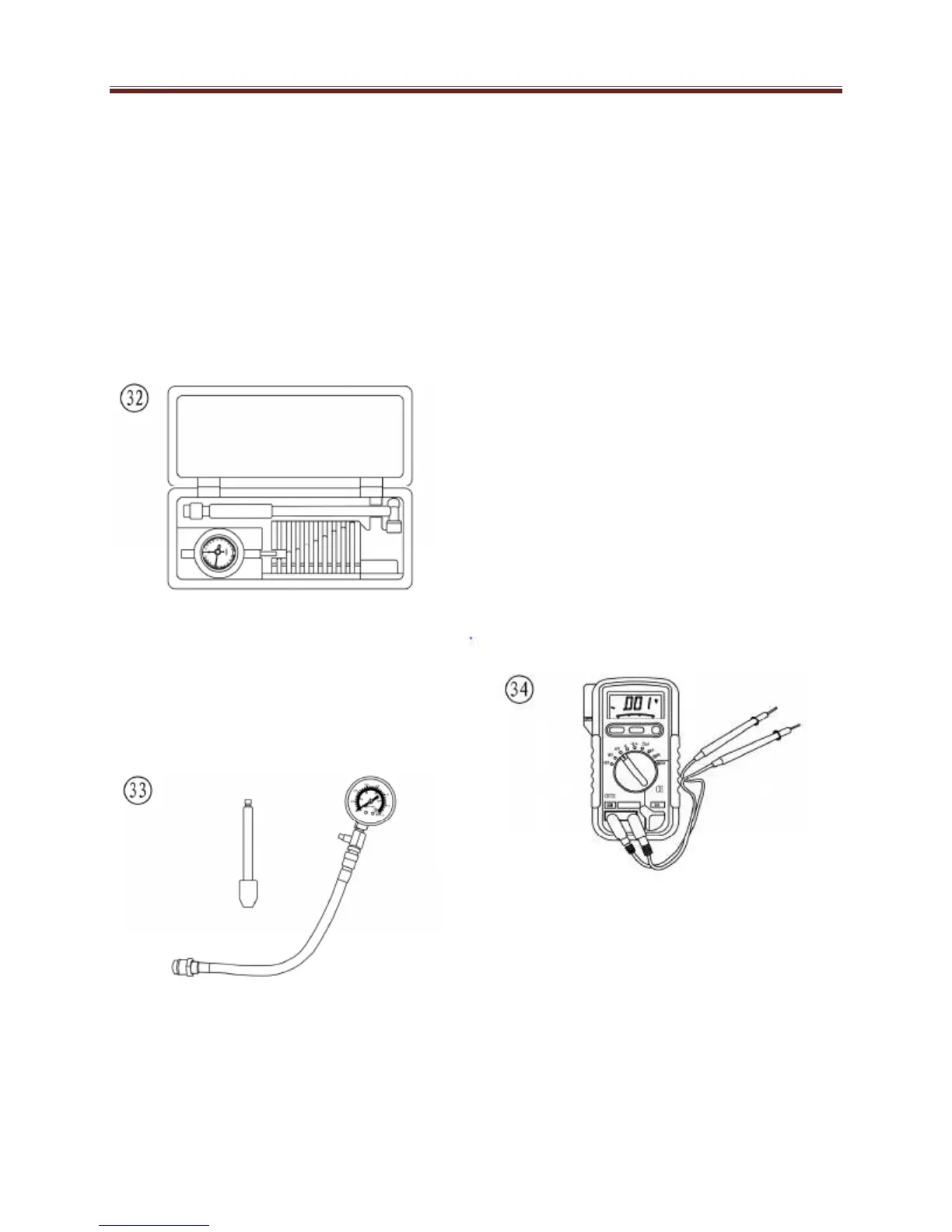
Cylinder Bore Gauge
A cylinder bore gauge is similar to a dial
indicator. The gauge set shown in
Figure 32 consists of a dial indicator,
handle, and different length adapters
(anvils) to fit the gauge to various bore
sizes. The bore gauge is used to
measure bore size, taper and out-of-
round. When using a bore gauge, follow
the manufacturer’s instructions.
Compression Gauge
A compression gauge (Figure 33)
measures combustion chamber
(cylinder) pressure, usually in PSI or kg/
cm2 .
The gauge adapter is either inserted
or screwed into the spark plug hole to obtain
the reading. Disable the engine so it does not
start and hold the throttle in the wide-open
position when performing a compression test
An engine that does
not have adequate compression cannot be
properly tuned. Refer to Chapter Three.
Multimeter
A multimeter (Figure 34) is an essential tool
for electrical system diagnosis. The voltage
function indicates the voltage applied or
available to various electrical components.
The ohmmeter function tests circuits for
continuity, or lack of continuity, and measures
the resistance of a circuit. Some
manufacturer’s specifications for electrical
components are based on results using a
specific test meter. Results may vary if using
a meter not recommended by the
manufacturer.
Such requirements are noted when
applicable. Ohmmeter (analog) calibration
Each time an analog ohmmeter is used or if
the scale is changed, the ohmmeter must be
calibrated



 To Next Page