WORKING WITH THE COMPACT CRANE
U.C10.00.00.EN Version 2.0 33
6.3 Crane functions/operation
DANGER!
Stay clear of the ballast, particularly during retraction of the ballast
(risk of crushing).
TIP
Make sure that the crane and the track undercarriage are parallel
to one another before collapsing the crane!
TIP
In the event of an overload, retract the extendable sections of the
crane or lower the winch cable until the load is once more within
the safe operating range of the crane.
6.3.1 Order of operations
To operate the arm of the compact crane, follow these steps in sequence:
Start the engine and activate the transmitter as described in section
6.46.4.
Check that the outriggers are extended and that the compact crane is
level (see section 6.5).
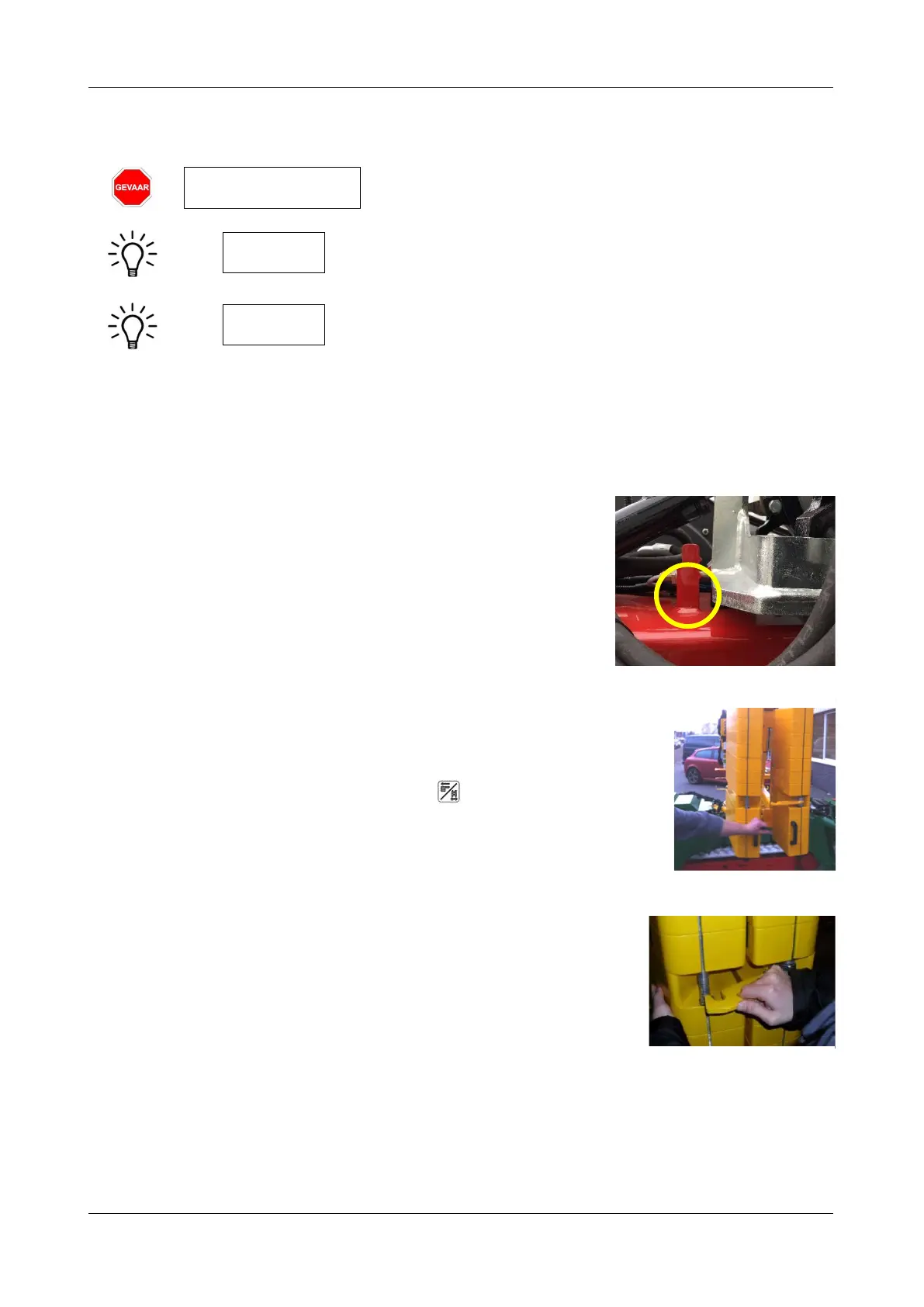
Check the gauge for the winch cylinder. Points on the plate
must be between the points on the boom (see yellow circle in figure 27).
Contact the dealer or Hoeflon International B.V. if the gauge goes
outside this range as a result of incorrect lifting capacity.
Turn the key switch on the electrical cabinet to the ‘crane’ position.
The Yanmar engine has a standard speed. Or, if fitted with the ‘actuator’
option, the engine speed is automatically increased when a function is operated.
Before extending the ballast make sure the ballast will not contact the boom.
Slide the ballast out completely by pressing this button on the transmitter.
Attention! A dangerous situation can arise if the ballast is not completely
extended, because the outrigger legs will be hit during slewing.
Swing both ballast sections to the rear (see figure 28).
Secure the ballast in place with the retainer (see figure 29).
Erect the crane by raising the cylinders of boom 1 and the jib in succession,
using the corresponding levers on the transmitter (see section 6.2.1). The
boom and jib can then be extended. Collapse the crane by performing this
procedure in reverse order.
6.3.2 Operation
Operate the crane with the remote control by moving the levers (see section 6.2.1).
Do not operate more than one crane function at a time.
An overload warning will be displayed if the crane reaches its maximum upper position. Lower the mast
slightly.
Figure: 27
Figure: 28
Figure: 29


 To Next Page