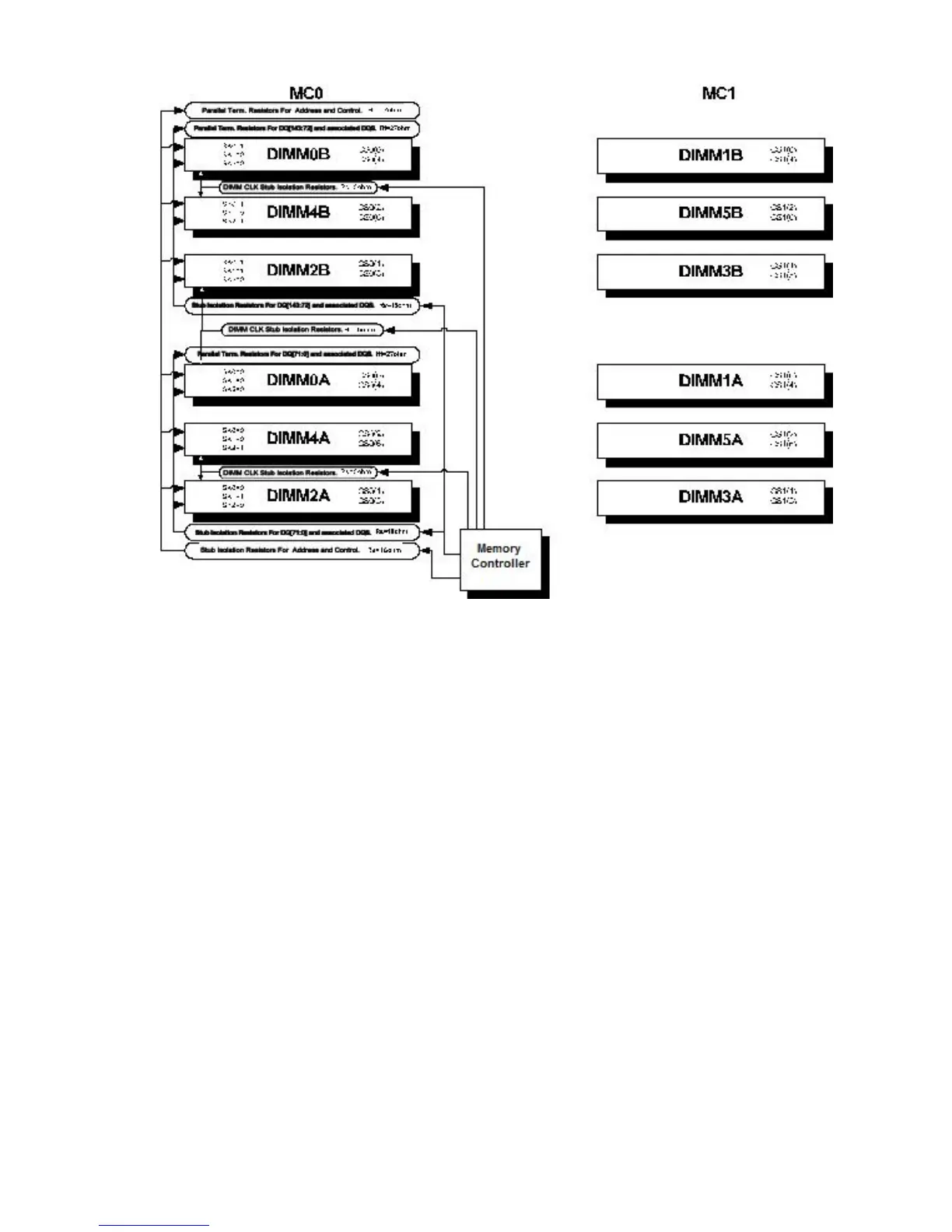
Figure 1-6 Memory Block Diagram
Memory Architecture
The I/O ASIC memory interface supports two DDR cells, each of which is 144 data bits wide.
The memory subsystem physical design uses a comb-filter termination scheme for both the data
and address/control buses. This part of the topology is similar to other DDR designs in the
computer industry. Clocks are distributed directly from the I/O ASIC; each clock pair drives two
DIMMs.
Memory data is protected by ECC. Eight ECC bits per DIMM protect 64 bits of data. The use of
ECC enables correction of single-bit errors, and detection of multi-bit errors. Only DIMMs with
ECC are qualified or supported.
DIMMs
The memory subsystem only supports Double Data Rate Synchronous Dynamic Random Access
Memory (DDR SDRAM) technology utilizing industry-standard PC-1600 type DDR SDRAM
DIMMs, 1.2" tall. This is currently being used by high-volume products. The DIMMs use a 184-pin
JEDEC standard connector.
DIMMs are loaded in groups of four, known as a rank or quad (except for 256 MB DIMMs, which
is loaded in pairs). All four DIMMs in a rank or quad must be the same size. The following
information summarizes the memory solutions.
Memory Array Capacities
Table 1-2 lists the memory array capacities for the server.
26 Overview



 To Next Page