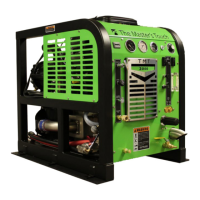
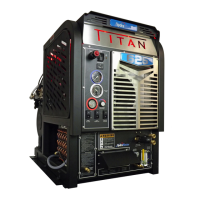
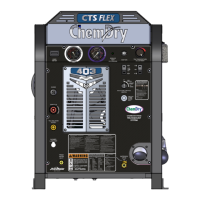
The HydraMaster Boxxer 318 is a truck-mounted carpet and hard surface cleaning system designed for professional use. It utilizes an internal combustion engine to power both a vacuum pump (blower) and a high-pressure water pump. The system is engineered to provide efficient cleaning by heating water, injecting chemicals, and recovering the dirty solution.
Function Description:
The Boxxer 318 operates by drawing fresh water into a water box, where its level is maintained by a float valve. This water is then gravity-fed to the high-pressure pump, which pressurizes it. The pressurized water then enters a bypass valve, allowing for manual adjustment of the pressure level. When the cleaning tool's valve is closed, most of the water recirculates back to the water box. When the cleaning tool is in use, the necessary amount of high-pressure water passes through the bypass valve to the heat exchanger.
The system's heat exchanger utilizes the heat from both the engine and blower exhausts to raise the water temperature to the desired cleaning level. The heated water then travels to a high-pressure manifold, which houses a temperature sensor for heat control and a high-temperature shutdown switch. A recirculation (or primary) orifice in the manifold allows a small amount of high-pressure, high-temperature water to return to the water box, preventing excessive pressure buildup when the cleaning tool valve is closed.
Water exiting the manifold passes through a check valve and then mixes with cleaning chemicals. The chemical is pressurized by a diaphragm chemical pump attached to the head of the water pump. This pump draws chemical from a jug through a flow meter. After pressurization, the chemical travels through a metering valve and is injected into the high-pressure water stream, creating the cleaning solution. This solution is then delivered to the cleaning tool.
The dirty solution is recovered by the vacuum generated by the blower and collected in a recovery tank for proper disposal. The system can be equipped with an optional Automatic Pump-Out (APO) system for continuous waste water removal.
Important Technical Specifications:
- Overall Dimensions: 24.0" W x 36" D x 31" H
- Weight: 570 lbs.
- Engine: Briggs and Stratton Vanguard 18 HP
- Oil Type: Synthetic 5W-30
- Oil Capacity: Approx. 1 1/2 quarts (48 oz.) when changing oil and filter
- Engine RPM: 3,150 rpm @ 14" Hg
- Vacuum Blower: Tuthill 3006 Competitor Plus SL (Dual Splash Lubrication)
- Oil Type: PneuLube or other ISO 100 rating
- Gear End Capacity: Approx. 7.0 oz.
- Drive End Capacity: Approx. 5.0 oz.
- Blower RPM: 3,150 rpm @ 14" Hg
- High Pressure Pump: HydraPump II
- Oil Type: Synthetic 15W-50
- Oil Capacity: Approx. 8.0 oz.
- Pump Rate: 3.5 gallons per minute
- Pump RPM: 1,750 rpm
- Operating Pressure: 0 - 1,000 psi
- Chemical System: Last Step Chemical Injection
- Heating System: Finned Tube Heat Exchanger
- Standard Equipment:
- 1/4" High Temperature Lined/Vinyl Cover - 100 ft. High Pressure Hose
- 2" Vacuum Hose - 100 ft.
- 1-1/2" Wand Whip Line - 10 ft.
- 50 gallon MaxAir Universal Recovery Tank
- Stainless Steel S-bend Cleaning Wand with Replaceable Grip and Rebuildable Solution Valve
- 5 gallon Chemical Jug
- Battery Box
- Van Decal
- Van Installation Kit
- Operation Manual
- Optional Equipment:
- 70 gallon MaxAir Universal Recovery Tank
- 85 gallon Rotomolded Fresh Water Tank
- Dura-Flow APO (Automatic Pump Out)
Usage Features:
- Start-up Procedure: Involves performing daily maintenance, connecting a garden hose for water supply (and turning on the optional "PUMP-IN" switch if used), ensuring the water box is full, connecting the cleaning tool, turning the key to "ON," pulling the choke to start the engine at "IDLE," pushing the choke in after starting for a 2-3 minute warm-up, pulling the throttle cable to full extension and locking it, setting the desired temperature, and turning on the "AUTO PUMP-OUT" switch if used.
- Pressure Adjustment: The "PRESSURE REGULATOR" allows adjustment to desired cleaning pressure (e.g., 300-400 psi for carpet, 1,000 psi for hard surfaces).
- Chemical Priming: The "CHEMICAL SELECTION VALVE" is turned to "PRIME" to purge air, assisted by blocking the vacuum intake to the recovery tank to achieve 12"-14" Hg vacuum. Chemical is allowed to flow at full rate for 30 seconds before turning the valve to "ON" and adjusting flow with the "CHEMICAL METERING CONTROL KNOB."
- Cleaning Tool Tips: Short, front-to-back strokes with a wand, followed by a "dry pass" (vacuum only) to prevent overwetting. For olefin fibers, solution should only be applied during the backward stroke. Rotary tools (like the RX-20) require short, side-to-side strokes and a dry pass between wet passes.
- Overwetting Prevention: Factors include sufficient vacuum strokes, clear vacuum blower filter, properly sealed vacuum tank lid, closed drain valve, unobstructed vacuum hoses, and using crystal defoamer for foam-saturated carpets.
- Streaking Prevention: Proper nozzle alignment, avoiding overlapping spray, clear vacuum head, and consistent solution temperature.
- Waste Water Disposal: Laws prohibit dumping "gray" water into storm drains. Acceptable methods include municipal sewage systems (after filtering solids) or accumulating waste water for proper dump sites. The optional APO system continuously pumps out waste water.
Maintenance Features:
Maintenance is categorized into daily, weekly, monthly, quarterly, and 500-hour intervals. A maintenance log is provided and must be kept for warranty validation.
- Daily Maintenance: Check engine and pump oil levels, inspect/clean recovery tank filters, orifices, and garden hose screen, inspect for leaks/loose connections, and lubricate the blower.
- Weekly Maintenance: Inspect recovery tank filters for damage, inspect/clean/lubricate vacuum relief valve, thoroughly clean recovery tank, check blower oil, check pump drive belt tension, inspect hoses/wiring, flush water/chemical systems with white vinegar and water, and check/tighten nuts and bolts. Initial high-pressure pump oil change after 50 hours, then every 500 hours. Initial engine oil change after 8 hours, then every 50 hours (every 25 hours in high ambient temperatures), with oil filter change every other oil change.
- Monthly Maintenance: Check/clean/replace engine air filter, check battery water level, and clean battery terminals.
- Quarterly Maintenance: Check/repair/replace fuel lines, clean/gap spark plugs (0.030 in), check/replace coupler element, and change blower oil after the first 100 hours (then every 500 hours).
- 500 Hours: Change blower oil, change high-pressure pump oil, and check engine valve clearance (intake and exhaust 0.004 - 0.006”).
- After Each Job: Empty and clean recovery tank and filters.
- Overall Machine Maintenance: Regular cleaning of the truckmount to allow visual inspection for potential problems. Wipe down truckmount, hoses, and cleaning wand. Inspect/clean wand vacuum slot and head for sharp edges. Visually inspect hoses for abrasions.
- High Pressure Pump Maintenance: Daily oil level check (center of sight glass or between MIN/MAX on dipstick). Periodic oil changes (initial 50 hours, then every 500 hours). Replace seals and check valves at 500 hours if running in high ambient temperatures. Do not run pump dry or with frozen water.
- Valve Maintenance: Involves removing valve caps, inspecting O-rings, and removing/inspecting suction and delivery check valves for wear and pitting.
- Pump Manifold Maintenance: Removing and replacing the manifold, ensuring proper alignment with pistons.
- Seals and V-Packing Maintenance: Removing and reassembling seals and V-packing, lubricating parts generously.
- Plunger Maintenance: Inspecting ceramic plunger, O-ring, and washers for wear.
- Crankcase Servicing: Inspecting crankcase oil seals for drying, cracking, or leaking.
- Vacuum System Maintenance: Lubricate blower daily to prevent rust. Change blower oil after initial 100 hours, then every 500 hours.
- Descaling Procedure (Required): Add descaler chemical to the water box, circulate through the system, let stand, flush, and repeat as necessary. Clean all screens and strainers. A recirculation kit can be used for this.
- Freeze Guarding: Essential to prevent damage. Involves draining the water box, adding a 50/50 antifreeze and water mix, circulating it through the system, removing the chemical feed line and turning the selector valve to "PRIME" to vacuum remaining chemical, and then spraying the antifreeze mix out into a container for reclamation. Flush antifreeze from the system before cleaning.
- Pump Drive Belt Tensioning: Involves removing the grill and right cover, loosening the idler pulley bolt, adjusting tension with a screw, and then tightening the idler pulley bolt.
Warnings and Cautions:
- Never touch moving or hot parts of the truckmount.
- Use hearing protective equipment when operating due to noise levels exceeding 85 decibels.
- Position the vehicle to direct engine/blower fumes away from inhabited areas. Do not occupy the vehicle during operation.
- Engine exhaust contains chemicals known to cause cancer, birth defects, and reproductive harm in California.
- Never operate with portable gas containers inside the vehicle.
- Transporting vented fuel containers with flammable liquids is forbidden.
- Never smoke in or around the truckmount.
- Keep flammable materials away from the exhaust system.
- Never operate the truckmount when tilted more than 10 degrees.
- Never perform cleaning operations at IDLE throttle position.
- Never operate with vehicle doors closed.
- Never use concentrated acids or solvents (including d-limonene) in the water or chemical systems.
- Never operate with water hardness 3.0 grains per gallon or higher without a water softening system or magnetic descaler. Failure to do so voids warranty.
- Never allow water to freeze inside the truckmount.
- Inspect the underside of the vehicle before drilling holes in the floor.
- Dispose of antifreeze according to local laws. Antifreeze is harmful if swallowed.
- Do not jump-start the truckmount from a running vehicle.
- Solid objects entering the blower will cause serious damage.
- Foam passing through the blower can cause serious problems.
- When installing a new battery, ensure it is properly charged.

 Need help?
 General

 To Next Page