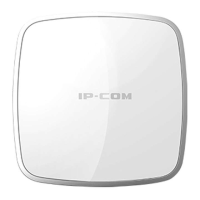
This document serves as a user guide for the IP-COM AX3000 Wi-Fi 6 In-Wall Access Point, models Pro-6-IW and Pro-6-IWV1.0. It provides comprehensive instructions for configuring, managing, and maintaining the device, ensuring optimal wireless network performance.
Function Description
The IP-COM AX3000 Wi-Fi 6 In-Wall Access Point (AP) is designed to provide robust and secure wireless network access. It supports Wi-Fi 6 (802.11ax) for enhanced speed, capacity, and efficiency. The AP can operate in two primary working modes: AP Mode and Client+AP Mode.
In AP Mode, the device connects to the internet via an Ethernet cable and converts wired signals into wireless signals, offering wireless coverage. This is the default working mode.
In Client+AP Mode, the AP wirelessly bridges to an upstream device (such as a wireless router or another AP) to extend the wireless network coverage of the upstream device. This mode is useful for expanding network reach without additional cabling.
The device offers extensive SSID settings, allowing the creation of multiple SSIDs (up to 8 for both 2.4 GHz and 5 GHz bands) with individual configurations. These settings include:
- Status: Enable or disable an SSID.
- Broadcast SSID: Enable or disable the visibility of the SSID.
- Isolate Client: Prevents wireless clients connected to the same SSID from communicating with each other.
- Isolate SSID: Prevents wireless clients connected to different SSIDs from communicating with each other.
- WMF (Wireless Multicast Forwarding): Optimizes multicast traffic to unicast traffic, reducing network congestion.
- Max. Number of Clients: Limits the number of devices that can connect to an SSID.
- Chinese SSID Encoding: Supports UTF-8 encoding for SSIDs.
- Security Mode: Offers various encryption options to protect the wireless network.
Important Technical Specifications
The AP supports various security modes for network encryption, including:
- None: No encryption, allowing any client to connect (not recommended).
- WEP (Wired Equivalent Privacy): Uses a static key for encryption (easily cracked, maximum throughput limited to 54 Mbps, not recommended).
- WPA-PSK (Wi-Fi Protected Access - Pre-shared Key): Encrypts with WPA-PSK.
- WPA2-PSK (Wi-Fi Protected Access 2 - Pre-shared Key): Encrypts with WPA2-PSK.
- Mixed WPA/WPA2-PSK: Allows clients using either WPA-PSK or WPA2-PSK to connect.
- WPA (Wi-Fi Protected Access): Uses 802.1x for authentication and generates data encryption keys.
- WPA2 (Wi-Fi Protected Access 2): Similar to WPA but with stronger security.
- WPA3-SAE (Wi-Fi Protected Access 3 - Simultaneous Authentication of Equals): An upgraded version of WPA2-PSK, offering enhanced security.
- WPA2-PSK&WPA3-SAE: A transition mode compatible with both WPA3-SAE and WPA2-PSK for broader device support.
Encryption Algorithms supported include:
- AES (Advanced Encryption Standard)
- TKIP (Temporal Key Integrity Protocol): Limits maximum wireless throughput to 54 Mbps.
- TKIP&AES: Supports both TKIP and AES.
RF Settings allow for fine-tuning radio parameters:
- Wireless Network: Enable/disable wireless function.
- Country/Region: Compliance with local channel regulations.
- Network Mode: Supports 11b, 11g, 11b/g, 11b/g/n, 11b/g/n/ax for 2.4 GHz, and 11a, 11a/n, 11ac, 11a/n/ac/ax for 5 GHz.
- Channel: Auto or manual selection of operating channel.
- Channel Bandwidth: 20MHz, 40MHz, 20/40MHz (for 2.4 GHz), and 80MHz, 160MHz, 20/40/80/160MHz (for 5 GHz).
- Extension Channel: Determines operating frequency band for 40 MHz bandwidth in 11n mode.
- Lock Channel: Locks channel settings.
- Transmit Power: Adjusts signal strength for coverage and performance.
- Lock Power: Locks transmit power settings.
- Preamble: Long Preamble (default, for compatibility) or Short Preamble (for better synchronization).
- Short GI (Guard Interval): Increases wireless throughput by 10%.
- Suppress Broadcast Probe Response: Saves wireless resources by not responding to probe requests without an SSID.
RF Optimization parameters include:
- Beacon Interval: Interval for sending Beacon frames (default: 100 ms).
- Fragment Threshold: Threshold for packet fragmentation (default: 2346).
- RTS Threshold: Threshold for triggering RTS/CTS mechanism (default: 2347).
- DTIM Interval: Countdown for broadcast/multicast frames (default: 1 Beacon interval).
- RSSI Threshold: Minimum acceptable received signal strength (default: -90 dBm).
- Signal Transmission: Coverage-oriented (broader coverage) or Capacity-oriented (decreases interference in dense deployments).
- Air Interface Scheduling: Evenly allocates downlink transmission time to clients.
- Anti-interference Mode: 0 (Disable), 1 (Suppress weak), 2 (Suppress moderate), 3 (Suppress critical, default).
- APSD (Automatic Power Save Delivery): WMM power saving protocol (disabled by default).
- MU-MIMO (Multi-User Multiple-Input Multiple-Output): Enables communication with multiple users concurrently.
- OFDMA (Orthogonal Frequency Division Multiple Access): Improves transmission efficiency for multiple clients.
- Client Timeout Interval: Disconnects inactive wireless clients.
- Mandatory Rate/Optional Rate: Specifies supported data rates for clients.
- Prioritize 5 GHz: Encourages dual-band clients to connect to the 5 GHz band if signal strength is sufficient.
QVLAN Settings support 802.1Q VLANs:
- QVLAN Mode: Enable 802.1Q VLAN function.
- PVID: ID of the default native VLAN for the trunk port.
- Management VLAN: ID of the AP management VLAN.
- Trunk Port: Specifies LAN port(s) as trunk port(s).
- Wired LAN Port: Specifies LAN ports (LAN0, LAN1) and their VLAN IDs.
- 2.4 GHz SSID VLAN ID / 5 GHz SSID VLAN ID: Assigns VLAN IDs to SSIDs.
Usage Features
- Web UI Access: The AP is configured via a web-based user interface. Initial access requires connecting a computer to the AP (or a switch connected to the AP) and configuring the computer's IP address to be in the same network segment as the AP (default AP IP: 192.168.0.254).
- Login: Default username and password are "admin/admin".
- Quick Setup: Provides a simplified process for initial AP configuration, including setting the working mode, radio band, SSID, and security mode.
- Access Control: Allows or disallows wireless devices to connect based on their MAC addresses. Supports Blacklist (prevents listed devices) and Whitelist (only allows listed devices) modes.
- Advanced Settings: Includes "Identify Client Type" (identifies client OS) and "Broadcast Packet Filter" (reduces air interface usage by filtering broadcast/multicast data).
- Traffic Control: Limits internet speed for clients to ensure fair bandwidth allocation. Supports manual configuration of maximum upload/download rates for SSIDs and individual clients.
- Frequency Analysis: Scans and analyzes nearby wireless networks to identify channels with low usage, helping to optimize the AP's operating channel for better transmission efficiency.
- Channel Scan: Provides detailed information about nearby wireless networks, including SSID, MAC address, channel, bandwidth, and signal strength.
- WMM (Wi-Fi Multimedia): A wireless QoS protocol that prioritizes packets with higher priorities (voice, video, best effort, background) to ensure better service experience. Supports optimization for 1-10 users, more than 10 users, or custom EDCA parameters.
Maintenance Features
- System Time: Allows setting the system time manually or synchronizing with an internet time server.
- Login Timeout Interval: Configures the duration of inactivity after which the web UI automatically logs out for security purposes (default: 5 minutes).
- Reboot:
- Manual Reboot: Allows immediate reboot of the AP.
- Reboot Schedule: Configures the AP to automatically reboot at set intervals or specific times to prevent performance degradation.
- Reset: Restores the AP to its factory default settings. This can be done by holding the reset button for about 10 seconds or via the web UI.
- Upgrade Firmware: Enables upgrading the AP's firmware to access new functions and improve stability. Firmware files are typically in .bin format and downloaded from the manufacturer's website.
- Backup/Restore:
- Backup: Exports the current AP configuration to a local computer.
- Restore: Imports a previously backed-up configuration file to the AP. This is useful for restoring settings after a reset or applying consistent configurations to multiple APs.
- LED Indicator Control: Allows turning the LED indicator on or off. By default, the LED is on, displaying the AP's working status.
- System Log: Provides a record of events and user operations, useful for troubleshooting.
- Diagnostic Tool: Includes a ping utility to detect network connection status and quality.
The user guide emphasizes the importance of professional guidance when modifying RF Optimization settings to avoid degrading wireless performance. It also provides a list of factory default settings for major parameters and an acronyms & abbreviations section for clarity.

 Need help?
 General

 To Next Page