4230 Flow Meter
Section 4 Optional Equipment
4-12
Note
The pH and D.O. probes require continuous submersion after
installation, or they will lose sensitivity. Prolonged dehydra-
tion of the sensor bulb may damage or even ruin the pH
probe.
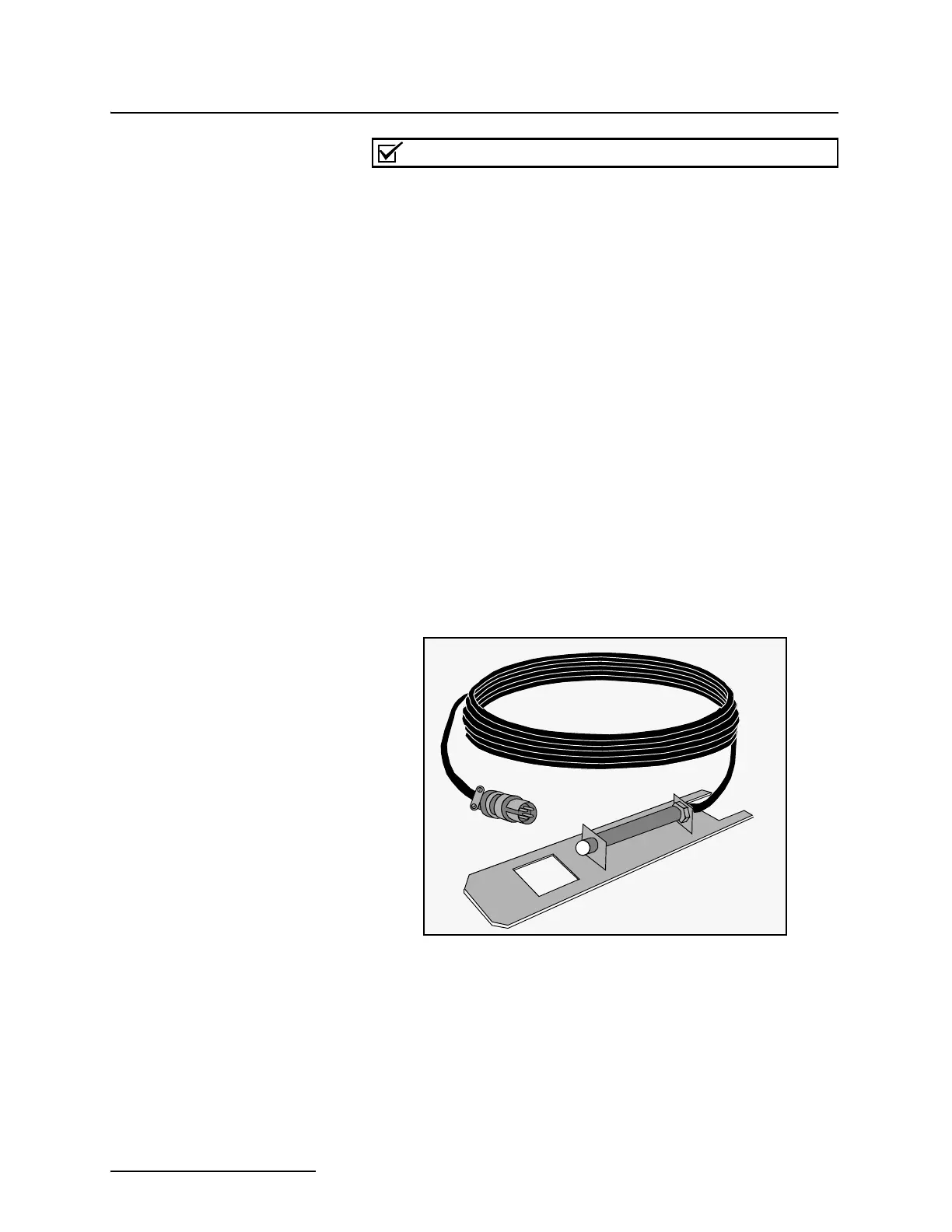
4.7.2 Temperature Probe The temperature probe is the simplest of the three, consisting of
a thermistor inside a metal housing. The thermistor changes
resistance with an increase or decrease in temperature. The flow
meter converts this resistance change to a temperature reading
and displays it, in degrees Celsius or Fahrenheit, as chosen by
menu selection during programming.
4.8 pH Probe The pH probe measures the acidity or alkalinity of an aqueous
solution by determining the relative quantity of dissociated
hydrogen ions, H
+
(actually H
3
O
+
) in the solution. A larger
quantity of H
+
ions indicates acidity, while a smaller quantity of
H
+
ions indicates alkalinity. The H in pH stands for Hydrogen
and the p stands for power.
The normal scale for pH runs from 0 to 14, with 0 being most
acidic and 14 being most alkaline. Distilled water at 25° C is
neutral at 7, based on the fact that the dissociation constant
(number of H
+
and OH
–
[hydroxyl] ions present) for pure water
at that temperature is 10-7.
Figure 4-3 Temperature Probe
A dissociation constant is a number that indicates the amount of
ionic dissociation occurring for a given substance after it is dis-
solved in aqueous solution. Dissociation constants vary widely
for substances depending on the nature of the chemical bonds
within the substance.



 To Next Page