4230 Flow Meter
Section 4 Optional Equipment
4-13
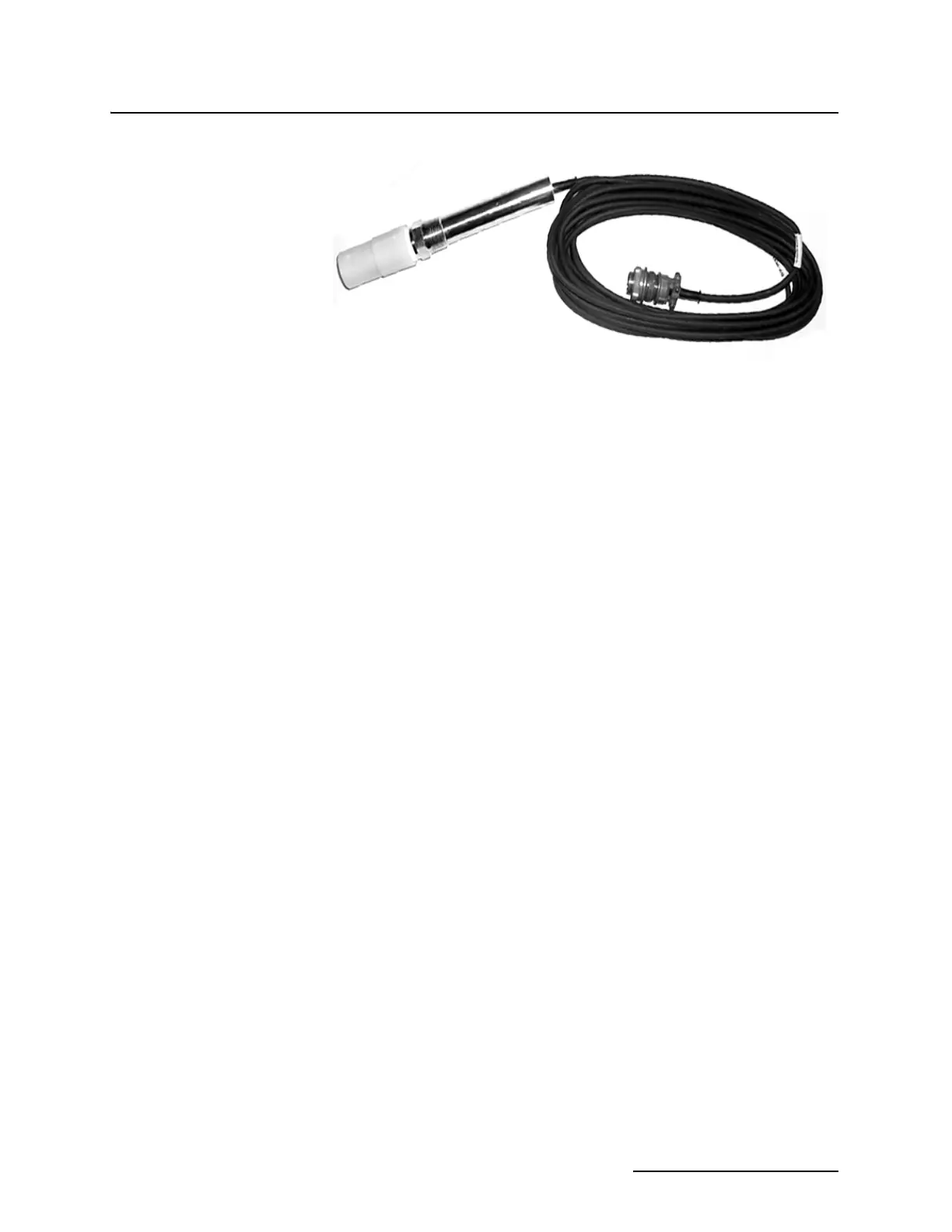
Figure 4-4 pH Probe With Protective Cap
Each number on the pH scale between 7 and 0 equals a tenfold
increase in H
+
ion. Each number between 7 and 14 equals a
tenfold decrease of H
+
ion. pH measurements of wastewater are
commonly made to monitor the effect of treatment chemicals
added to raise or lower the pH.
Water that has been used for various industrial processes may
deviate substantially from 7. Chemicals are often added to the
water to bring the pH close to that of neutral water, which is 7.
For example, if the effluent has a concentration of heavy metal
ions, they must be removed before discharge. Raising the pH of
solutions containing transition-metal ions will cause them to pre-
cipitate, where they can easily be removed as sludge. The
resultant solution will be high in pH and will require acid to neu-
tralize it.
4.8.1 How the pH Probe
Works
The pH probe is a combination of two electrochemical half-cells.
Together they provide a low-voltage signal that corresponds to
the hydrogen-ion concentration of a solution. If you look at the
pH probe, you will see a glass bulb on one end. This is called the
glass mono electrode. The glass is of special composition and sen-
sitive only to hydrogen ions. It is exposed to the solution to be
measured. The specific sensitivity to hydrogen ions prevents
interference from other ions that may be present in the solution.
The glass membrane produces an electrical potential propor-
tional to hydrogen ion activity.
The other electrode, called the reference electrode, completes the
circuit between the glass electrode and the solution.
The Isco pH probe combines both electrodes in a single housing
and also contains an amplifier to reduce the extremely high
impedance of the circuit. This improves the reaction of the probe
to stray capacitance and reduces interference caused by electrical
noise in the vicinity.
pH measurement is affected significantly by temperature, like
any other chemical reaction. Consequently, temperature compen-
sation is provided in the flow meter. The Isco pH probe has a
built-in temperature sensor that is exposed for faster response.



 To Next Page