4230 Flow Meter
Section 2 Programming
2-11
DISABLE inhibits this function altogether. CONDITIONAL
lets you program the flow meter to signal these alarms for a
variety of reasons. You can use rainfall, time, level, flow rate, dis-
solved oxygen, pH, rate-of-change, a combination of conditions,
or define the operation through FLOWLINK software from
another computer. STORM lets you set the alarm through a
combination of rainfall and time. You can also program the
interval between calls and set up the system to reset the alarm
condition by dialing back from the remote telephone.
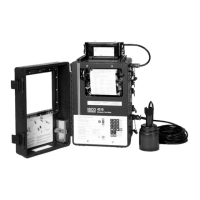
2.5.8 Printer The 4230 has a built-in printer. The printer is also capable of
plotting linear data along with printing alphanumeric (letters
and numbers) messages. In this step you set the speed for the
chart to advance, from
1
/2" to 4" per hour.
Chart speed is set according to the amount of resolution you
want to see on the chart. If there is a great deal of activity on the
chart, you would generally choose a faster speed so the marks are
more “spread out” and are easier to interpret. If there is little
activity on the chart and you want the flow meter to run for long
periods without having to change the chart paper roll, you would
probably pick a slower speed.
The flow meter is capable of plotting three separate data lines on
the chart in addition to alphanumeric messages. These lines may
indicate various things, such as level, flow rate, pH, dissolved
oxygen, or temperature. You must have the appropriate sensors
for pH, DO, and temperature to take advantage of the avail-
ability of these plots. Rainfall is printed as a bar graph.
The printer is capable of plotting over-ranges for the data lines it
plots. You can tell when the printer is in over-range if a data line
goes off the chart on the right side and then immediately starts
over again plotting on the left side.
2.5.9 Reports/History This step lets you program the flow meter to print out regular
reports on the internal printer. The reports the flow meter prints
are a summary of activity the unit records over a period of time.
Typically included are such items as maximum and minimum
flow rates, the time they were reached, sample records, etc.
The flow meter will let you create two separate reports, and let
you define what appears on them to a great extent. Note that the
contents of the reports are defined in Setup in step 1. Step 9
merely lets you turn them off and on and set the timing. You can
define the start time, the interval between reports and other
aspects of the report.
History provides a record of changes made to the flow meter's
program or operation events. As many as 50 changes can be
stored in the flow meter's memory at a time. The memory can
store up to 50 history items and 200 sample events at a time.
2.6 Interpreting the
Program Screens
Following are the program screens as they appear on the display
of a 4230. Explanations of most of the screens will be provided.



 To Next Page