EasyManua.ls Logo

ITW Alpine ALS 4.0 XE - User Manual

ITW Alpine ALS 4.0 XE
80 pages
Print Icon
To Next Page IconTo Next Page
Loading...
EN
ALS 4.0 XE
Product Manual
IMPORTANT! DO NOT DESTROY!
It is the customers responsibility to have employees read and understand this manual.
Read instructions completely before using the equipment.
The Latest
Evolution of the
I
ndustrys Leading
Linear Saw
The Alpine ALS 4.0 takes linear cutting to
the next level. The ALS 4.0 is designed for
production efficiency, only requiring one
sawyer for operation. The result is a reduction
in labor, a boost in production and an increase
to your bottom line.
This is not only an operation manual, but a
tool that can be utilized to gain the maximum
potential from your ALS 4.0 linear saw. Each
plant runs differently and the ALS 4.0 stands up
to the challenge—providing ultimate flexibility
in setup and operation.

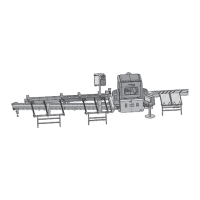
Table of Contents

Questions and Answers

ITW Alpine ALS 4.0 XE Specifications

General IconGeneral
BrandITW
ModelAlpine ALS 4.0 XE
CategorySaw
LanguageEnglish

Summary

Safety Information

General Safety Warnings

Explains the meaning of WARNING, CAUTION, and NOTE symbols used in the manual.

Read Manual and Operator Training

Emphasizes reading the manual and operator training before operating equipment.

Equipment Safety Precautions

Details specific safety measures for electrical, operational, and personal protection.

1. Introduction

1.1 Parts List

Details the components and parts for the ALS 4.0.

1.2 General Specifications

Provides overall technical specifications for the machine.

2. Getting to Know the ALS 4.0

2.1 System Overview

Introduces the major components of the ALS 4.0 system.

2.2 Axes of Motion

Describes the various axes of motion for the ALS 4.0.

2.4 Sensors

Details the sensors used for lumber feeding and clamping.

2.5 Operator Console

Describes the interface for controlling machine functions.

2.6 Getting Data to the Saw

Explains how to transfer cutting data to the saw.

3. ALS 4.0 Software

3.1 ALS 4.0 Home Screen

Overview of the main screen interface and its elements.

3.2 Auto Screen

Describes the Auto Screen interface and its functions.

3.3 Automatic Screen Operations

Covers operations performed automatically by the saw.

3.4 Semi-Automatic Operation

Describes manual operation modes for cutting.

6. Troubleshooting

6.1 Incorrect Homing;Cannot Home the Machine

Addresses issues with the machine not homing correctly.

6.2 Centerline is Off

Troubleshoots problems with the cut centerline accuracy.

6.3 Length is not Correct

Helps resolve issues with incorrect cut length measurements.

6.4 Conveyor will not Start

Provides solutions for conveyor startup failures.

6.5 Printer will not Print

Offers fixes for printer not producing output.

6.6 Prints Same Information

Addresses issues where the printer repeats data.

6.7 Cannot Read the Print Information

Troubleshoots problems with unreadable print data.

6.8 Inconsistent Print Placement

Helps resolve issues with variable print positioning.

6.9 Automated Infeed Bad Lumber Load

Deals with problems caused by incorrect lumber feeding.

6.10 Automated Infeed will not Start

Provides solutions for automated infeed failures.

6.11 L1 Belt Runs in Reverse

Troubleshoots the L1 belt running in the wrong direction.

6.12 Pneumatic Cylinder does not Actuate or Actuates Slowly

Addresses issues with pneumatic cylinder performance.

6.13 Blade Motor will not Start

Provides solutions for the blade motor not engaging.

6.14 Machine Stops during Cutting Operation

Helps diagnose unexpected machine stops during cuts.

6.15 Bevel Troubleshooting

Guides troubleshooting for bevel cutting inaccuracies.

6.16 E-Stop Troubleshooting

Addresses issues related to the emergency stop function.

7 Error Log Diagnostics

7.1 System Diagnostics and Troubleshooting

Explains how to diagnose and troubleshoot system faults using error logs.

2.2 Axes of Motion

2.3 Infeed and Outfeed System

Details the infeed and outfeed conveyor systems.

2.4 Sensors

2.4.1 Edge Detect Sensor (EDS)

Describes the through-beam sensor in the L1 feeder.

2.4.2 Lumber Present Sensor (LPS)

Describes the through-beam sensor in the L2 feeder.

2.5 Operator Console

2.6 Getting Data to the Saw

2.6.1 General

Covers file formats (TRS) and software compatibility.

2.6.2 Network

Details network connection requirements and considerations.

2.6.3 USB Device

Explains the use of USB devices for data transfer.

3.2 Auto Screen

3.2.1 Job Select Menu

Explains how to select jobs and view job details.

3.2.2 Current Stock Length Menu

Allows selection of stock length for single stock option.

3.2.3 Utility Tools

Lists various tools for managing cut pieces and jobs.

3.2.4 Create a Pick List

Details the process of creating a pick list for lumber.

3.2.5 Single Piece Run

Explains how to cut individual pieces of lumber.

3.3 Automatic Screen Operations

3.3.1 Load Lumber Screen

Displays stock size and grade for feeding.

3.3.2 Cut Status Screen

Shows cutting progress and diagnostic information.

3.3.3 Change Stock Screen (Single Stock Option)

Allows selection of stock length for single stock.

3.3.4 Change Stock Screen (Multi Stock Option)

Allows selection of stock for multiple stock options.

3.4 Semi-Automatic Operation

3.4.1 Board Select

Guides the user through selecting board configurations and angles.

3.4.2 Semi-Auto Save

Details saving custom pieces to the Standard Piece List.

3.4.3 Bevel

Explains how to set and adjust bevel angles for cuts.

3.5 Manual Control

3.5.1 Manual Axis Control

Provides manual control over machine axes and system functions.

3.6 System Options Menu

3.6.1 General Options (1)

Configures general settings like login, units, and data stripping.

3.6.2 Optimization Options (2)

Sets parameters for optimizing cutting to reduce waste.

3.6.3 Pick List Options (3)

3.6.4 Cutting Options (4)

3.6.5 Saw-Production Reporter Options (5)

3.6.6 Standard Piece List (6)

Dead Reckoning Inventory System

Manages standard pieces to ensure sufficient but not excessive supply.

3.6.7 Pick List Sort Options (7)

3.6.8 Printer Setup (8)

3.6.8.1 Ink Jet Setup

Details setup for the inkjet printer.

3.6.9 Bevel Options (9)

3.6.10 Advanced Options (10)

1. CONFIGURATION OPTIONS

Settings for saving data, debug mode, and pick lists.

2. DIMENSION QUANTITIES

Sets parameters for piece dimensions and quantities.

3. NAMES;PATHS

Configures file paths and names for system operations.

4. NESTING OPTIONS

5. OPTIMIZER ON

6. ACCEPT OPTIONS

7. CANCEL OPTIONS

3.7 Optimizer

3.7.1 Introduction

Introduces the optimizer for maximizing cutting and reducing waste.

3.7.2 How it Works

Explains the optimizer's process of analyzing and nesting cuts.

3.7.3 Optimizer Options

3.7.4 Nesting

3.7.5 Non-Optimize Look Ahead

3.7.6 Pick List Options

3.7.7 Stock Sorting

3.7.8 Optimizing Example

3.8 Additional Options:

Quick Camber Adj.

Adjusts for known camber in components.

Non-Optimize Look Ahead

Refers to section 3.7.5 for details.

Max Pieces Per Stock

Limits the number of pieces per board.

Trailing Dbl. Cut Spacing

Sets spacing after double cut trailing end.

L1 Grip Distance

Sets distance from L1 to blade.

Minimum Transfer Length

Min length for transfer from L1 to L2.

Minimum 4+ Cut Piece

Shortest length for a 4-cut piece.

No Ejection Max Length

Length that drops onto waste conveyor.

Backfeed Eject Max Length

Max length for small parts conveyor.

Return Waste Length

Min length for waste conveyor.

3.8.1 Names;Paths

3.9 Standard Pieces

3.9.1 Introduction

Introduces the software option for automatically cutting frequently used pieces.

3.9.2 How it works

Explains how standard pieces are identified and used with existing stock.

3.9.3 Entering Standard Pieces

Details methods for adding pieces to the standard list.

3.9.4 Capture a Piece from a Job

Describes how to extract pieces from a job into the standard list.

3.10 Creating a Pick List

3.11 Auto Infeed System

3.12 XML Files

1. GENERAL

Settings related to small part ejection.

2. SYSTEM

System settings for speed, offsets, and time delays.

3. AXIS PARAMETER L1-L2-L1 P

Settings for L1, L2, and L1P axes.

4. AXIS PARAMETER A1-B1-T1

Settings for A1, B1, and T1 axes.

5. AXIS PARAMETER Z1

Settings for the Z1 axis.

6. EXPORT CHANGES

Saves parameter changes to the controller.

7. SAVE CHANGES

Saves system setting changes.

4. Calibration Procedure

4.1 Turn Off Power

Steps to safely turn off power before calibration.

4.2 L1;L2 Belt Feeder Alignment

Aligns the L1 and L2 belt feeders for accuracy.

4.3 Infeed & Outfeed Conveyor Alignment

Aligns infeed/outfeed conveyors for proper lumber transfer.

4.4 Calibrate Bevel Axis (B1)

4.5 Calibrate the Cut Angle (A1)

4.6 Calibrate Center of Rotation

4.7 Calibrate Centerline (T1)

4.8 L1;L2 Belt Tension Adjustment

4.9 Calibrate Cut Length (L1;L2)

4.10 Check Alignment of the T;Z Slide & Belt Feeders

5. Maintenance

5.1 Parts Identification

Identifies key parts of the inkjet printer and cutting cabinet.

5.1 Parts Identification

5.1.1 Inkjet Printer

Identifies components of the inkjet printer.

5.1.2 Inside the Cutting Cabinet

Identifies components within the main cutting cabinet.

L1 Conveyor Components

General Mechanical Components

Door Safety Interlocks

L2 Conveyor Components

Axis Drive Components

A1 Axis Drive Components

Details components for the A1 axis drive.

B1 Axis Motor

5.1.3 Automated Infeed Components

Infeed System Valves

Identifies lumber stop and clamp valves.

5.1.4 Outfeed Components

Parts Sorting Conveyor Components

Identifies parts of the parts sorting conveyor.

Waste Conveyor Components

Identifies parts of the waste conveyor system.

Outfeed Conveyor Parts

5.1.5 Main Saw Electrical Cabinet

5.1.6 Printer Electrical Cabinet

5.2 Cleaning

General Cleaning Procedures

Basic instructions for cleaning sawdust and dust.

Component Specific Cleaning

Highlights areas needing special attention during cleaning.

5.3 Machine Lubrication

Lubrication Locations and Grease Type

Specifies where to apply grease and the type of grease to use.

Lubrication Points for Drive Assemblies

5.4 Automated Infeed Lubrication

5.5 EXLAR Actuator Maintenance

5.5.1. EXLAR Actuator Belt Change

Steps for changing the EXLAR actuator belt.

Disable Software Limits

Lock Out;Tag Out Procedure

Install Belt and Tension

5.5.2. Removing the Z1 Actuator

5.6 InkJet Printer Maintenance

5.7 Conveyor Belt Replacement & Tensioning

5.7.1. Conveyor Belt Removal & Installation

Steps for removing and installing conveyor belts.

5.7.2 Waste Conveyor Belt Tensioning

5.7.3 Small Parts Conveyor

6.1 Incorrect Homing;Cannot Home the Machine

6.2 Centerline is Off

6.3 Length is not Correct

6.4 Conveyor will not Start

6.5 Printer will not Print

6.6 Prints Same Information

6.7 Cannot Read the Print Information

6.8 Inconsistent Print Placement

6.9 Automated Infeed Bad Lumber Load

6.10 Automated Infeed will not Start

6.11 L1 Belt Runs in Reverse

6.12 Pneumatic Cylinder does not Actuate or Actuates Slowly

6.13 Blade Motor will not Start

6.14 Machine Stops during Cutting Operation

6.15 Bevel Troubleshooting

6.16 E-Stop Troubleshooting

7.1 System Diagnostics and Troubleshooting

Appendix A - Maintenance Intervals

ALS 4.0 Machine Inspection Guide and Maintenance Log

Provides a log for daily, shift, and periodic maintenance checks.

Appendix B - Pneumatic System Schematic

Appendix B - Pneumatic System Schematic - L1;L2 Blow-off

Appendix C - Unit Conversion Tables

Appendix D - Terms Glossary

Appendix E - Warranty

Appendix F - Bibliography