
 Need help?
Do you have a question about the Johnson Controls HICM008B21S and is the answer not in the manual?
Manual title and system type.
This service manual focuses on heat pump air conditioning units.
Explains the meaning of WARNING, CAUTION, and NOTICE.
Provides general safety guidelines for using the equipment.
Lists precautions to prevent property damage during installation and operation.
Covers wall/room installation, environmental factors, brazing, and testing.
Covers R410A handling, piping thickness, and system pressure.
Addresses electrical safety, wiring, grounding, and interference.
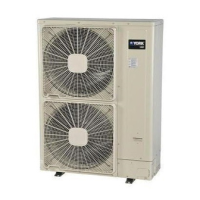
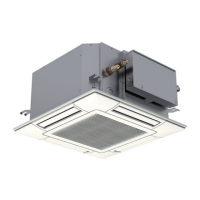
Lists outdoor units, change-over boxes, indoor units, control devices, and optional parts.
Refer to operation manuals for indoor units and control devices.
Basic checks for system abnormalities.
Detailed steps and methods for diagnosing issues.
Explains controller alarms and provides an alarm code reference table.
Steps for troubleshooting float switch failures.
Steps to resolve communication issues between units.
Troubleshooting for inlet air thermistor faults.
Diagnosing and fixing outlet air thermistor problems.
Resolving issues related to the liquid pipe thermistor.
Addressing problems with the gas pipe thermistor.
Steps for troubleshooting the indoor fan motor protection device.
Correcting capacity settings for outdoor and indoor units.
Addresses duplicate indoor unit numbers in the same group.
Correcting the unit model code setting (DSW4).
Correcting unit number and refrigerant cycle settings.
Troubleshooting fan motors, compressors, magnetic switches, PCBs, and thermistors.
Troubleshooting incorrect optional and input/output settings.
Addressing fan speed, thermistor, valve, and PCB failures.
Investigating low suction pressure and airflow/heat exchanger problems.
Diagnosing issues related to high discharge pressure.
Troubleshooting communication and power supply issues.
Investigating low suction pressure and airflow issues.
Troubleshooting communication and power supply issues for heating.
Diagnosing issues related to high discharge pressure during heating.
Diagnosing abnormal sounds from fan motors and compressors.
Diagnosing motion sensor detection levels and operation problems.
Troubleshooting radiation sensor operation and temperature correction.
Procedures for self-checking PCBS and the wired controller.
Essential checks and steps before and during the test run.
Interpreting controller indications and performing checks during test run.
Verifying fan rotation, power voltage, and operating pressures.
Refer to the Service Manual for Outdoor Unit maintenance.
Steps to remove and replace air filters and inlet grilles.
Steps to remove the electrical box cover for access.
Instructions for removing the optional decorative panel.
Detailed steps for removing the turbo fan and fan motor assembly.
Detailed steps for safely removing the printed circuit board.
Instructions for removing the drain pan and draining residual water.
Steps to remove the drain-up mechanism.
Instructions for removing the float switch.
Steps for removing the outlet air thermistor.
Steps to remove liquid pipe and gas pipe thermistors.
Instructions for removing the expansion valve coil.
Steps for removing the inlet air thermistor.
Steps for removing auto louver motors and the louver.
Lists necessary tools and materials for cleaning the heat exchanger.
Step-by-step instructions for cleaning the indoor unit heat exchanger.
Instructions for suspending the cleaning water collector.
Steps for applying cleaning agent and water to the heat exchanger.
Checks after cleaning and neutralization of cleaning water.
Refer to Service Manual for Outdoor Unit main parts.
Diagram of connectors and check points for PCB1.
Technical drawing and specifications for the fan motor.
Location and types of thermistors for indoor unit.
Function and characteristics of the suction air thermistor.
Technical diagram and specifications for the electronic expansion valve.
Details on specifications, wiring, and drive circuit for the valve.
How to configure functions using the wired controller interface.
Steps for selecting functions and configuring I/O settings via test run menu.
Explains terminals, connectors, and display codes for I/O settings.
Using level and pulse signals for remote ON/OFF control.
How the unit restarts automatically after a power failure.
How to cancel controller commands during forced stoppage.
How the unit operates automatically when power is supplied.
How to connect and use a field-supplied room thermostat.
Changing cooling/heating mode via external contact signal.
Using auxiliary relay for operation and alarm signals.
Using auxiliary relay for cooling operation and thermo-ON signals.
Using auxiliary relay for heating operation and thermo-ON signals.
Lists available function selection items and their settings.
Continues the list of function selection items and settings.
Further function selection items and settings.
More function selection items and their settings.
More function selection items and their settings.
Detailed description of specific function selection items.
Further details on function selection items.
More descriptions of function selection items.
Final descriptions of function selection items.
Additional descriptions of function selection items.
More descriptions of function selection items.
Final descriptions of function selection items.
Limits the lowest setting temperature for cooling operations.
Limits the highest setting temperature for heating operations.
Setting indicator color and enabling energy-saving operation.
Configuring motion sensor levels and thermistor control modes.
Setting sensor position and louver control during energy saving.
Adjusts fan speed for energy saving during cooling.
Compensates setpoint when card key is removed for setback operation.
Controls power saving schedules for capacity and intermittent control.
Switches indoor unit modes sequentially and repeats modes in fixed intervals.
Sets power saving and operation noise reduction schedules.
Displays compressor power consumption and provides saving guidance.
Important safety precautions regarding refrigerant gas leakage.
Emphasizes adherence to safety standards like ASHRAE.
Warns against using non-specified refrigerants due to safety risks.
General maintenance checks for outdoor and indoor units.
Maintenance tasks specific to the outdoor unit.
Directs users to another manual for record details.
A data sheet for recording checks performed using the wired controller.
Recording compressor and sensor condition data.
A checklist for service and maintenance of the unit.
Graph showing saturation pressure vs. temperature for R410A.
Mollier chart displaying R410A refrigerant properties.
Directs users to the specific parts list for Mini Cassette units.
 General
| Model Number | HICM008B21S |
|---|---|
| Category | Air Conditioner |
| Manufacturer | Johnson Controls |
| Energy Efficiency Ratio (EER) | 11.0 |
| Voltage | 115V |
| Phase | 1 |
| Frequency | 60 Hz |
| Refrigerant | R-410A |
| Cooling Capacity | 8000 BTU |
| Operating Temperature (Cooling) | 64°F to 90°F |


 To Next Page