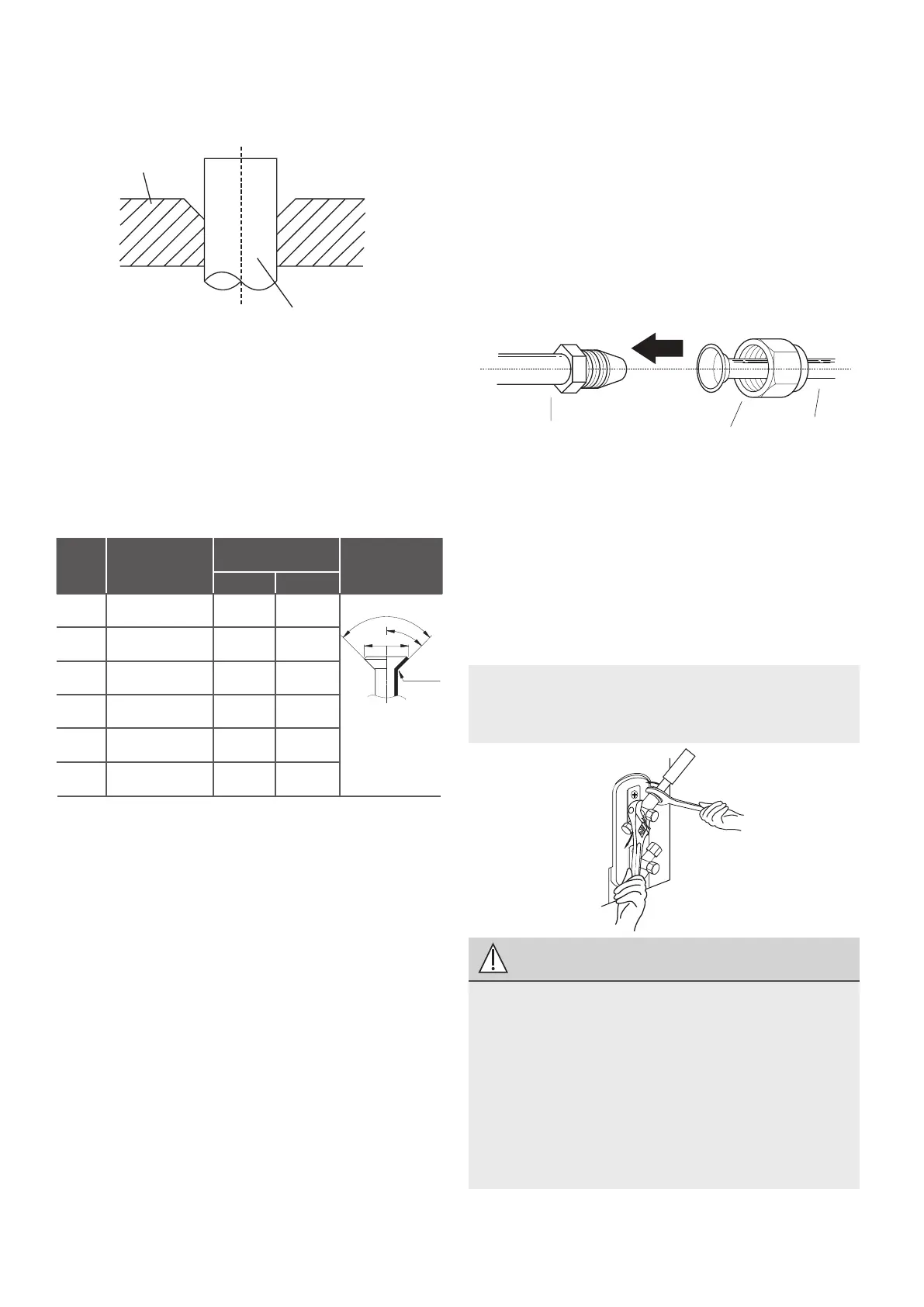
5. Clamp flare form on the end of the
pipe. The end of the pipe must extend
beyond the flare form.
Flare form
Pipe
6.
Place flaring tool onto the form.
7.
Turn the handle of the flaring tool
clockwise until the pipe is fully
flared. Flare the pipe in accordance
with the dimensions.
PIPING EXTENSION B
EYOND FLARE FORM
8. Remove the flaring tool and flare
form, then inspect the end of the pipe
for cracks and even flaring.
Step 4: Connect pipes
Connect the copper pipes to the indoor
unit first, then connect it to the outdoor
unit. You should first connect the low-
pressure pipe, then the high-pressure
pipe.
1.
2.
When connecting the flare nuts,
apply a thin coat of refrigeration oil
to the flared ends of the pipes.
Align the center of the two pipes
that you will connect.
Indoor unit tubing
Flare nut Pipe
3.
4.
Tighten the flare nut as tightly as
possible by hand.
Using a spanner, grip the nut on
the unit tubing.
5. While firmly gripping the nut, use a
torque wrench to tighten the flare nut
according to the torque values in
above table.
NOTE:
Use both a spanner and a torque
wrench when connecting or discon-
necting pipes to/from the unit.
Pipe
gauge
Tightening
torque
Flare dimension
(A) (Unit: mm/Inch)
Flare shape
Min. Max.
Ø 6.35
R0.4~0.8
45°±2
90
±
°
4
A
Ø 9.52
Ø 12.7
Ø 16
Ø 19
Ø 22
65-67 N.m
(663-683 kgf.cm)
23.2/0.91 23.7/0.93
75-85N.m
(765-867 kgf.cm)
26.4/1.04 26.9/1.06
18-20 N.m
(183-204 kgf.cm)
8.4/0.33 8.7/0.34
25-26 N.m
(255-265 kgf.cm)
13.2/0.52 13.5/0.53
35-36 N.m
(357-367 kgf.cm)
16.2/0.64 16.5/0.65
45-47 N.m
(459-480 kgf.cm)
19.2/0.76 19.7/0.78
CAUTION
Ensure to wrap insulation around
the piping. Direct contact with the
ba
re piping may result in burns or
frostbite.
Make sure the pipe is properly
connected. Over tightening may
damage the bell mouth and under
tightening may lead to leakage.


 To Next Page