Refrigerant Piping Connection
Note on Pipe Length
When connecting refrigerant piping, do not
let substances or gases
other than the specified
refrigerant enter the unit. The presence of
other gases or substances will lower the unit’s capacity, and can
cause abnormally high pressure in the refrigeration cycle. This can
cause explosion and injury.
Ensure that the length of the refrigerant pipe, the number of bends, and the
drop height between the indoor and outdoor units meets the requirements
shown in the following table:
The Maximum Length And Drop Height Based on Models. (Unit: m/ft.)
Type of model Capacity (Btu/h)
Length of piping
Maximum drop height
North America,
Australia and the
EU frequency
conversion Split
Type
<15K 25/82 10/32.8
≥15K - <24K
30/98.4 20/65.6
≥24K - <36K
50/164 25/82
≥36K - ≤60K
65/213 30/98.4
Other Split Type
12K 15/49 8/26
18K-24K 25/82 15/49
30K-36K 30/98.4 20/65.6
42K-60K 50/164 30/98.4
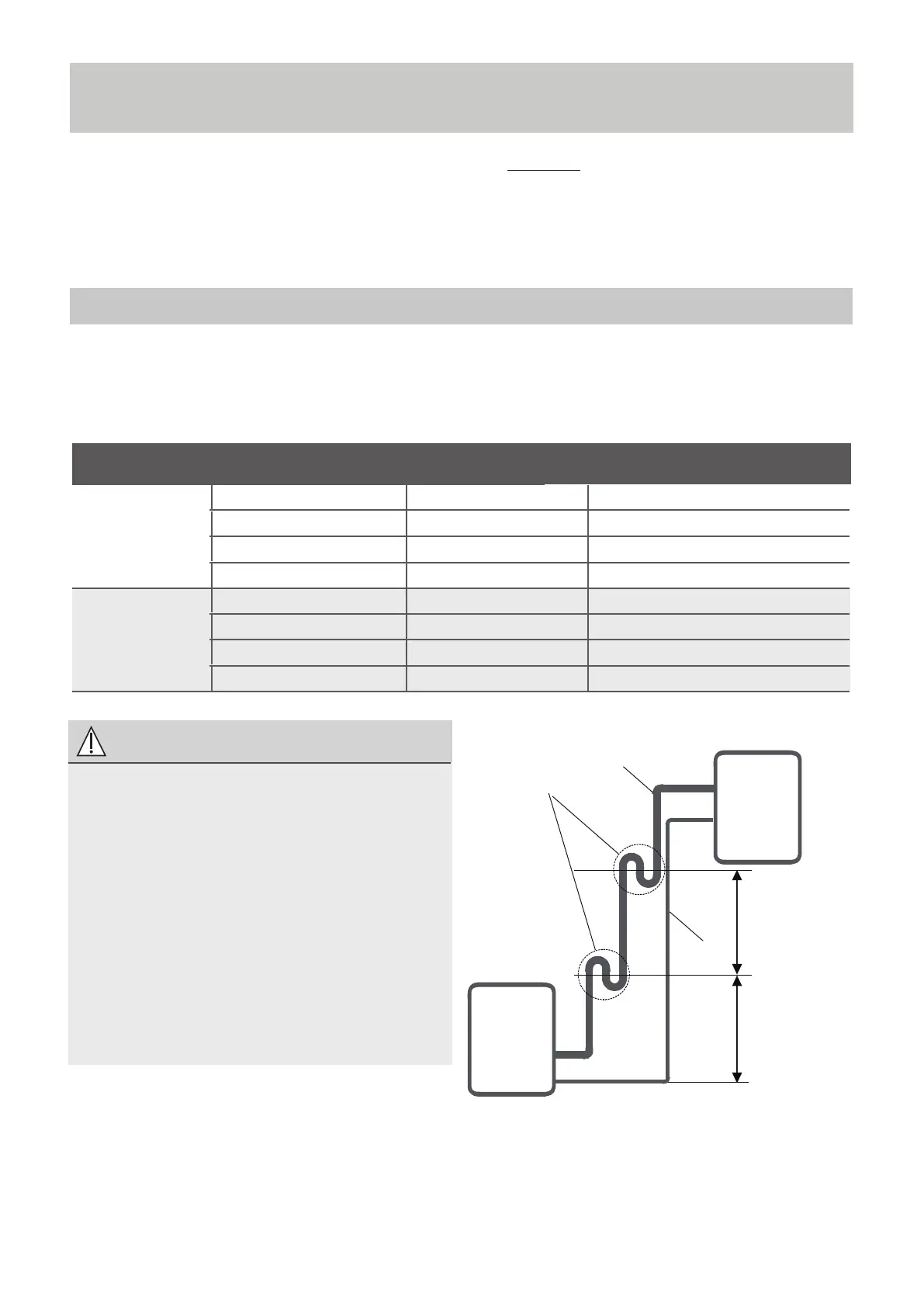
CAUTION
Oil traps
If oil flows back into the outdoor
unit’s compressor, this might cause
liquid compression or deterioration
of oil return. Oil traps in the rising
gas piping can prevent this. An oil
trap should be installed every 6m
(20ft) of vertical suction line riser (<
36000 Btu/h unit).
An oil trap should be installed every
10m(32.8ft) of vertical suction line
riser (≥36000Btu/h unit).
10m/32.8ft
(≥36000Btu/h unit)
6m/20ft
(<36000Btu/h unit)
10m/32.8ft
(≥36000Btu/h unit)
6m/20ft
(<36000Btu/h unit)
Indoor unit/
Outdoor unit
Indoor unit/
Outdoor unit
Gas piping
Liquid
piping
Oil trap


 To Next Page