Preparations and Precautions
Air and foreign matter in the refrigerant
circuit can cause abnormal rises in
pressure, which can damage the air
conditioner, reduce its efficiency, and
cause injury. Use a vacuum pump and
manifold
gauge to evacuate the refrige-
rant circuit, removing any non-conden-
sable gas and moisture from the system.
Evacuation should be performed upon
initial installation and when unit is
relocated.
BEFORE PERFORMING EVACUATION
Check
t
o make sure the connective
pipes
bet
ween the indoor and
out
door units are connected properly.
Che
ck to make sure all wiring is
conne
cted properly.
Evacuation Instructions
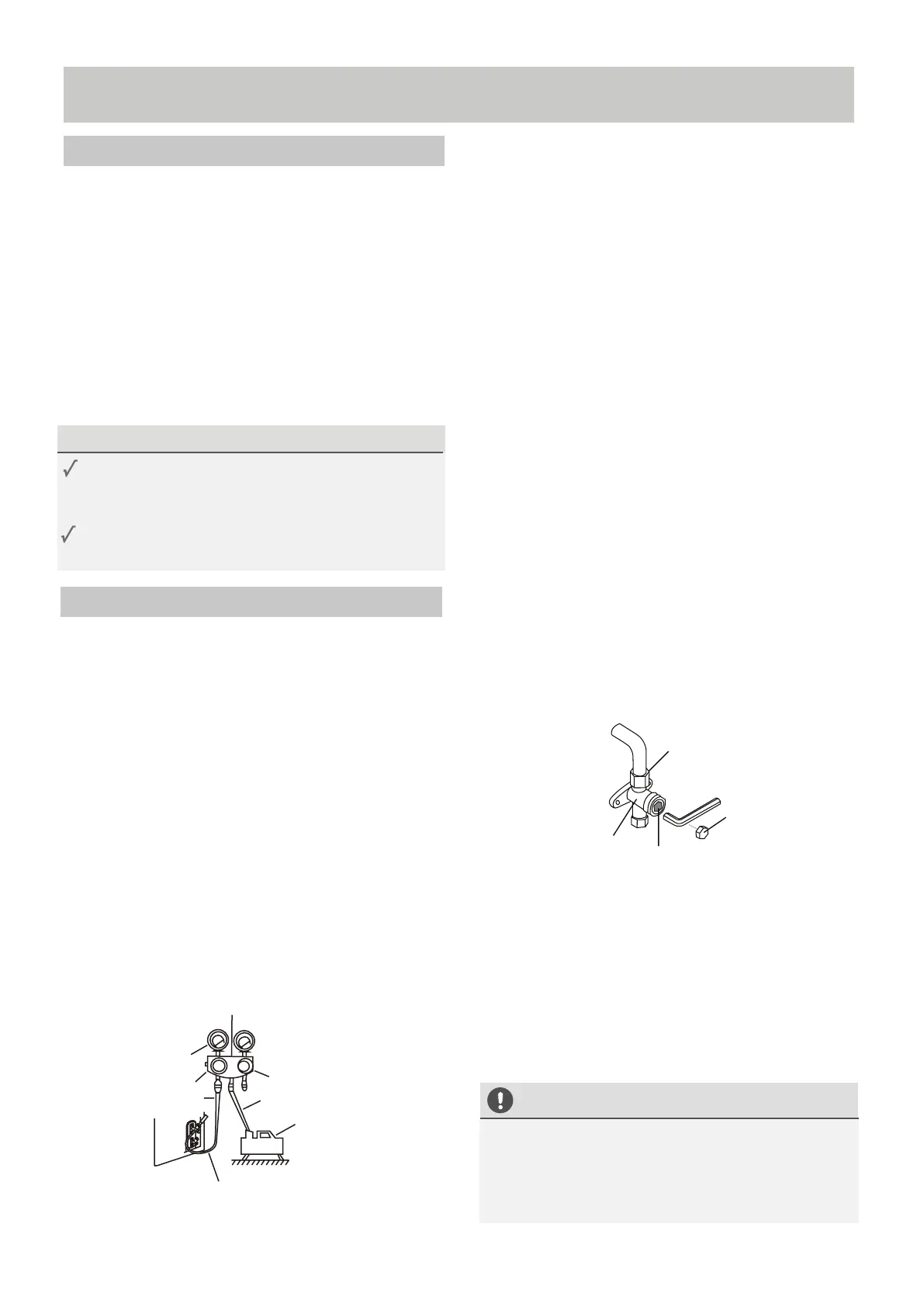
Compound
gauge
-76cmHg
Low pressure valve
High pressure
valve
Pressure hose /
Charge hose
Charge hose
Vacuum
pump
Pressure gauge
Low pressure valve
Manifold Gauge
1. Connect the charge hose of the
manifold gauge to service port
on the outdoor unit’s low
pressure valve.
2.
Connect another charge hose
from the manifold gauge to the
vacuum pump.
3.
Open the Low Pressure side of
the manifold gauge. Keep the
High Pressure side closed.
4.
Turn on the vacuum pump to
evacuate the system.
5.
Run the vacuum for at least 15
minutes, or until the
Compound Meter reads
-76cmHG (-10
5
Pa).
Flare nut
Cap
valve body
valve stem
6. Close the Low Pressure side of the
manifold gauge, and turn off the
vacuum pump.
7. Wait for 5 minutes, then check that
there has been no change in sys-
tem pressure.
8. If there is a change in system pres-
sure, refer
to Gas Leak Check sec-
tion for information on how to
check for leaks. If there is no
change in system pressure, un-
screw the cap from the packed
valve (high pressure valve).
9. Insert hexagonal wrench into the
packed valve (high pressure valve)
and open the valve by turning the
wrench in a 1/4 counterclockwise
turn. Listen for gas to exit the
system, then close the valve after 5
seconds.
10. Watch the Pressure Gauge for one
minute to make sure that there is
no change
in pressure. The Pressure
Gauge should read
slightly higher
than atmospheric pressure.
11. Remove the charge hose
from the
service port.
12.
13.
Using hexagonal wrench, fully
open both the high pressure and
low pressure valves.
Tighten valve caps on all three
valves (service port, high pressure,
low pressure) by hand. You may
tighten it further using a torque
wrench if needed.
OPEN VALVE STEMS GENTLY
When opening valve stems, turn
the hexagonal wrench until it hits
against the stopper. Do not try to
force the valve to open further.
Air Evacuation


 To Next Page