98
EVO-S, EVO-H MODULAR AIR HANDLING UNITS
OPERATION AND MAINTENANCE MANUAL
Code Name
Setpoint
value
Description
F203 Main frequency source 2 External analogue - AI1
F300 Relay function 5 Alarm-free operation
F600 DC braking function selection 1 pre-start braking
F602
DC braking performance
before take-o (%)
20÷30
The higher the value, the more
eective the braking, but remember
not to overheat the motor
F604
Braking performance before
take-o (s)
15 s
F607
Automatic selection of
dynamic parameters
0 disabled
F613 Inverter reset 0 disabled
F753
Type of thermal motor
protection
0 Standard motor
F801 Rated engine power …kW Plate
F802 Rated motor voltage …V Plate
F803 Rated motor current …A Plate
F804 Number of the poles … Automatic setting [120*H118/F805]
F805 Rated motor velocity ...rpm. Plate
F810 Motor power frequency Plate related to F118
F800 Motor autotuning 1 Dynamic - recommended
If the unit is delivered together with Klimor control system, do
not use these settings, only the information contained in the
OMM of automatic system.
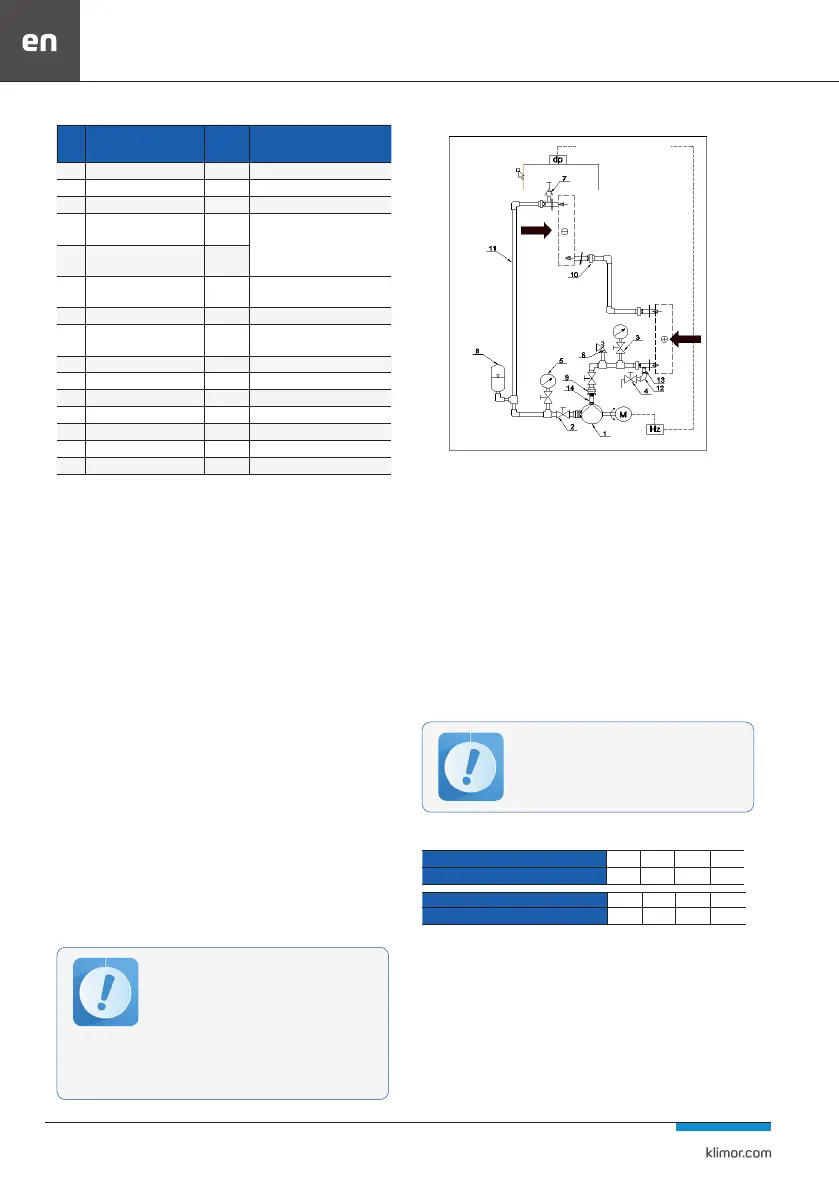
4.13.2 Filling the system with glycol
Glycol systems are supplied unlled as standard. Scope of
pipeline installation by Klimor is determined each time the
order is placed. Before start-up, ll the system with glycol
solution.
The procedure for lling the system:
1. Connect the hand or electric pump with a hose to drain
valve no. 4. Check the opening of all valves on the system.
2. Glycol should be added gradually so that the pressure on
manometer no. 3 does not exceed 5.5 bar. There is a safety
valve set to 6 bars in the system.
3. After letting some glycol in, observe the vents. The re-
lease of air indicates that the system is venting. Lack of bub-
bles means that another portion of glycol can be let into
the system. Repeat steps 2 and 3 until the system is lled
with an appropriate amount of glycol.
4. If most of the required amount of glycol is already pres-
ent in the glycol system, you can close the drain valve and
switch on the circulation pump. This will speed up the ven-
tilation of the system.
5. Before commissioning, the circulation pump is ooded
with the agent according to the manufacturer’s OMM.
Fig. 76 Diagram of glycol system
1. Circulation pump
2. Shut-o valve
3. ½” pressure gauge tap
4. Drain valve
5. Manometer
6. Safety bypass valve ½”
7. Manual air vent
8. Diaphragm vessel with ¾” connection
9. Flat two-connectors PP GZ
10. Flat two-connectors PP GW
11. PP pipe SDR7,4/SDR11
12. pipe elbow ½” A4
13. Stainless steel connector GC.1/2”
14. Double-sided GZ
nipple for pressure switch
Hz Frequency converter
Table 24 Beginning frost temperatures for ethylene and propylene glycol
Freezing point temperature [˚C]
-15 -20 -25 -35
Concentration of ethylene glycol (% vol)
28 35 40 48
Freezing point temperature [˚C]
-15 -20 -25 -35
Concentration of propylene glycol (% vol)
33 37 42 50
4.13.3 Operating a heat recovery system with an intermediary me-
dium
The heater and cooler must be handled in the same way as
other CuAl exchangers, as well as the tray, condenser and
trap (section 4.8.5).
The hydraulic installation requires periodic leakage check-
ing and, if necessary, replenishing the glycol loss. The circu-
lation pump and valves must be operated and inspected as
required in the individual documentation.
AUTOMATION
The table shows the concentrations of glycol
causing the freezing process to start at a gi-
ven temperature. The concentration in the
system at a given temperature should be hi-
gher to ensure safe operation of the system.
The type and concentration of glycol given
in the air handling unit data sheet must be
strictly observed. The type of glycol is selec-
ted according to the purpose of the unit. The
installation with ethylene glycol may not be
connected to the drinking water installation
at any point. Glycol concentration determines
the freezing temperature - if the concentra-
tion is too low (and consequently the freezing
temperature), it may lead to permanent da-
mage to the installation and glycol leakage.


 To Next Page