Machine Description
59
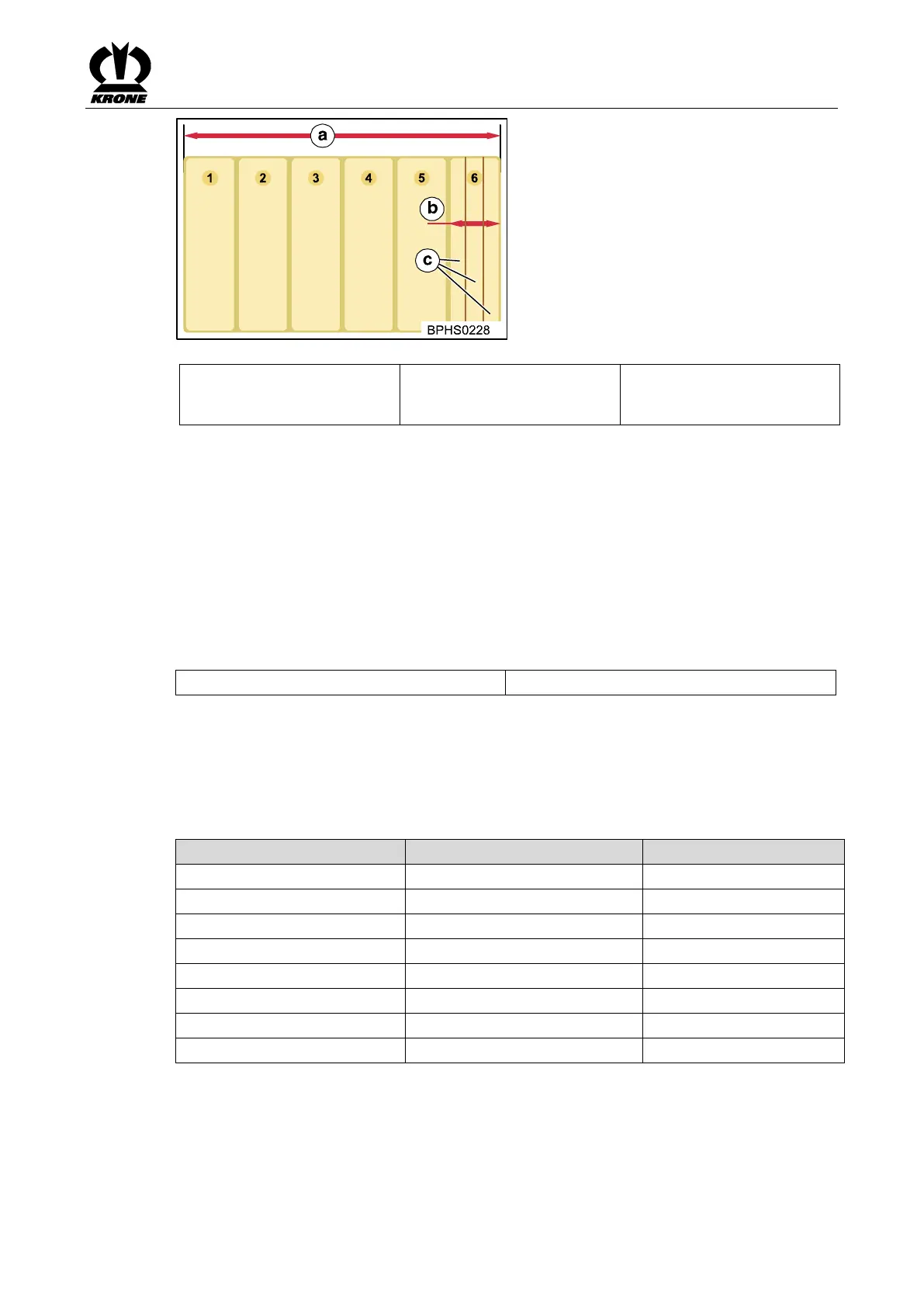
Fig.
Big bale / length of the big
bale
Small bale / length of the
small bale
Layer thickness of the
small bale / number of
layers
The bale length and the number of small bales (from 2 to 9) must only be set at the beginning of
a bale to get ideal small bales. The layer thicknesses of the small bales must be a multiple of
the length of the small bale. It must be read on the display while the swath is picked-up. The
layer thickness depends on the travelling speed and the uniformity of the swath. The faster you
drive, the thicker the layer thickness. It is more difficult to get an ideal small bale if the travelling
speed is high. It is not possible to select layer thicknesses of more than 17 cm / 6.6 inch.
The determined layer thickness must be maintained during the entire baling process.
The length of the small bale is determined by the length of the big bale (a) divided by the
number of small bales.
Example:
The desired bale length is 240 cm / 94 inch. The number of the desired small bales is 5 units.
Determining the length of the small bales
b = a / 5 (a= 240 cm / 5 = 48 cm)
b = a / 6 (a= 94 inch / 6 = 19 inch)
Determining the layer thickness
Based on a length of the small bale of 48 cm / 19 inch in this example, the following layer
thicknesses result depending on the number of layers:
The layer thickness is calculated from the length of the small bale divided by the number (z) of
the desired layers.
c = a / z
Layer thickness (c) in cm/inch
Pos: 55.21 /La yout Module /---------------Seitenumbruch---------------- @ 0\mod_11961 75311226_0.doc x @ 4165 @ @ 1





 To Next Page