71
10 Appendix
With an activated constant control:
10.2 Flame Monitoring
10.2.1 Integral Flame Monitoring (Option)
10.2.1.1 Purpose
The integral flame monitoring system is primarily used for standard applications (e.g. oil or gas
flames at a burner in a combustion chamber) because of it’s limited adjustment possibilities.
NOTICE
We recommend the LAMTEC flame monitoring systems (like F300K, F200K2), if you have
other requirements for the flame monitoring (e.g. combustion of coal dust). You will find infor-
mation on this devices in the corresponding manuals (DLT7650, DLT7600 and DLT7502/
DLT7503).
The task of the flame monitoring device is to scan the burner’s flame in combustion plants un-
affected from any condition in the combustion chamber (e.g. glowing nogging) and to release
the closing of the fuel valves at a flame blow out with an internal control command of the burn-
er control system.
The flame monitoring device has the following tasks:
– Scanning the burner flame unaffected of the conditions in the combustion chamber (e.g.
glowing refractory lining)
– internal release of the control command to close the fuel valves at a flame blow out with
the burner control system
Connect the following LAMTEC flame sensors:
FFS08 IR/UV, FFS07 IR/UV (also in version for Ex zone 1 or Ex zone 2).
NOTICE
The F250 flame scanner as well as FFS05 and FFS06 flame sensors are discontinued since
01/2014 and are not taken into account in the current certifications.
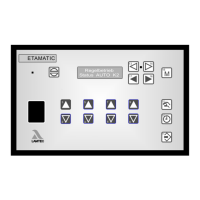
Set the firing rate with keys 16 and 17. On the left side of the display, the actual set-
point 1 or setpoint 2 will be showed depending on which value terminal 50 has (0V
at terminal 50 = setpoint 1, 24V on terminal 50 = setpoint 2).
Press key 6 and key 9 simultaneously, left value flashes in display (setpoint).
Setpoint can be changed with keys 4 and 5.
To save the new setpoint, press key 11 (ENTER).
To end the function "Set power control unit" without saving the setpoint, press keys
7 and 8 simultaneously.


 To Next Page