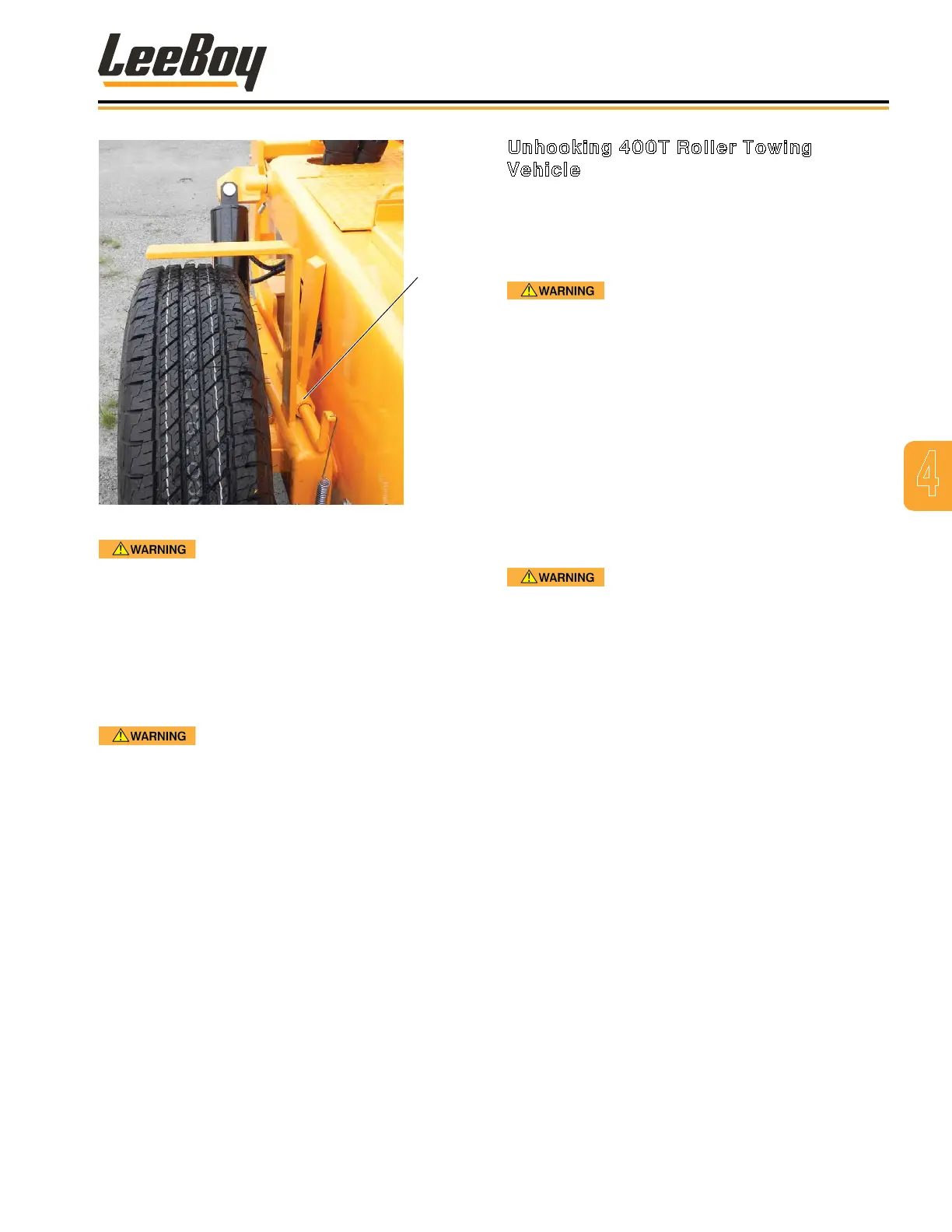
Tow Wheel
Lock
Figure 4-6. Tow Wheel Lock
Never exceed 45 MPH while towing the
roller. use reduced or lower speed when towing over
slippery or uneven surface.
11. From the operator’s seat, turn OFF roller engine.
SLOWLY release pressure on towing wheel
extension cylinders and lower roller until wheel
locks are in the lock position. Now slowly release
pressure on tongue extension cylinder until tongue
support latch is in positive lock position.
Check safety chains, tow wheel tongue
support latch and yoke lock pin to ensure that these
devices are in the proper position BEFORE towing.
Unhooking 400T Roller Towing
Vehicle
To unhook the 400T Roller from the towing vehicle:
1. Park towing vehicle and roller on level surface.
Secure towing vehicle by blocking wheels in both
directions.
Raise the 400T wheels with rear drum
on the ground before unhooking tongue from the
towing vehicle.
2. Sitting in the operator’s seat, start the roller and
extend the towing wheels until towing wheel locks
are out of the lock position.
3. Extend tongue cylinder, lift tongue until tongue
support latch is clear from stop.
4. Dismount and move towing wheel lock, tongue
support latch, and yoke pin lock out of the way to
prevent interference during lowering.
5. Put yoke locking pin into stow position and secure
with the hitch pin.
Improper towing methods and
equipment can result in severe personal injury or
death.
6. Remove and store safety chains.
7. Disengage pintle hook safety devices.
8. From the operator’s seat, activate lever for towing
wheels and lower rear drum to the surface.
9. Continue activating lever until towing wheels are in
the full UP position.
10. Using tongue extension lever, lower the front drum
to the surface.
11. Using the drive lever, move roller forward or
backward as necessary, to release the pressure on
the eyelet in pintle hook.
12. Raise the tongue extension slightly; then, back the
roller up to disengage.
13. Restore tongue to full back position.
4
Operation
LeeBoy Model 400 & 400T Rollers 4-9



 To Next Page