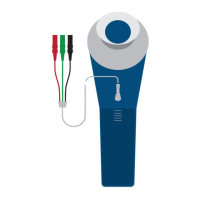
RETeval Complete Option
RET
eval
Device User Manual 41
For the dark adapted 0.1 Hz 85 Td·s and 3 cd·s/m² tests, oscillatory potentials and cursors are
reported. The oscillatory potential waveform is obtained by applying an 85 Hz – 190 Hz bandpass
filter. Up to 5 cursors are automatically placed on the oscillatory potential peaks and troughs
and are indicated on the report as black dots on the waveform. Implicit times (time to peak) and
amplitudes (peak to following trough) are reported for each individual cursor. The sums of
implicit times and amplitudes for all cursors are also reported. When interpreting the summed
cursor times and amplitudes, you should examine the cursor dots on the waveform to ensure
that no waves are missed.
For dark adapted tests, the display is automatically dimmed and reddened. The green power
status LED is also turned off to assist in dark adaptation. The display and LED are automatically
brightened at the end of the dark adaptation tests.
To create the visual stimulus, the RET
eval
device generates variable-duration flashes of white
light, made from red, green, and blue LEDs all being on for the same duration. The maximum
energy flash of white light is 30 cd·s/m², which has a flash duration of 5 ms. For the constant
Troland tests, the flash duration may be longer than 5 ms for pupil sizes smaller than 1.9 mm.
Modeling of the 3 stage activation phase of phototransduction, as described by (Cideciyan and
Jacobson 1996) in equation A5, shows very small differences in rod or cone photocurrent
between having an instantaneous flash and flash energies uniformly spread into flash durations
as long as 10 ms as long as all measurements are considered relative to the center of the flash,
as done by the RET
eval
device. If the pupil size is sufficiently small that the required flash energy
for a Troland protocol is not obtainable, the RET
eval
device will produce its maximum flash
energy.
The signal processing for the non-flicker tests uses the followings steps. A zero-phase 0.3 Hz high-
pass filter reduces electrode drift and offset while preserving waveform timing. Measurements
from multiple flashes are combined to improve the signal to noise ratio using a trimmed mean to
reduce the effect of outliers after removing outlier replicates whose amplitudes exceed 1 mV.
The resulting waveform is then processed using wavelet-based denoising (Ahmadi and Rodrigo
2013) where wavelets are attenuated based on the signal to noise power between the post-
stimulus (signal) and pre-stimulus (noise) portions of the waveform. Oscillatory potential analysis
does not use the wavelet denoising.
The number of flashes combined is specified in the tables below. If a different number of flashes
is desired, a custom protocol can be created by modifying a protocol in the EMR/built-in-
protocols folder and placing it in the Protocols/ folder on the device. Any text editor can be used
to edit the protocol (e.g., Emacs or Notepad). Because of the relatively few flashes combined for
the non-flicker tests, reducing the noise is more important in these tests; consequently, skin
preparation is suggested for all patients in order to reduce the electrode contact impedance.
ISCEV ERG protocols
The following tables describe the ISCEV standard ERG protocols in detail.
This protocol (ISCEV 6 step, light adapted first, cd) performs the light adapted tests first, and
assumes light adaptation occurs before the tests start. Some clinicians use room lights to do the


 To Next Page