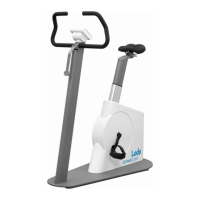
Need help?
Do you have a question about the Lode 925900 and is the answer not in the manual?
Describes the ergometer's purpose as a diagnostic stress test device in medical environments.
Outlines contraindications and requirements for annual calibration and service.
Important cautions regarding device usage, environment, and clothing to ensure safe operation.
Lists residual hazards such as incorrect installation, use, dose, interpretation, or component breakdown.
Explains key terms like Hyperbolic and Linear Ergometry and their relationships.
Describes RPM dependent ergometry where workload increases with pedaling speed.
Defines Linear Factor formula (P=a*RPM5) and Fixed Torque Ergometry (constant torque).
Explains Isokinetic mode where RPM is constant, linking Workload and Torque.
Illustrates and lists the main physical parts of the Excalibur Sport ergometer.
Details the components and functions of the standard control panel.
Details the components and functions of the programmable control panel option.
Information regarding the Blood Pressure panel and its option requirement.
Explains ergonomic adjustments for saddle, handlebars, and dimensions.
Instructions on how to safely move the ergometer to its operating location.
Lists all items that should be included in the Excalibur Sport ergometer package.
Details optional features like RPM set, Programmable Display, and SpO2/HR.
Details the 0 Watt Start-up System option for starting without load.
Describes the Blood Pressure (B) Option for automatic measurement during exercise.
Details the Heart Rate (HR) option for monitoring and controlled protocols.
Step-by-step guide for performing an exercise test using the manual menu.
Instructions for controlling the ergometer via analog signals from external devices.
Steps for digital external control via RS232 connection to PCs or ECG equipment.
Adjusts which parameters are shown on the display, allowing two per screen.
Configures the ON/OFF status for the power (watt) indication on the display.
Configures the ON/OFF status for the RPM (revolutions per minute) display.
Configures the ON/OFF status for the Heart Rate display.
Configures the ON/OFF status for the Torque display in Newton meter.
Configures the ON/OFF status for the Timer display in minutes and seconds.
Configures the ON/OFF status for the Distance display in kilometers.
Allows adjustment of total resistance from 1-100 N for various test subjects.
Sets the workload regulation steepness, with a default of 25 W/s.
Workload is constant and independent of RPM; adjusted in steps.
Workload adjusts to maintain a target heart rate.
Workload is RPM dependent, defined by formula P = a * (n)², with adjustable 'a'.
Workload is regulated by maintaining a constant torque value.
RPM is kept constant, linking Workload and Torque.
Customizes the default start menu for the ergometer.
Enables or disables keyboard input to prevent accidental interaction.
Access to diagnostic tools for service and calibration, protected by a safety code.
Configuration for analog input/output for external control and scaling.
Enables error code visibility for BP option issues, for expert interpretation.
Selects the communication protocol for external control via RS232.
Allows selection of the ergometer's interface language.
Assigns a unique number for looping ergometers and RS232 communication.
Displays key seating position parameters like saddle height and handlebar position.
Details device performance, power, workload, accuracy, and control methods.
Specifies fuse types and ratings for different voltage settings.
Provides the physical measurements (length, width, height) of the ergometer.
Details adjustable components like handlebars, saddle, and pedals for user comfort.
Lists optional hardware and software features with their part numbers.
Specifies operating and storage conditions for temperature, humidity, and air pressure.
Describes the RS232 connectors for external communication and loop connections.
Instructions for daisy-chaining multiple ergometers via RS232.
Details RS232 port settings for various communication protocols.
Details the analog connector for external control and specifications.
Instructions for cleaning the ergometer housing and external surfaces.
Step-by-step guide for safely replacing fuses, including voltage-specific types.
Guide for service personnel to install the Programmable Display Unit.
Illustrates and lists the elements of the programmable control panel.
Explains the startup sequence and initial displays for the programmable unit.
Details the menu hierarchy and navigation for the programmable display unit.
Shows the display format for the manual operating mode on the programmable unit.
Displays the screen when the Analog menu is selected on the programmable panel.
Displays the screen when the Terminal menu is selected on the programmable panel.
Explains selection of menus within System Parameters on the programmable control panel.
Shows how to display Target HR and Energy, and program up to 4 parameters.
Details contrast adjustment for the display and ECG START selection.
Explains switching control to the basic panel for service or programming.
Describes options for managing exercise protocols: run, edit, delete.
Allows programming new protocols or editing existing ones, with memory for 50 protocols.
Details protocol stage types (S, T, L, H, P, Recovery) and measurement options (BPM, Repeat).
Explains EOS measurement and programming of repeat time during recovery.
Step-by-step guide to program a demonstration protocol with various parameters.
Continues example protocol programming with different stage types and parameters.
Finalizes example protocol programming, including BPM selection.
Used to select and run a desired programmed exercise protocol.
Details the Åstrand protocol for VO2 max estimation, including formulas and requirements.
Guides through setting offset, gender, and age for the Åstrand protocol.
Shows weight setting and the start of the Åstrand protocol execution.
Shows progression of Åstrand protocol steps and final VO2 max estimation.
Programs measurement intervals or starts manual BP measurement during a protocol.
Details toggling BP parameters, starting measurement, and stopping the exercise test.
Allows deletion of selected exercise protocols from the ergometer's memory.
Instructions for connecting the heart rate option to the analog i/o connector.
Guidance on mounting the Polar belt and positioning for accurate heart rate readings.
Steps for proper installation of the Excalibur Sport ergometer.
Final steps for ergometer installation, including power connection and initial startup.
Instructions for using the BP system, including cautions and menu navigation.
Details patient hook-up, warnings, error codes, and preparation for BP measurement.
Guidance on locating the brachial artery and applying the microphone correctly.
Instructions for correct cuff placement above the elbow and securing it.
Important notes on cuff size, microphone alignment, and patient rest for accurate measurements.
Lists common error messages, displays, and possible causes for BP measurement failures.
Instructions for cleaning the cuff, including air-hose and microphone removal.
Details cuff washing and air-hose cleaning procedures.
Instructions for installing a BP option, to be performed by service personnel.
Details SpO2/HR ranges, wavelengths, accuracy, and operating conditions.
Lists contraindications and safety precautions for using the SpO2 option.
Provides warnings about sensor use, hazards, monitoring loss, and EMC compliance.
Explains startup, display of SpO2/HR, and error reporting for the SpO2 option.
Lists common SpO2 error codes like MIDA, ARTF, MPRF, LPRF and their meanings.
Explains how to use the 0 Watt system in different operational modes.
Shows the operating menu and target RPM setting for the 0 Watt option.
Lists manufacturers, devices, and RS232 protocols for connecting external equipment.
Continues listing compatible devices and RS232 protocols for external connections.
Details how to change the RS232 protocol to connect different equipment.
Details compliance levels and guidance for emissions, RF, and surge immunity tests.
Provides guidance on voltage variations, RF immunity, and separation distances.
Recommends separation distances for portable/mobile RF equipment to prevent interference.
Provides formulas and tables for calculating RF separation distances based on transmitter power.
 General
| Brand | Lode |
|---|---|
| Model | 925900 |
| Category | Exercise Bike |
| Language | English |

 To Next Page