ZENIT
15
YARN CLEARING GENERAL
Foreign Matter (F)
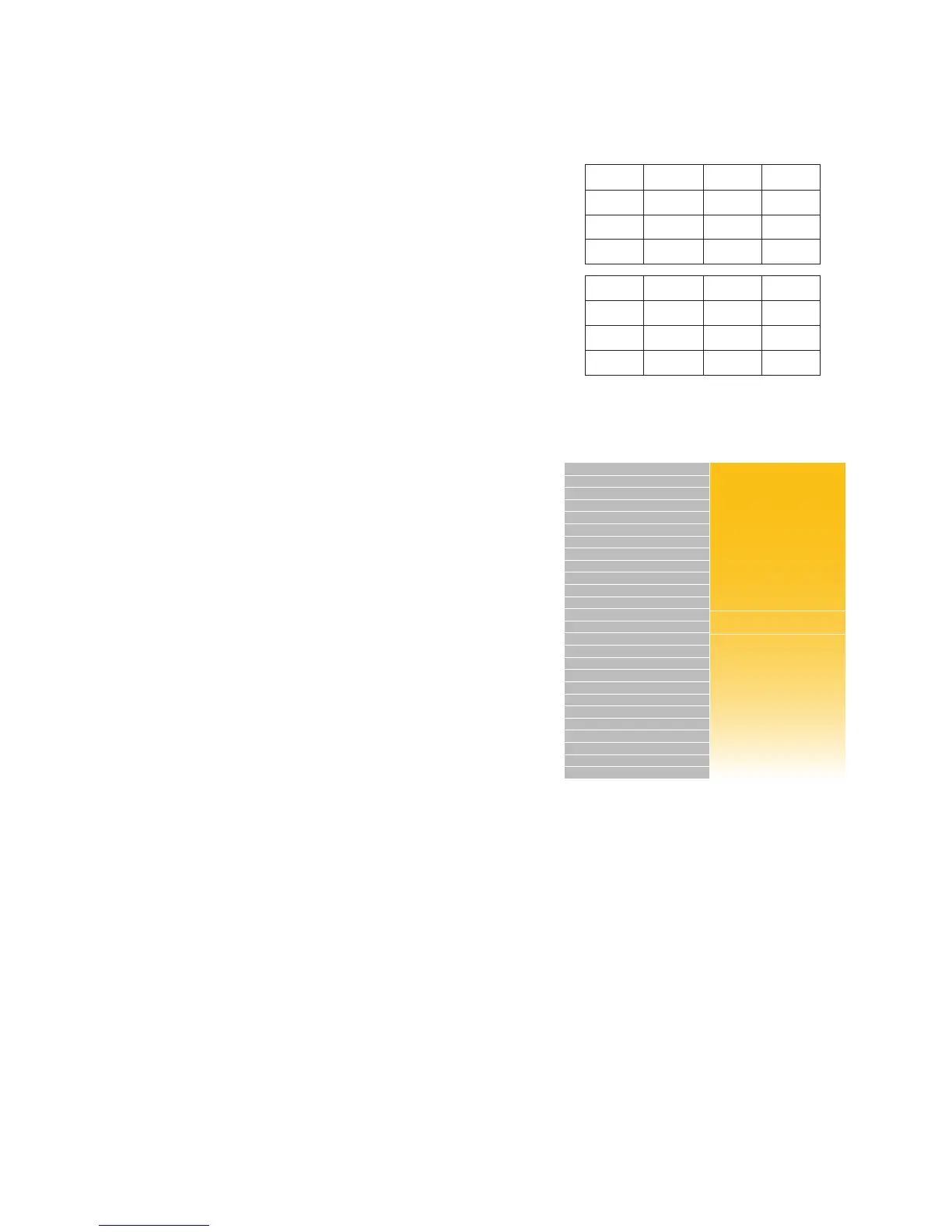
The classification of foreign matter is based on the evaluation
of differences in contrast.
Foreign matters are classified as follows: The length class-
es on the horizontal axis are divided into S–I–R–O, the dark-
ness levels on the vertical axis into 1–2–3–4. In addition, each
class is divided into four subclasses. (= total 128 classes).
The darkness scale is divided into a positive area (darker color
positions) and a negative area (for brighter color positions).
Synthetic Foreign Matter (P)
The detection of synthetic foreign matter as polypropylene,
polyamide (nylon) etc. is based on Triboelectricity. The differ-
ent electrical charging of materials (e.g. cotton and polypro-
pylene) caused by the winding process is evaluated.
Triboelectric Effect
The triboelectric effect is an electrical phenomenon
where certain materials become electrically charged after
coming into contact with another, different, material.
The polarity and strength of the charges produced differ
according to material and surface smoothness.
That means: The further the materials lie off each other in the
triboelectric series, the more definitely they can be detected.
Variable CV Channel (VCV)
Disturbing diameter variations caused by draft faults, soiled
cylinders or sporadically occurring irregularities can be de-
tected.
As opposed to laboratory practice where check lengths of
400 or 1000 m are normally used for CV determination, the
check length of the VCV can be varied continuously between
1 and 50 m. This allows for the specific detection of diameter
variations in this length range.
The clearer calculates continuously the VCV values from the
yarn pieces with the set check length and compares these
with its floating mean value.
Note : These values cannot be compared with the optical CV
values of the Statistics or the data collected in the laboratory
because the check lengths as well as the cutting lengths for
calculation are different.
Dark
Bright



 To Next Page