medin Medical Innovaons GmbH
Adam-Geisler-Str. 1
82140 Olching, Germany
+49 8142 448 460
info@medin-medical.com
www.medin-medical.com
IFU_medin-NC3 EN
Rev 05 Status as of 28.04.2021
7 of 68
2 Descripon of the Device and Condions for Use
Warning:
- The medin-NC3® is intended only for clinical use or transport within the hospital.
- The medin-NC3® may only be used while the paent’s oxygen saturaon is being monitored at the
same me.
- The medin-NC3® may only be used by expert sta who have been trained for the device and under
their supervision.
- Use of the CPAP modes only in combinaon with the Medijet® nCPAP generator.
- Use of the nasal cannula mode only in combinaon with Nuow® nasal cannulas approved by medin.
- The medin-NC3® is a CPAP device. It is suitable only for paents who can breathe spontaneously and
not for paents who are dependent on arcial respiraon.
- The medin-NC3® may not come into contact with ammable anesthesia gases or other ammable
materials while in use.
- The medin-NC3® should not be operated in an oxygen-enriched environment.
- US legislaon spulates that this device may only be sold to or on the instrucons of a doctor (for
USA: Rx only).
- Use only in a securely assembled, upright posion.
- The medin-NC3® must not be used for the simultaneous treatment of mulple paents.
Indicaons
nCPAP or High Flow therapy are used in the paent's various respiratory problems. These may be caused by
immaturity of the lung (RDS [1]), infecons (pneumonia [2]), or factors related to delivery/development (TTN [3],
broncho-/tracheomalacia [4]). In addion, nCPAP or High Flow therapy are used for respiratory support following
extubaon [5].
Expected clinical benet
nCPAP leads to an increase in lung volume (FRC - funconal residual capacity) and thus to the (re-)opening of
alveoli (air sacs). In addion, nCPAP can improve the supply of oxygen, stabilize the airways, smulate breathing,
and reduce breathing eort [6].
Contraindicaons
nCPAP or High Flow therapy are contraindicated if certain clinical situaons, anatomic malformaons or the degrees
of severity of a disease necessitate intubaon and mechanical venlaon or make nCPAP treatment impossible.
Side eects
Possible general side eects caused by nCPAP therapy are, on the one hand, skin damage due to excessive pressure
over the interface on the skin [7], and on the other hand, too much (posive or negave) pressure can lead to lung
injury (pneumothorax) [8]. The air which facilitates the paent’s breathing during the nCPAP therapy can also get
into the gastrointesnal region to some extent, due to the noninvasive applicaon. This can lead to distenon and/
or food intolerances to the point of voming [9].
2.1 Intended use
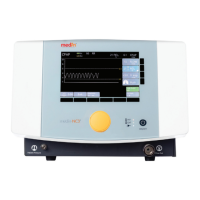
The medin-NC3® CPAP driver is used in combinaon with the Medijet® nCPAP generator to administer CPAP therapy
or with a suitable Nuow® nasal cannula to administer High Flow therapy to premature infants and neonates. The
medin-NC3® must be used under the supervision of expert, specially trained sta in a clinical seng or during
intrahospital transport, and the paent’s oxygen saturaon must be monitored at the same me.


 To Next Page