This document and the information contained herein, is the exclusive property of MODE. And represents a nonpublic,
confidential and proprietary trade secret that may not be reproduced, disclosed to third parties, or otherwise employed in
any manner. whatsoever without the express written consent of MODE. Copyright © (2016) MODE. Allrights reserved.
2.6 Intended use of the product
Electric chain hoists are available for different purposes with various fittings and safety features.
It is very important to select correct type of electric chain hoist based on the hazards arising
from the type and conditions of use.
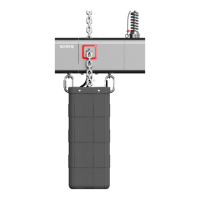
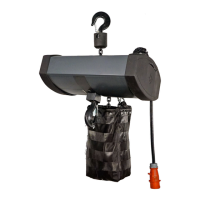
This product is designed for use in event industry. The electric chain hoists used in event
industry can be divided into three classes:
● D8 chain hoist can be used to lift loads during set-up.
● D8 Plus chain hoist can be used to lift loads during set-up and with hold loads at rest above
people.
● C1 chain hoist (scenery hoist) can be used to hold and move loads above people.
Assure that the class of the hoist meets the requirements of the use.
DO NOT ALLOW THE EQUIPMENT TO BE USED FOR LIFTING
PERSONNEL UNLESS THE MANUFACTURER OR MANUFACTURER’S
REPRESENTATIVE HAS DECLARED IN WRITING THAT IT MAY BE
USED FOR THIS PURPOSE.
DO NOT USE THE CHAIN HOIST FOR HOLDING OR MOVING LOADS
ABOVE PEOLPLE UNLESS IT IS DESIGNED FOR THAT PURPOSE.
Modifying the equipment without the permission of the manufacturer or manufacturer's
representative can be dangerous and can invalidate the equipment guarantee. Any
fundamental modifications to the equipment must be authorized in writing by the manufacturer.
Examples of such modifications include:
● Welding or otherwise attaching new items to the product.
● Attaching devices for special material handling such as turning the load.
● Alterations to load-bearing components.
● Alterations to drives and speeds.
● Replacement of major items such as trolleys.
No modifications or additions to the equipment structures or
performance values are permitted unless they are first discussed with,
and approved by, the supplier of the equipment.
Never use the hoist as an earth reference for welding.
Modifying the equipment without the manufacturer or manufacturer's
representative approval can invalidate the guarantee. Furthermore, the
manufacturer does not accept responsibility for accidents which
happen as a consequence of unauthorized modifications.
2.6.1 Duty Group
When the product is designed and purchased, the predicted lifetime of the product is agreed,
based on the expected use of the product. This expected use is known as the duty group.
Hoisting machinery which is used continuously to lift heavy loads is clearly in a very different
duty group to a product of the same size which is used occasionally just to lift light loads. While
the product is used in accordance with the designed duty group, the expected lifetime should
be reached.


 To Next Page