This document and the information contained herein, is the exclusive property of MODE. And represents a nonpublic,
confidential and proprietary trade secret that may not be reproduced, disclosed to third parties, or otherwise employed in
any manner. whatsoever without the express written consent of MODE. Copyright © (2016) MODE. Allrights reserved.
7.4 Load Handling
Correct load handling allows the operator to move loads quickly and safely.
Handle the load safely at all times. During movements, ensure that
the hook, the load, the product and its moving parts will not collide
with objects or people. Failure to do so could cause death or serious
injury.
Evaluating the load
To prevent overloading, the operator shall determine the weight of the load before lifting. The
operator shall only lift the load when he or she is sure that it weighs no more than the permitted
load of the product and accessories. The product’s overload device shall not be used to
determine whether the load can be lifted.
Never attempt to lift a load that weighs more than the maximum permitted load of the equipment
and accessories.
Attempting to lift a load that weighs more than the maximum
permitted load of the equipment and accessories could cause death
or serious injury.
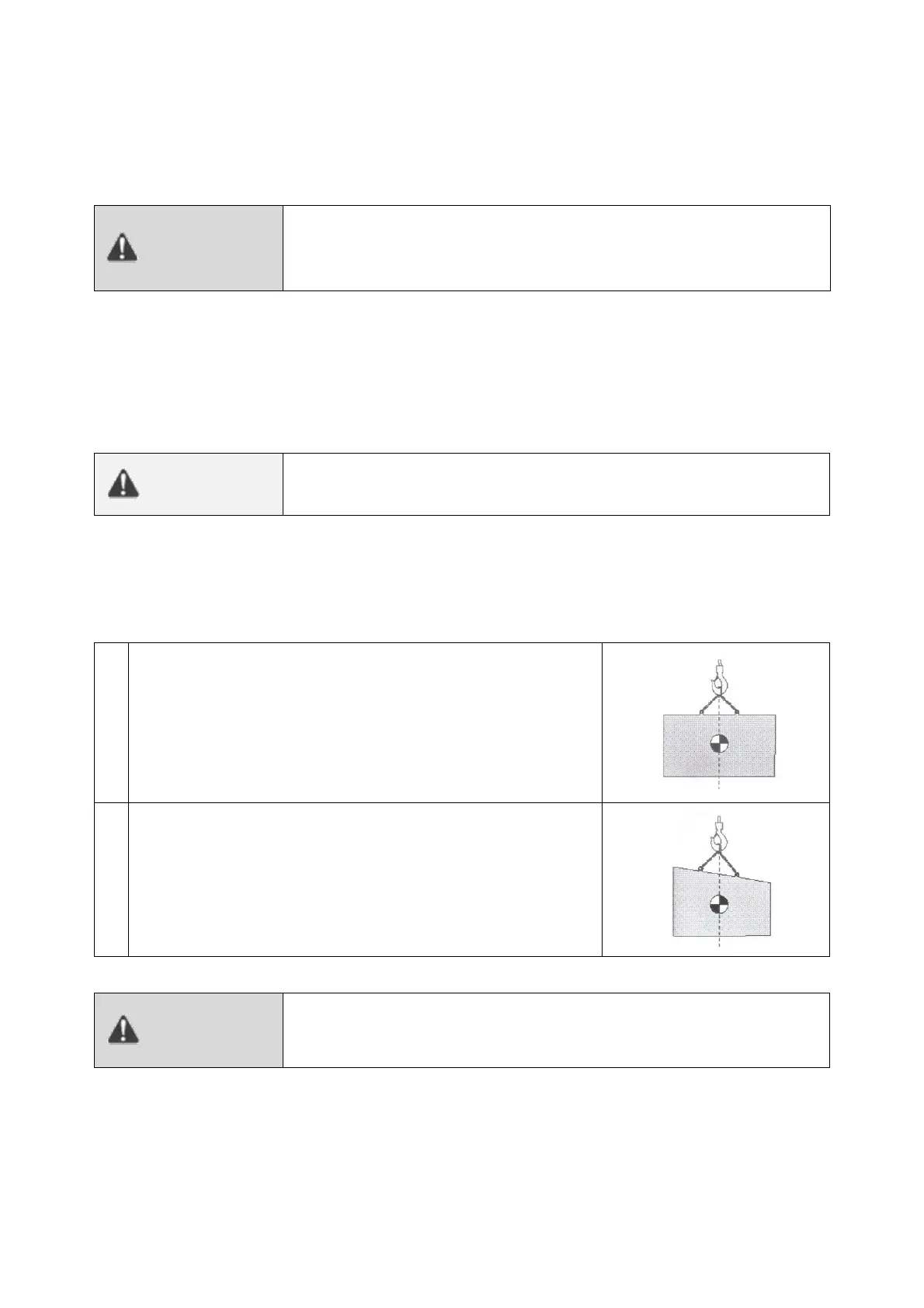
Balancing the load
The hook, slings and harnesses must be positioned so that the pulling force of the product lies
on the load's center of gravity so that the load is balanced. When the operator begins to hoist a
load, he or she shall check that it is properly balanced before lifting it high off the ground. If the
load is not balanced, lower it down and adjust the lifting point.
Lifting centrally balanced loads
The center of gravity will usually be in line with the center of the
load.
Provided that the contents of the container cannot move around,
the balance of the load stays the same.
Lifting off-center balanced loads
The center of gravity of an off-center balanced load will usually be
towards the heavier end of the load.
Provided that the contents of the container cannot move around,
the balance of the load stays the same.
Never try to balance an unbalanced load with your hands. Lower the
load and adjust the lifting point. Trying to balance an unbalanced
load with your hands could cause death or serious injury.
Shock loading
The hoist and accessories are designed to take up the weight of loads gradually and steadily.
They are not designed to withstand sudden increases or decreases in the apparent weight of
the load. Shock loading can occur in any situation where the load on the hoist suddenly
increases or decreases. Some examples of how shock loading can occur are shown below.


 To Next Page