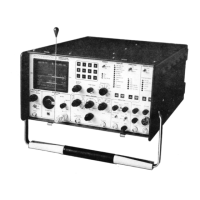
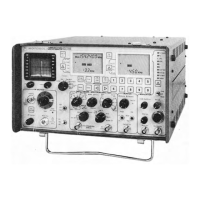
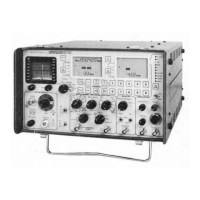
TABLE
2-1. CONTROLS, INDICATORS, AND CONNECTORS
ITEM
DESCRIPTION
FRONT
PANEL
(figure 2-1)
FUNCTION
Ext Level control
1 KHz Level control
Mic connector
Ext
Mod
In connector
Mod
Out
connector
MONITOR
section:
Volume control
BW switch
BFO control
Sig Lvi indicator
Squelch control
Image/Dplx
toggle switch
Demod
Out
connector
Potentiometer
Iswitch
PotentiometerIswitch
4-pin connector
Pre-emphasis and
IDC
are used
BNC connector
BNC connector
Potentiometer
Two-position toggle
switch
PotentiometerIswitch
LED
(red)
Potentiometer
Two-position switch
BNC connector
Controls modulation level
of
external input (microphone
and
other
external generators). Switch
at
fulJ
counterclock-
wise position disables external modulation inputs.
Internal I KHz tone modulation level control. Switch
at
full
counterclockwise position disables I KHz modulation tone.
Microphone input. Provides microphone bias
and
PUSH
TO
TALK
(GENERATE) connection to equipment. Uses
RTM-4000 microphone
or
handset.
External modulation signal input.
Output
connector for all modulation signals (all signals
combined).
Controls speaker
output
level.
In monitor mode, selects
IF
bandwidth. Wide BW
is
± 100
KHz
mod
acceptance. Narrow BW
is
± 5 KHz
mod
accep-
tance. In Gen, FM mode selects modulation range: 0-100
KHz deviation in WB or 0-25 KHz in NB.
BFO
on/off
and
beat frequency control for sideband recep-
tion.
To
minimize interference,
turn
off
the BFO when not
in use.
Squelch indicator.
Adjusts squelch threshold level, full counterclockwise posi-
tion disables squelch.
NOTE; Monitor sensitivity
is
greatly decreased (for high-
level use) as the control
is
increased clockwise beyond the
quieting point.
In duplex generation mode, controls the duplex frequency
output
for above (High)
or
below (Low) the receive pro-
grammed frequency. In
monitor
mode it selects the fre-
quency
of
the local oscillator injection above
or
below the
programmed monitor frequency to remove image inter-
ference.
Receiver audio
output.
2-7


 To Next Page
 Loading...