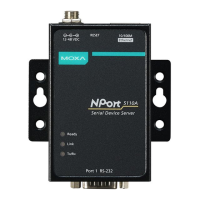
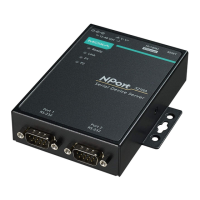
NPort 5100A Series Choosing the Proper Operation Mode
UDP Mode
Compared to TCP communication, UDP is faster and more
efficient. In UDP mode, you can unicast
or multicast data from
the serial device to one or multiple host computers, and the
serial device can also receive data from
one or multiple host
computers, making this mode ideal for message display
applications.
Pair Connection Mode
Pair Connection Mode employs two NPort 5100A units in tandem, and can be used to remove the 15-meter
distance limitation imposed by the RS-232 interface. One NPort 5100A is connected from its RS-232/422/485
port to the COM port of a PC or other type of computer, such as hand-held PDAs that have a serial port, and the
serial device is connected to the RS-232/422/485 port of the other NPort 5100A. The two NPort 5100A units are
then connected to each other with a cross-over Ethernet cable, both are connected to the same LAN, or in a
more advanced setup, they communicate with each other over a WAN (i.e., through one or more routers). Pair
Connection Mode transparently transfers both data and modem control signals (although it cannot transmit the
DCD signal) between the two NPorts.
Ethernet Modem Mode
Ethernet Modem Mode is designed for use with legacy operating systems, such as MS-DOS, that do not support
TCP/IP Ethernet. By connecting one of NPort 5100A’s serial ports to the MS-DOS computer’s serial port, it is
possible to use legacy software originally designed to transmit data via modem, but now transmit the data over
the Ethernet.



 To Next Page
 Loading...