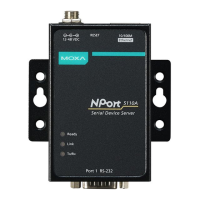
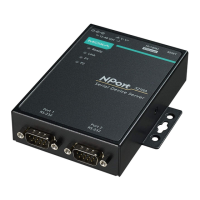
NPort 5100A Series Web Console Configuration
Dial-in
The NPort 5100A listens for a TCP/IP connection request from the remote Ethernet modem or host. The NPort
5100A’s response depends on the ATS0 value, as outlined below.
ATS0=0 (default):
The NPort 5100A will temporarily accept the TCP connection and then send the “RING” signal out through the
serial port. The serial controller must reply with “ATA” within 2.5 seconds to accept the connection request,
after which the NPort 5100A enters data mode. If no “ATA” command is received, the NPort 5100A will
disconnect after sending three “RING” signals.
ATS0
≧
1:
The NPort 5100A will accept the TCP connection immediately and then send the “CONNECT <baud>” command
to the serial port, in which <baud> represents the baudrate of the NPort 5100A’s serial port. After that, the
NPort 5100A immediately enters data mode.
Dial-out
The NPort 5100A accepts the AT command “ATD <IP>:<TCP port>” from the serial port and then requests a
TCP connection from the remote Ethernet Modem or PC. This is where <IP> is the IP address of the remote
Ethernet modem or PC, and <TCP port> is the TCP port number of the remote Ethernet modem or PC. Once the
remote unit accepts this TCP connection, the NPort 5100A will send out the “CONNECT <baud>” signal via the
serial port and then enter data mode.
Disconnection Request from the Local Site
When the NPort 5100As is in data mode, the user can drive the DTR signal to OFF, or send “+++” from the local
serial port to the NPort 5100A. The NPort 5100A will enter command mode and return “NO CARRIER” via the
serial port, and then input “ATH” to shut down the TCP connection after 1 second.
The “+++” command cannot be divided. The “+” character can be changed in register S2, and the guard time,
which prefixes and suffixes the “+++” in order to protect the raw data, can be
changed in register S12.
Disconnection Request from the Remote Site
After the TCP connection has been shut down by the remote Ethernet modem or PC, the NPort 5100A will send
the “NO CARRIER” signal via the serial port and then return to command mode.



 To Next Page
 Loading...