MX Series Voice Gateway User Manual
New Rock Technologies, Inc. 77
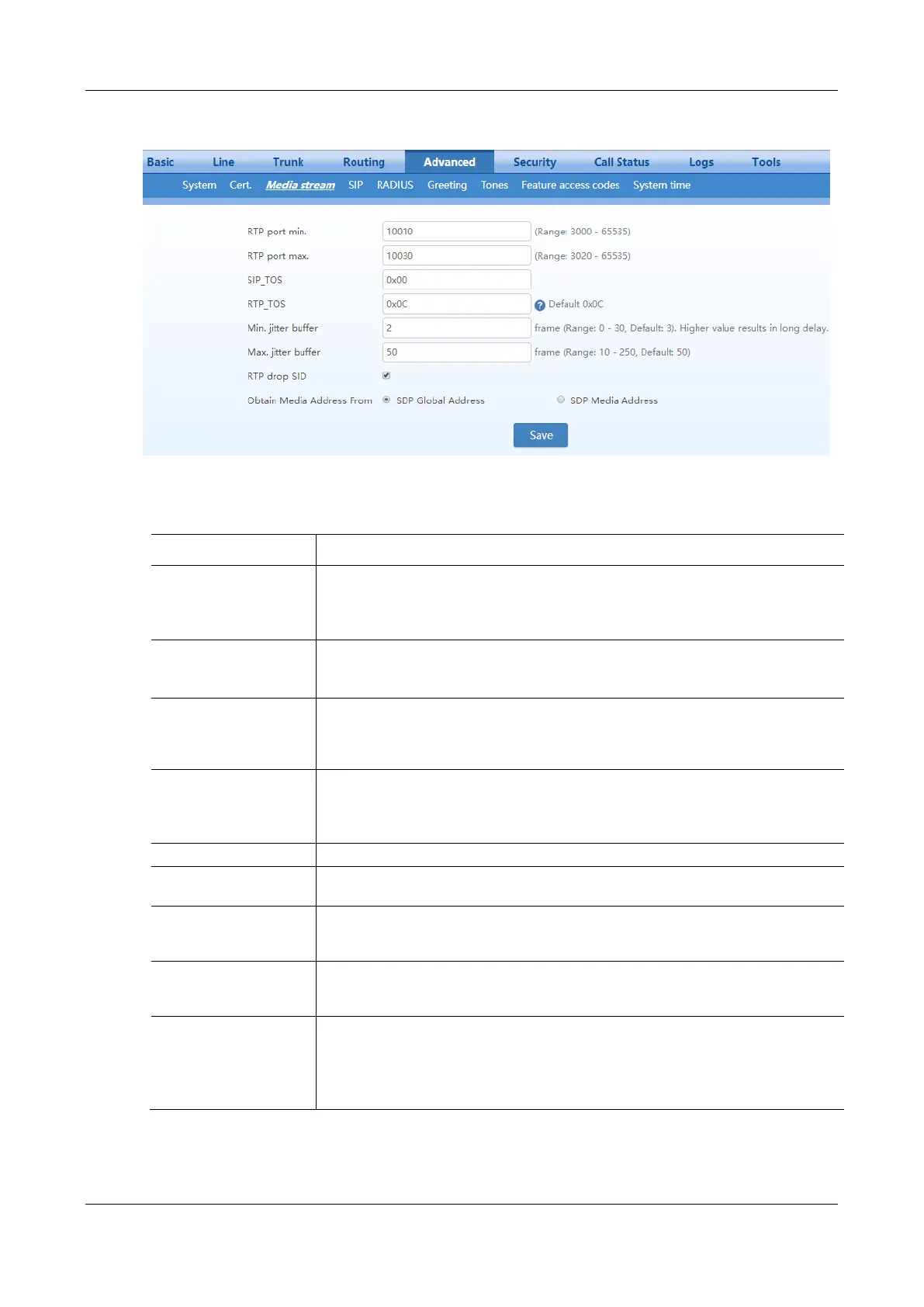
Figure 2-48 MX60/MX60E/MX120G Media Stream Configuration Interface
Table 2-27 Media Stream Configuration Parameter
The lowest port number of UDP ports for RTP transmission and receiving. The parameter
must be greater than or equal to 3000. This is a required field.
Note: each phone call will occupy RTP and RTCP ports. If the gateway is equipped with 4
subscriber lines (or trunk line), then at least 8 UDP ports are needed.
The highest port number of UDP ports for RTP’s transmission and receiving.
This is a required field. The value must be greater than or equal to “2 × number of lines +
min. RPT port”.
iLBC payload type
(MX60/MX60E/
MX120G)
Specify the RTP payload type value of the iLBC codec in the range of 97 to 127 with the
default value 97.
The value should be consistent with that on the platform.
G.723.1 rate
(MX60/MX60E/
MX120G)
Specify the bit rate at which G.723.1 operates to either 5,300 bit/s or 6,300 bit/s. It is 6,300
bit/s by default.
For SIP signaling, set the service quality for different priorities. The default value is 0x00.
For RTP voice streams, set the service quality for different priorities. The default value is
0x0c.
RTP Jitter Buffer is constructed to reduce the influence brought by network jitter. This
parameter specifies the minimum number of RTP packets in the buffer. The default value
is 2 frames. The value range is 0 to 30 frames.
RTP Jitter Buffer is constructed to reduce the influence brought by network jitter. This
parameter specifies the maximum number of RTP packets allowed in the buffer. The
default value is 50 frames. The value range is 10 to 250 frames.
Select to discard received RTP SID voice packets. By default, SID voice packets will not
be dropped.
Note: RTP SID packets should be dropped only when they are in nonconformity to the
specifications. Nonstandard RTP SID data could generate noise for calls.



 To Next Page