6 – ENGLISH
INSTALLATION
3
3 INSTALLATION
3.1 PRE-INSTALLATION CHECKS
a
The installation must be carried out by qualied person-
nel in compliance with the current legislation, standards
and regulations, and with the instructions provided in this
manual.
Before proceeding with the product’s installation, it is necessary to:
– Check the integrity of the supply
– Check that all the materials are in good working order and suitable for
the intended use
– Make sure that the structure of the sliding gate is suitable for being
automated
– Make sure that the characteristics of the sliding gate fall within the oper
-
ating limits specied in the “Product usage limits” paragraph (page 6)
– Verify that there are no points of greater friction during the opening and
closing movements along the entire path of the sliding gate
– Verify that the area where the gearmotor is installed allows for unlocking
the latter and manoeuvring easily and safely
– Verify that there is no risk of derailment of the leaf or that it may come
off the guides
– Make sure that the overrun mechanical stops are sturdy enough and
that there is no risk of the deformation even when the leaf strikes the
mechanical stop vigorously
– Verify that the gate leaf is well balanced: it must not move by itself when
left in any position
– Make sure that the area where the gearmotor is xed is not subject to
ooding. If necessary, mount the gearmotor raised from the ground
– Verify that the mounting points of the various devices are protected
against impacts and that the mounting surfaces are sufciently sturdy
– Components must never be immersed in water or other liquids
– Keep the product away from heat sources and open ames and acid,
saline or potentially explosive atmospheres; these may damage the
product and cause malfunctions or dangerous situations
– Connect the control unit to an electricity supply line equipped with a
safety earthing system
– If there is an access door in the gate, or within its range of movement,
make sure that it does not obstruct the gate’s normal path; install an
appropriate interlock system if necessary
– The power line must be protected by an adequate residual-current de
-
vice
– Mount a device on the electric power line that completely disconnects
the automation from the grid. The disconnection device must have con
-
tacts with a sufcient gap to ensure complete disconnection, under the
Category III overvoltage conditions, in accordance with the installation
instructions. Should it be necessary, this device guarantees fast and
safe disconnection from the power supply; it must therefore be posi
-
tioned in view of the automation. If placed in a non-visible location, it
must have a system that blocks any accidental on unauthorised recon
-
nection of the power supply, in order to prevent dangerous situations.
The disconnection device is not supplied with the product.
3.2 PRODUCT USAGE LIMITS
The data relative to the product’s performances is included in the “TECH-
NICAL SPECIFICATIONS” chapter (page 54) and is the only data that
allows for properly assessing whether the product is suitable for its intend
-
ed use.
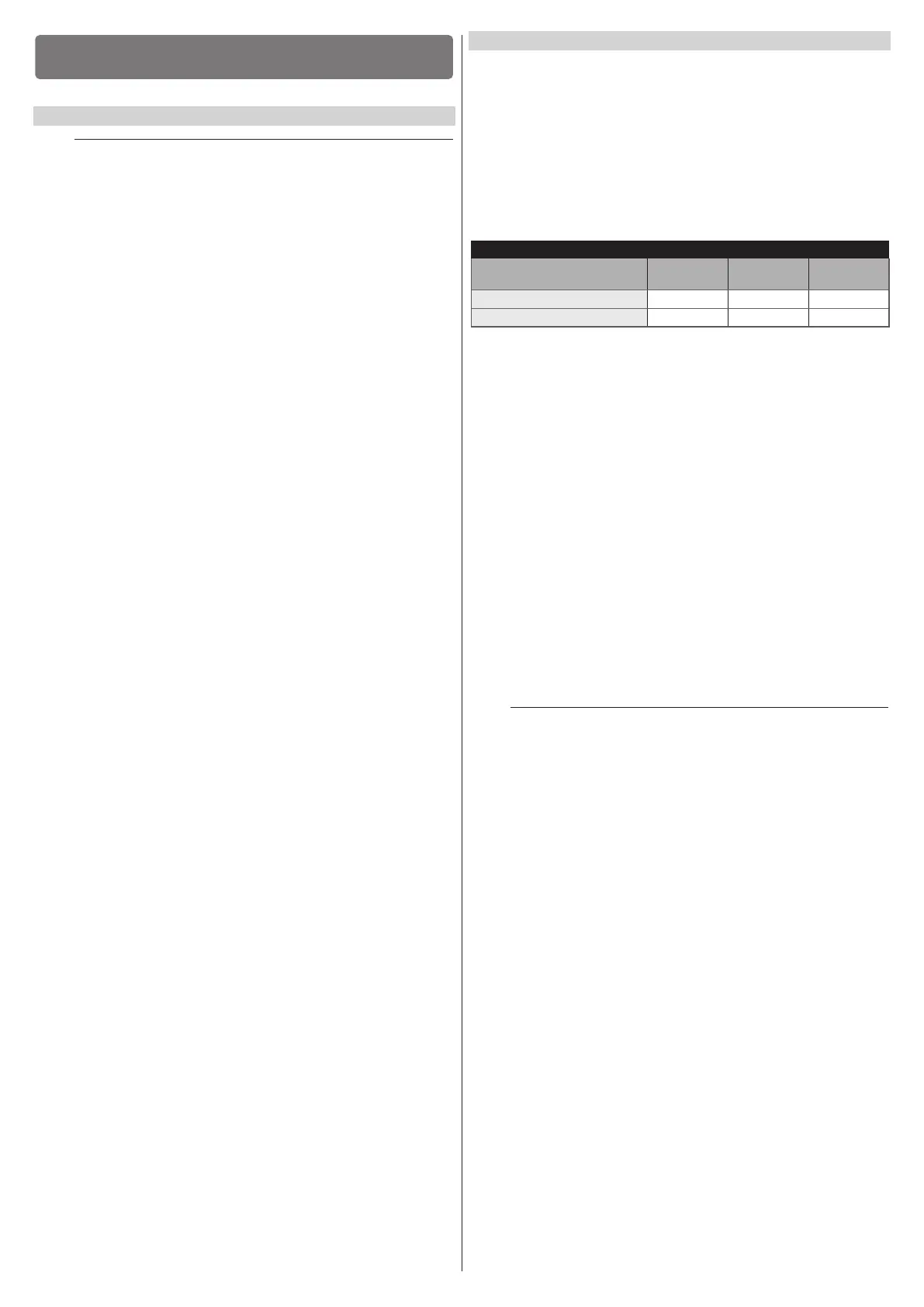
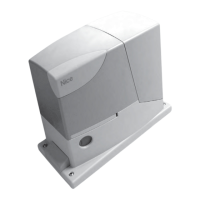
Check the application limits of ROBUS and of the accessories to be in
-
stalled, assessing whether their characteristics are capable of meeting the
requirements of the environment and the limitations specied below:
– the weight of the sliding gate leaf must not exceed the limit specied in
“Table 2”.
– The length of the sliding gate leaf must not exceed 8 m.
Table 2
ROBUS - LIMITATIONS OF USE IN RELATION TO THE TYPE OF MODEL
ROBUS 400 ROBUS 600
ROBUS 600
HS
Gate leaf limit (m) 8 8 8
Weight limit (kg) 400 600 600
The measurements shown in “Table 2” are purely indicative and are only
needed for making a rough estimate. The actual suitability of ROBUS to
automate a specic sliding gate depends on friction and on other factors,
even occasional, such as the presence of frost, which may interfere with
the leaf’s movement.
To determine the actual conditions, the force required to move the leaf
throughout its path must be measured, to ensure that this value does not
exceed half the “rated torque” specied in the “TECHNICAL SPECIFI
-
CATIONS” chapter (page 54).
A margin of 50% is recommended because adverse weather conditions
can increase friction
“Table 3” (page 7) includes an estimate of the “durability”, that is, the
average economic life of the product. The durability value is strongly in
-
uenced by the severity of the manoeuvres, i.e. the sum of all factors that
contribute to product wear. To make the estimate it is necessary to add all
the severity indices of the “Table 3”. Check the total against the estimated
durability graph.
For example, ROBUS 400 on a 200 kg gate that is 5 metres long, with
-
out any other fatigue-inducing factors, obtains a severity index of 50%
(30+20). An estimated duration of 80.000 cycles can be inferred from the
graph.
a
The control unit is equipped with a manoeuvre limiting
device that prevents possible overheating; it is based on
the motor load and duration of the cycles, and intervenes
when the maximum limit is exceeded.


 To Next Page