ENGLISH – 9
3.5 PRE-INSTALLATION WORKS
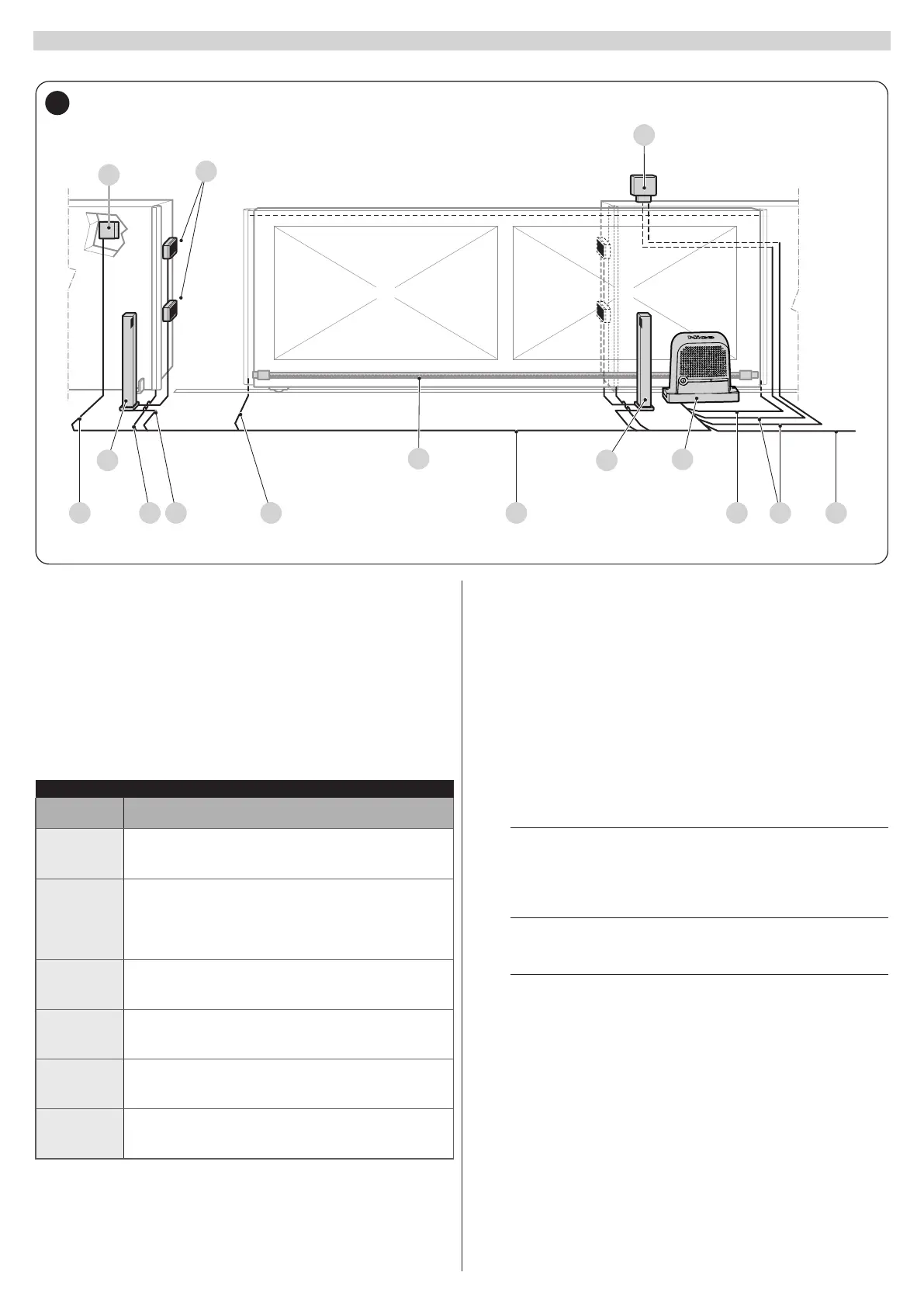
The gure shows an example of an automation system, constructed using Nice components.
A
B
C
D
C
F
4
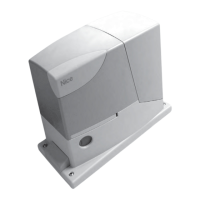
A Gearmotor
B Photocells
C Posts for photocells
D Key selector
E Warning light with aerial
F Rack
The above-mentioned components are positioned according to a typical
standard layout. Using the layout shown in “Figure 4” for reference, dene
the approximate position in which each component of the system will be
installed.
Table 4
TECHNICAL SPECIFICATIONS OF ELECTRICAL CABLES
Identication
no.
Cable characteristics
1
GEARMOTOR POWER SUPPLY cable
1 cable 3 x 1.5 mm
2
Maximum length 30 m [note 1]
2
Cable for WARNING LIGHT WITH AERIAL
1 cable 2 x 0.5 mm
2
Maximum length 20 m
1 x RG58-type shielded cable
Maximum length 10 m; recommended < 5 m
3
PHOTOCELL cable
2x0.5mm
2
Maximum length 30 m [note 2]
4
KEY SELECTOR cable
2 cables 2 x 0.5 mm
2
[note 3]
Maximum length 50 m
5
FIXED EDGES cable
1 cable 2 x 0.5 mm
2
[note 4]
Maximum length 30 m
6
MOVABLE EDGES cable
1 cable 2 x 0.5 mm
2
[note 4]
Maximum length 50 m [note 5]
Note 1 If the power supply cable is longer than 30 m, a cable with larger
cross-sectional area (3 x 2.5 mm
2
) must be used and a safety
earthing system must be installed near the automation.
Note 2 If the “BlueBus” cable is longer than 30 m, up to maximum 50 m,
a 2 x 1 mm
2
cable is required.
Note 3 These two cables can be replaced by a single 4 x 0.5 mm
2
cable.
Note 4 If more than one edge is present, refer to the paragraph “Adding
or removing devices“ (page 45) “STOP input” for the type of
connection recommended.
Note 5 Movable edges must be connected to sliding leaves using spe
-
cial devices, which enable the connection even when the leaf is
moving.
a
Before proceeding with the installation, prepare the re-
quired electrical cables by referring to “Figure 4” and to
that stated in the “TECHNICAL SPECIFICATIONS” chap-
ter (page 54).
a
The cables used must be suited to the type of environ-
ment of the installation site.
a
When laying the pipes for routing the electrical cables,
take into account that any water deposits in the junction
boxes may cause the connection pipes to form conden-
sate inside the control unit, thus damaging the electronic
circuits.


 To Next Page