SECTION F
Pistons and Connecting Rods
F1
To Remove Pistons and Connecting Rods
1. Remove the
cylinder
head assembly. (Refer to
Page
E.1).
2.
Remove the oil sump. (Refer to Page
L.1
).
NOTE: Any
ridges
or
carbon
deposits
around the
top
of
the
cylinder
bore should be removed
with
a suitable
scraper
before
piston
removal is
attempted.
3.
Rotate
the
crankshaft
until one
pair
of
big ends are
at
bottom
dead
centre, then remove
their
respec-
tive
connecting
rod cap
securing
bolts.
4.
Remove the
connecting
rod
caps
and
bearing
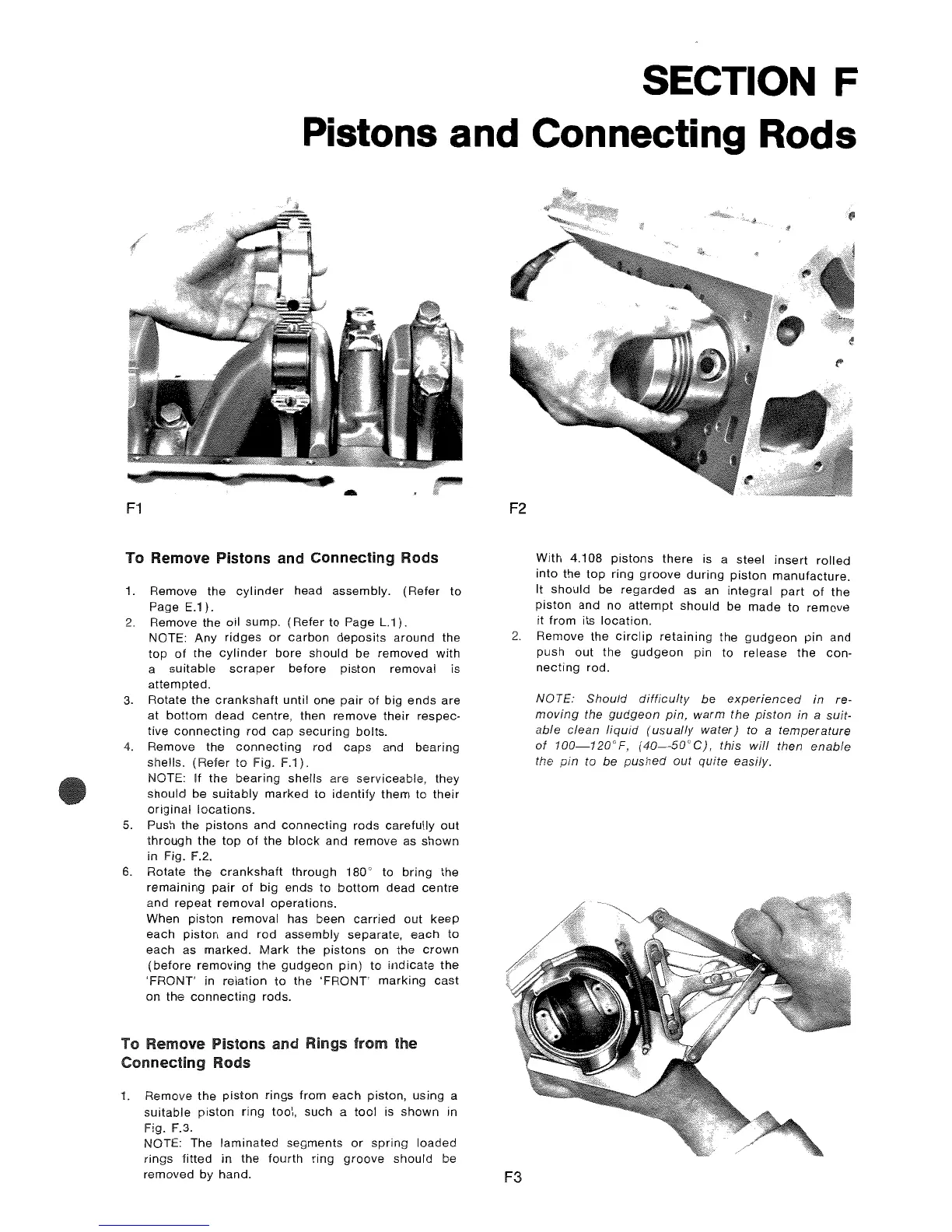
shells.
(Refer
to
Fig. F.1).
NOTE:
If
the
bearing
shells are serviceable, they
should
be
suitably
marked
to
identify
them to
their
original
locations.
5.
Push the
pistons
and
connecting
rods
carefully
out
through
the top
of
the
block
and remove as
shown
in Fig. F.2.
6.
Rotate the
crankshaft
through
180 Q
to
bring
the
remaining
pair
of
big ends
to
bottom
dead
centre
and
repeat
removal operations.
When
piston
removal has been
carried
out keep
each
piston
and
rod assembly separate,
each
to
each as marked.
Mark
the
pistons
on the
crown
(before
removing
the
gudgeon
pin)
to
indicate
the
'FRONT' in
relation
to
the 'FRONT'
marking
cast
on the
connecting
rods.
To Remove Pistons and Rings from the
Connecting Rods
1. Remove the
piston
rings from
each
piston, using a
suitable
piston
ring
tool,
such
a
tool
is shown in
Fig. F.3.
NOTE: The
laminated
segments
or
spring
loaded
rings fitted in the fourth ring
groove
should
be
F2
With 4.108
pistons
there
is a steel
insert
rolled
into
the
top
ring
groove
during
piston
manufacture.
It
should
be
regarded
as an integral
part
of
the
piston
and
no
attempt
should
be
made
to
remove
it from its
location.
2.
Remove the
circlip
retaining
the
gudgeon
pin
and
push out the
gudgeon
pin to release
the
con-
necting
rod.
NOTE:
Should
difficulty
be
experienced
in
re-
moving
the
gudgeon
pin,
warm
the
piston
in a
suit-
able
clean
liquid
(usually
water)
to a
temperature
of
100-120°F,
(40-50°C),
this
will
then
enable
the
pin
to
be
pushed
out
quite
easily.
removed by hand. F3



 To Next Page