EasyManua.ls Logo

Perkins 4.99 - Pre-Engaged Starter Motor; Pre-Engaged Starter Motor Description and Maintenance; Pre-Engaged Starter Motor Testing

Perkins 4.99
114 pages
Print Icon
To Next Page IconTo Next Page
To Previous Page IconTo Previous Page
Loading...
ELECTRICAL EQUIPMENT
-0.8
STARTER
MOTOR-PRE·ENGAGED
DRIVE
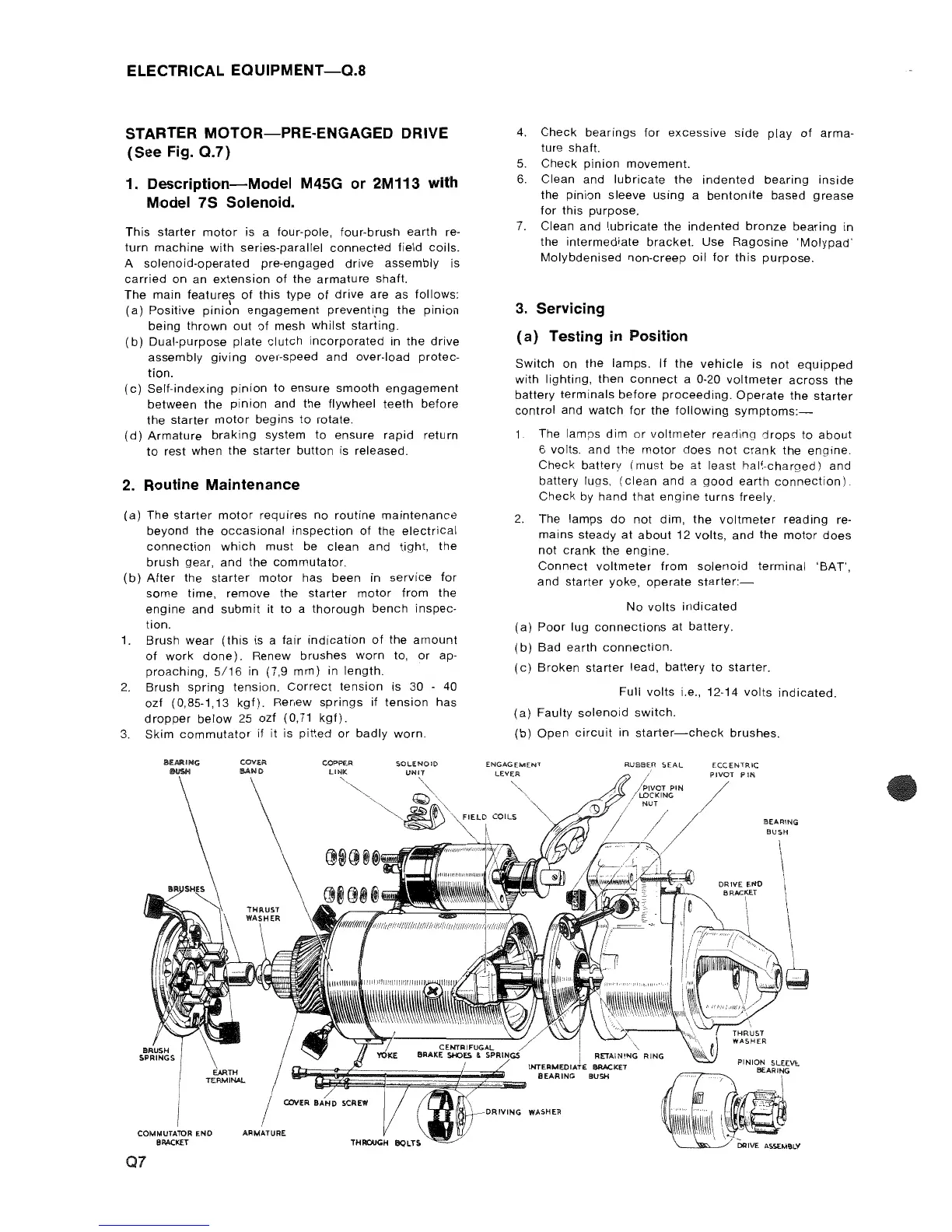
(See
Fig.
0.7)
1.
Description-Model
M45G or 2M113 with
Model 7S Solenoid.
This
starter
motor
is a four-pole, four-brush earth re-
turn
machine
with
series-parallel
connected
field
coils.
A
solenoid-operated
pre-engaged
drive
assembly
is
carried
on an
extension
of
the
armature
shaft.
The main feature;"
of
this type
of
drive
are as follows:
(a)
Positive
pinion
engagement
preventi,ng the
pinion
being
thrown
out
of mesh
whilst
starting.
(b)
Dual-purpose
plate
clutch
incorporated
in
the
drive
assembly
giving
over-speed and over-load
protec-
tion.
(c)
Self-indexing
pinion
to
ensure
smooth
engagement
between
the
pinion
and the flywheel teeth
before
the
starter
motor
begins
to
rotate.
(d)
Armature
braking
system
to
ensure rapid return
to
rest when
the
starter
button
is released.
2.
Routine Maintenance
(a)
The
starter
motor
requires no
routine
maintenance
beyond
the
occasional
inspection
of the
electrical
connection
which
must be
clean
and tight,
the
brush gear, and the
commutator.
(b)
After
the
starter
motor
has been in
service
for
some
time, remove the
starter
motor
from
the
engine
and
submit
it to a
thorough
bench
inspec-
tion.
1. Brush
wear
(this
is a
fair
indication
of
the
amount
of
work
done).
Renew brushes
worn
to,
or
ap-
proaching,
5/16
in (7,9
mm)
in length.
2.
Brush
spring
tension.
Correct
tension
is 30 - 40
ozf
(0,85-1,13
kgf).
Renew
springs
if
tension
has
dropper
below
25 ozf (0,71
kgf).
3.
Skim
commutator
if it is
pitted
or
badly worn.
COPPE.R
SOLENO
10
LI~
UNIT
~b
4.
Check
bearings
for
excessive
side
play
of
arma-
ture shaft.
5.
Check
pinion
movement.
6.
Clean and
lubricate
the
indented
bearing
inside
the pinion sleeve
using
a
bentonite
based
grease
for this purpose.
7.
Clean and
lubricate
the
indented
bronze
bearing
in
the
intermediate
bracket.
Use
Ragosine
'Molypad'
Molybdenised
non-creep
oil
for
this
purpose.
3. Servicing
(a)
Testing
in
Position
Switch
on
the
lamps. If
the
vehicle
is
not
equipped
with
lighting, then
connect
a 0-20
voltmeter
across
the
battery
terminals
before
proceeding.
Operate
the
starter
control
and
watch
for
the
following
symptoms:-
The lamps
dim
or
voltmeter
rearling
drops
to
about
6 volts. and
the
motor
does
not
crank
the
engine.
Check battery
(must
be at
least
half-charged)
and
battery lugs,
(clean
and a
good
earth
connection).
Check by hand that
engine
turns
freely.
2.
The lamps
do
not
dim,
the
voltmeter
reading
re-
mains
steady
at
about
12 volts,
and
the
motor
does
not
crank
the
engine.
Connect
voltmeter
from
solenoid
terminal
'BAT',
and
starter
yoke,
operate
starter:-
No
volts
indicated
(a)
Poor
lug
connections
at
battery.
(b)
Bad earth
connection.
(c)
Broken
starter
lead,
battery
to
starter.
Full
volts
i.e., 12-14
volts
indicated.
(a)
Faulty
solenoid
switch.
(b)
Open
circuit
in
starter-check
brushes.
ENGAGEMENT
LEvER
: \
I
RETAiN!NG
RING
ECCENTR
Ie
PIVOT
PIN
DRIvE
EN'O
BRACKET
BEARING
BUSH
~~~~¥~~~~~=iiiiiiiiiilINTER.MEOIATE
BRACKET
~
BEARING
BUSH
COMMUTATOR END
BRACKET
Q7
ARMATURE

Table of Contents

Related product manuals