EasyManua.ls Logo

Perkins 4.99 - SECTION N Air Cleaners and Fuel System; Air Cleaner Servicing Overview; Dry Type Air Cleaner Procedures

Perkins 4.99
114 pages
Print Icon
To Next Page IconTo Next Page
To Previous Page IconTo Previous Page
Loading...
SECllON N
Air Cleaners and Fuel System
AIR CLEANERS
Operating
conditions
play an
important
part
in de-
ciding
how
frequently
it is necessary to
service
the
air
cleaner. If you are
working
in
dusty
conditions
then
the
air
cleaner
should
be attended to every day.
as
indicated
under
"Preventive
Maintenance".
If
not
already
fitted, you
should
consider
the fitting
of
an 18 in
water
gauge
RESTRICTION INDICATOR in
the
air
trunking
between
the
air
cleaner
and
the
engine
induction
manifold.
It
indicates
by means
of
a visual
signal
when
the
air
cleaner
element
needs
servicing.
A means
of
visual
signalling
for
the
"Rotopamic"
type
air
cleaner
failure
is the use
of
the
"DUST
SIGHT".
A
window
in
this
device
becomes
cloudy
when
the
system has failed',
but
this
type
of
indicator
is
usually
only
used
with
the
two
stage
extreme
heavy
duty
cleaners.
The type of
air
cleaner
fitted to
your
vehicle
or
machine
depends
upon
the
manufacturer
of
your
equip-
ment. Usually,
guidance
for
the
method
of
servicing
is
shown
on the b'ody
of
the
air
cleaner. but the
following
advice
will
also
help.
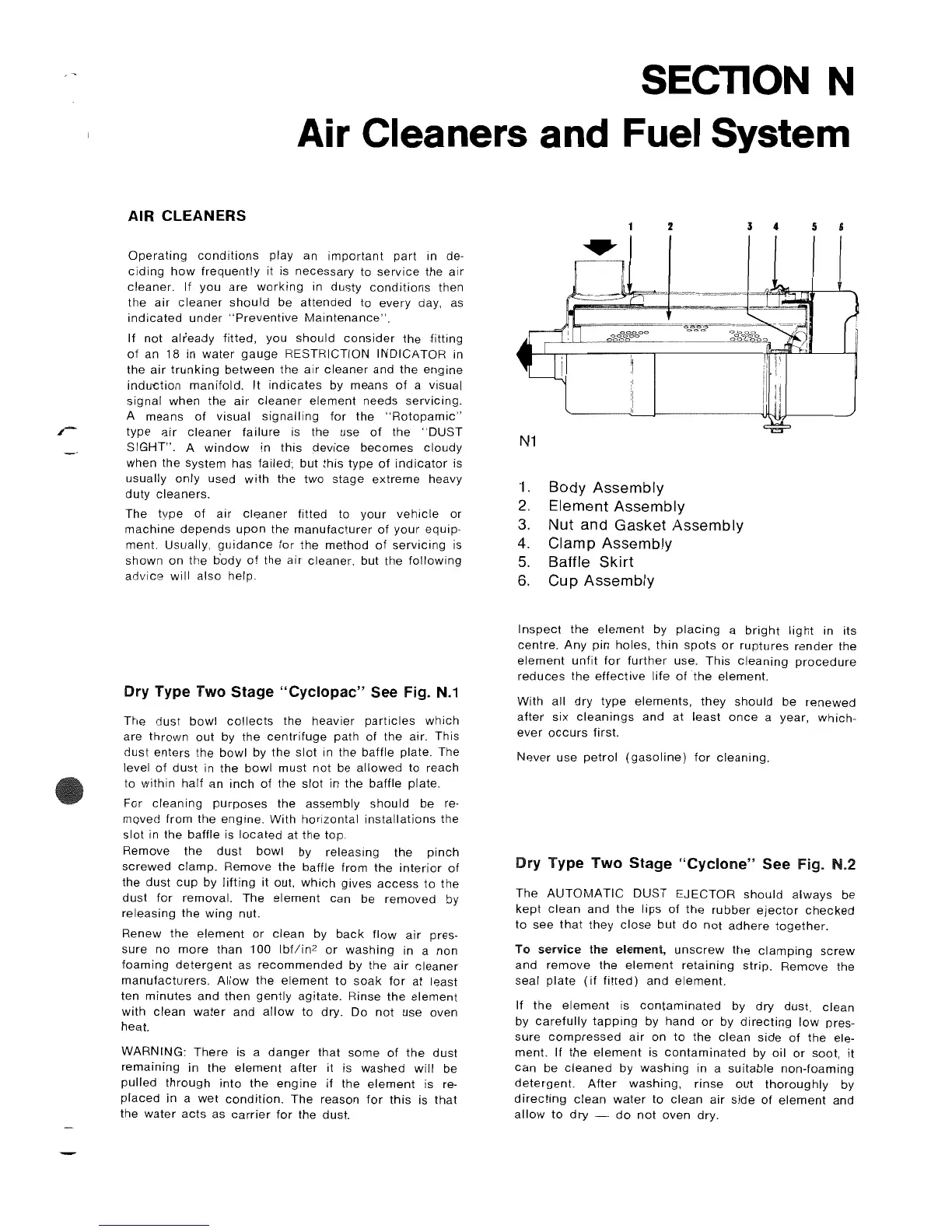
Dry
Type
Two
Stage
"Cyclopac"
See Fig.
N.1
The
dust
bowl
collects
the heavier
particles
which
are
thrown
out
by the
centrifuge
path
of
the air. This
dust
enters
the
bowl
by
the
slot
in the baffle plate. The
level
of
dust
in the
bowl
must
not
be
allowed
to reach
to
within
half
an
inch
of
the
slot
in the baffle plate.
For
cleaning
purposes
the
assembly
should
be re-
moved from the engine. With
horizontal
installations
the
slot in the baffle is
located
at
the
top.
Remove
the
dust
bowl
by releasing the
pinch
screwed
clamp.
Remove
the
baffle from the
interior
of
the
dust
cup
by
lifting
it out,
which
gives
access
to
the
dust
for
removal. The
element
can be removed by
releasing
the
wing
nut.
Renew
the
element
or
clean
by
back
flow
air
pres-
sure
no
more
than 100
Ibflin
2
or
washing
in a non
foaming
detergent
as
recommended
by
the
air
cleaner
manufacturers.
Allow
the
element
to
soak
for
at least
ten
minutes
and then
gently
agitate. Rinse
the
element
with
clean
water
and
allow
to
dry.
Do
not
use oven
heat.
WARNING:
There
is a
danger
that
some
of
the
dust
remaining
in
the
element
after
it is
washed
will
be
pulled
through
into
the
engine
if the
element
is re-
placed
in
a
wet
condition.
The reason
for
this
is
that
the
water
acts
as
carrier
for
the
dust.
2 3 4
5
6
N1
'1.
Body
Assembly
2.
Element
Assembly
3.
Nut
and
Gasket
Assembly
4.
Clamp
Assembly
5.
Baffle
Skirt
6.
Cup
Assembly
Inspect
the
element
by
placing
a
bright
light
in its
centre.
Any
pin
holes,
thin
spots
or
ruptures
render
the
element
unfit
for
further
use.
This
cleaning
procedure
reduces
the
effective
life
of
the
element.
With
all
dry
type
elements,
they
should
be
renewed
after
six
cleanings
and
at
least
once
a year,
which-
ever
occurs
first.
Never
use
petrol
(gasoline)
for
cleaning.
Dry
Type
Two
Stage
"Cyclone"
See Fig. N.2
The
AUTOMATIC
DUST
EJECTOR
should
always
be
kept
clean
and
the
lips
of
the
rubber
ejector
checked
to
see
that
they
close
but
do
not
adhere
together.
To
service
the
element,
unscrew
the
clamping
screw
and
remove
the
element
retaining
strip.
Remove the
seal
plate
(if
fitted)
and
element.
If
the
element
is
contaminated
by
dry
dust,
clean
by
carefully
tapping
by
hand
or
by
directing
low
pres-
sure
compressed
air
on
to
the
clean
side
of
the ele-
ment.
If
the
element
is
contaminated
by oil
or
soot,
it
can
be
cleaned
by
washing
in a
suitable
non-foaming
detergent.
After
washing,
rinse
out
thoroughly
by
directing
clean
water
to
clean
air
side
of
element
and
allow
to
dry
-
do
not
oven
dry.

Table of Contents

Related product manuals