EasyManua.ls Logo

Perkins 4.99 - Electrical System Testing; Alternator Output Test and Regulator Test; Dynamo Description and Operation

Perkins 4.99
114 pages
Print Icon
To Next Page IconTo Next Page
To Previous Page IconTo Previous Page
Loading...
ELECTRICAL EQUIPMENT
-Q.4
Alternator Output Test with Regulator
Inoperative
Withdraw
the
two-part
connector
from the alternator,
remove the
moulded
cover
(secured by
two
screws)
and
link
together
regulator
terminals 'F' and
'-'.
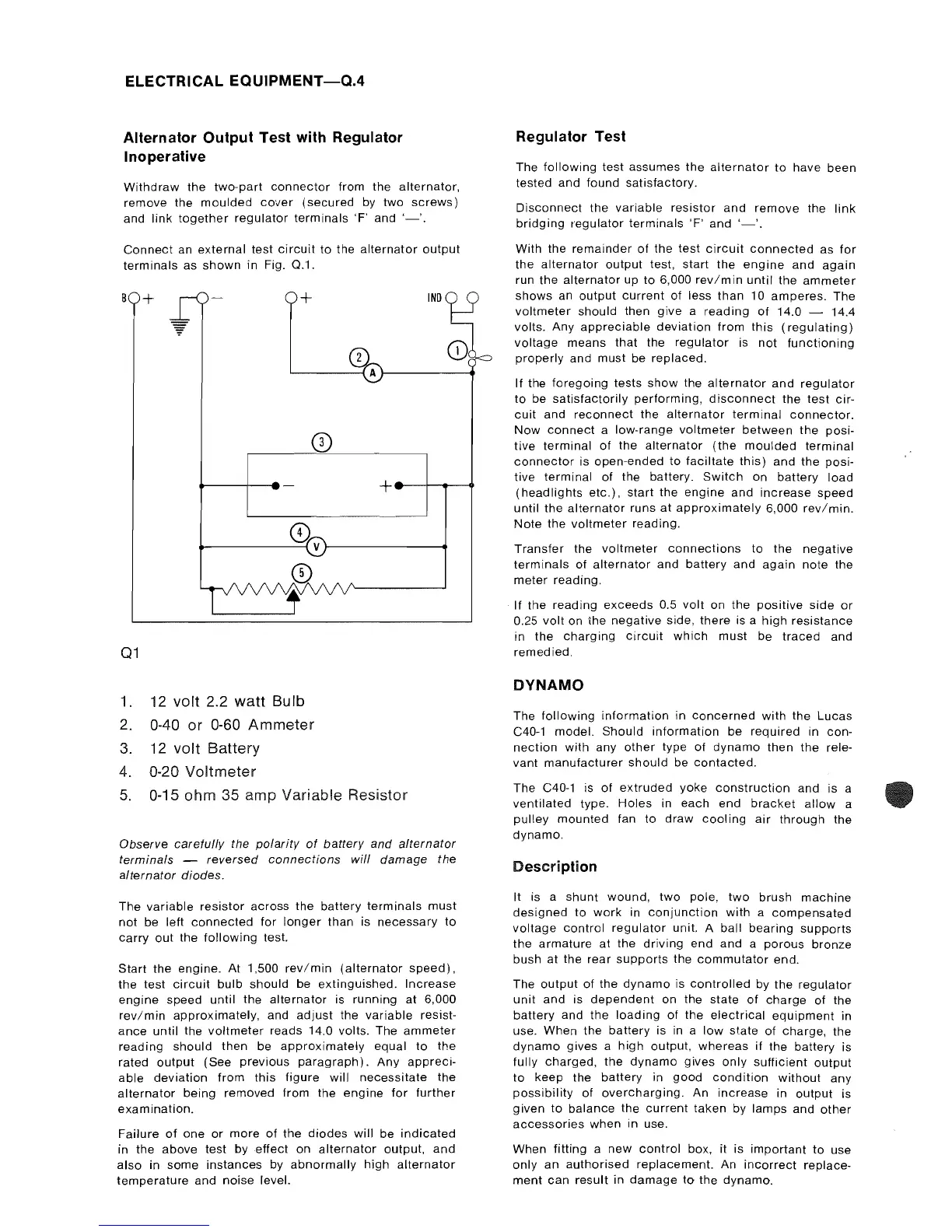
Connect
an
external
test
circuit
to the
alternator
output
terminals
as
shown
in Fig. Q.1.
B +
+
INO
'--------iAI------.
0)
CD
~--------iVI_------_1I
01
1.
12
volt
2.2
watt
Bu
Ib
2. 0-40
or
0-60
Ammeter
3.
12
volt
Battery
4. 0-20
Voltmeter
5.
0-15
ohm
35 amp
Variable
Resistor
Observe
carefully
the
polarity
ot
battery
and
alternator
terminals
-
reversed
connections
will
damage
the
alternator
diodes.
The
variable
resistor
across
the
battery
terminals
must
not
be left
connected
for
longer
than
is
necessary
to
carry
out the
following
test.
Start
the
engine.
At
1,500
rev/min
(alternator
speed),
the
test
circuit
bulb
should
be
extinguished.
Increase
engine
speed
until
the
alternator
is running
at
6,000
rev/min
approximately,
and
adjust
the
variable
resist-
ance
until
the
voltmeter
reads 14.0 volts. The
ammeter
reading
should then be
approximately
equal
to
the
rated
output
(See
previous
paragraph).
Any
appreci-
able
deviation from
this
figure
will
necessitate
the
alternator
being removed from the
engine
for
further
examination.
Failure
of
one
or
more
of
the
diodes
will be
indicated
in
the
above test by effect on
alternator
output,
and
also
in some instances by
abnormally
high
alternator
temperature
and
noise
level.
Regulator Test
The
following
test assumes
the
alternator
to
have been
tested and found satisfactory.
Disconnect
the variable
resistor
and
remove
the
link
bridging
regulator
terminals
'F'
and
'-'.
With the
remainder
of
the
test
circuit
connected
as
for
the
alternator
output test,
start
the
engine
and
again
run the
alternator
up
to
6,000
rev/min
until
the
ammeter
shows an output
current
of less
than
10
amperes.
The
voltmeter
should then
give
a
reading
of
14.0 - 14.4
volts. Any
appreciable
deviation
from
this
(regulating)
voltage
means that the
regulator
is
not
functioning
properly
and must be replaced.
If the
foregoing
tests
show
the
alternator
and
regulator
to be
satisfactorily
performing,
disconnect
the
test
cir-
cuit
and
reconnect
the
alternator
terminal
connector.
Now
connect
a low-range
voltmeter
between
the posi-
tive
terminal
of
the
alternator
(the
moulded
terminal
connector
is open-ended
to
faciltate
this)
and
the
posi-
tive
terminal
of
the battery.
Switch
on
battery
load
(headlights
etc.),
start
the
engine
and
increase
speed
until
the
alternator
runs
at
approximately
6,000
rev/min.
Note the
voltmeter
reading.
Transfer
the
voltmeter
connections
to
the
negative
terminals
of
alternator
and battery
and
again
note
the
meter reading.
If
the
reading
exceeds
0.5
volt
on
the
positive
side
or
0.25
volt
on the negative side, there is a
high
resistance
in the
charging
circuit
which
must be
traced
and
remedied.
DYNAMO
The
following
information
in
concerned
with
the
Lucas
C40-1
model.
Should
information
be
required
in con-
nection
with
any
other
type
of
dynamo
then
the rele-
vant
manufacturer
should
be
contacted.
The
C40-1
is of
extruded
yoke
construction
and is a
ventilated
type.
Holes
in each
end
bracket
allow
a
pulley
mounted fan to
draw
cooling
air
through
the
dynamo.
Description
It is a shunt wound,
two
pole,
two
brush
machine
designed
to
work
in
conjunction
with
a
compensated
voltage
control
regulator
unit. A ball bearing
supports
the
armature
at the
driving
end and a porous bronze
bush
at
the rear
supports
the
commutator
end.
The
output
of the
dynamo
is
controlled
by the
regulator
unit
and
is
dependent
on the state
of
charge
of
the
battery
and the
loading
of the
electrical
equipment
in
use. When the
battery
is in a
low
state of charge,
the
dynamo
gives a
high
output,
whereas
if the battery is
fully
charged, the
dynamo
gives
only
sufficient
output
to
keep
the
battery
in
good
condition
without
any
possibility
of
overcharging.
An increase in
output
is
given
to
balance
the
current
taken
by lamps and
other
accessories
when in use.
When fitting a
new
control
box, it is
important
to
use
only
an
authorised
replacement. An
incorrect
replace-
ment
can
result
in
damage
to
the
dynamo.

Table of Contents

Related product manuals