EasyManua.ls Logo

Perkins 4.99 - Starter Motor Servicing and Operation; Starter Motor Testing and S Type Drive Operation; S Type Starter Drive Maintenance

Perkins 4.99
114 pages
Print Icon
To Next Page IconTo Next Page
To Previous Page IconTo Previous Page
Loading...
NOTE:
This
is
applicable
to
a
brush
when half the
available
wearing
length
has been
worn
away.
3.
The
commutator
must
be
clean
and
have a
polished
appearance.
If
necessary,
clean
It by
pressing
a
fine
dry
cloth
agaiinst
it
whilst
the
armature
is
turned
by
hand.
If
the
commutator
is very
dirty,
moisten
the
cloth
with
petrol.
4.
Keep
all
the
electrical
connections
clean
and
tight.
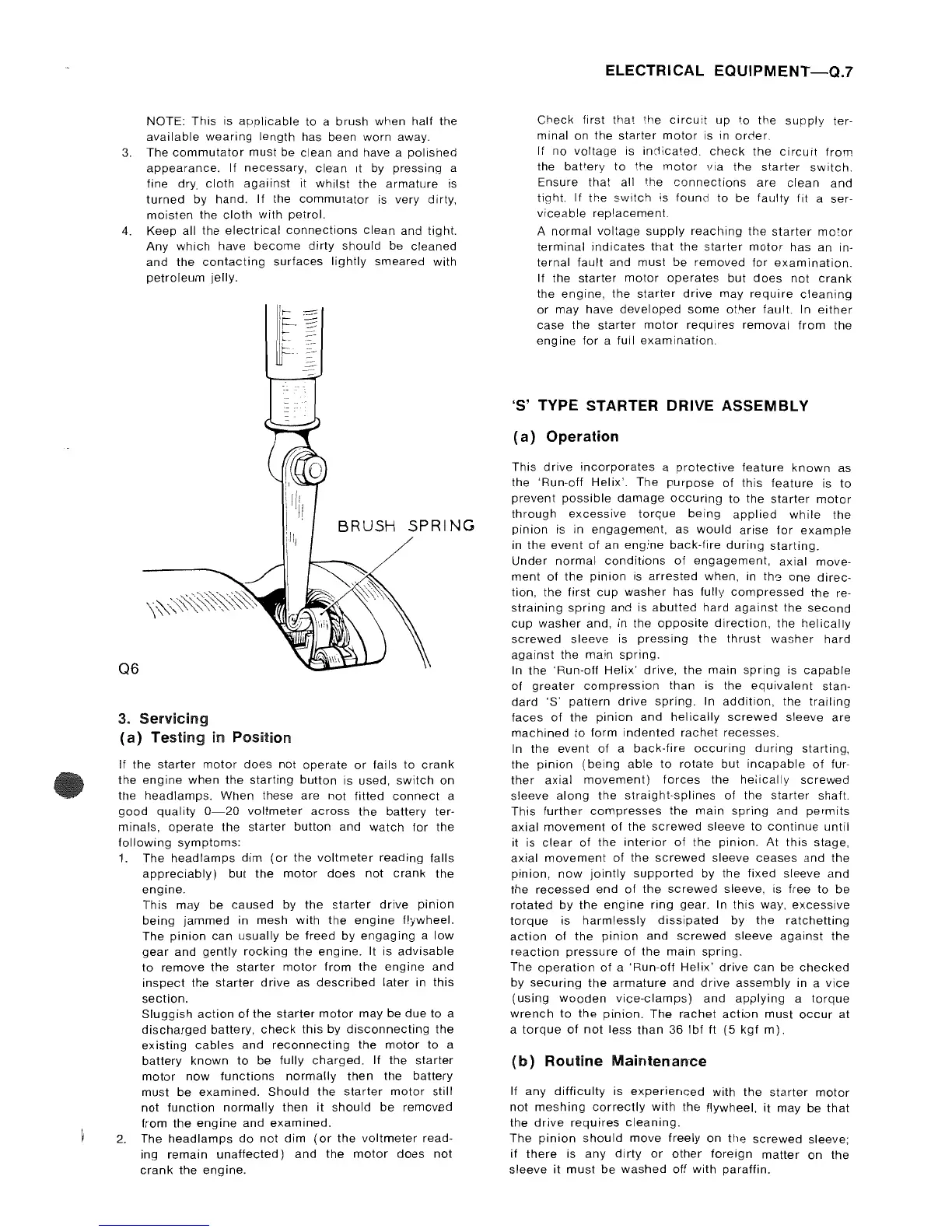
06
Any
which
have
become
dirty
should
be
cleaned
and
the
contacting
surfaces
lightly
smeared
with
petroleum
jelly.
3.
Servicing
(a)
Testing
in
Position
If
the
starter
motor
does
not
operate
or
fails
to
crank
the
engine
when
the
starting
button
is used,
switch
on
the
head
lamps.
When
these
are
not
fitted
connect
a
good
quality
0-20
voltmeter
across
the
battery
ter-
minals,
operate
the
starter
button
and
watch
for
the
following
symptoms:
1.
The
headlamps
dim
(or
the
voltmeter
reading
falls
appreciably)
but
the
motor
does
not
crank
the
engine.
This
may
be
caused
by
the
starter
drive
pinion
being
jammed
in
mesh
with
the
engine
flywheel.
The
pinion
can
usually
be
freed
by
engaging
a
low
gear
and
gently
rocking
the
engine.
It is
advisable
to
remove
the
starter
motor
from
the
engine
and
inspect
the
starter
drive
as
described
later
in
this
section.
Sluggish
action
of
the
starter
motor
may
be
due
to
a
discharged
battery,
check
this
by
disconnecting
the
existing
cables
and
reconnecting
the
motor
to
a
battery
known
to
be
fully
charged.
If
the
starter
motor
now
functions
normally
then
the
battery
must
be
examined.
Should
the
starter
motor
still
not
function
normally
then
it
should
be
removed
from
the
engine
and
examined.
2.
The
head
lamps
do
not
dim
(or
the
voltmeter
read-
ing
remain
unaffected)
and
the
motor
does
not
crank
the
engine.
ELECTRICAL
EQUIPMENT-Q.7
Check
first
that
the
circuit
up
to
the
supply
ter-
minal
on
the
starter
motor
is in
order.
If no
voltage
is
indicated.
check
the
circuit
from
the
battery
to
the
motor
via
the
starter
switch.
Ensure
that
all
the
connections
are
clean
and
tight. If
the
switch
is
found
to
be
faulty
fit
a ser-
viceable
replacement.
A
normal
voltage
supply
reaching
the
starter
motor
terminal
indicates
that
the
starter
motor
has
an
in-
ternal
fault
and
must
be
removed
for
examination.
If
the
starter
motor
operates
but
does
not
crank
the
engine,
the
starier
drive
may
require
cleaning
or
may
have
developed
some
other
fault.
In
either
case
the
starter
motor
requires
removal
from
the
engine
for
a
full
examination.
"S'
TYPE STARTER DRIVE ASSEMBLY
(a)
Operation
This
drive
incorporates
a
protective
feature
known
as
the
'Run-off
Helix'.
The
purpose
of
this
feature
is
to
prevent
possible
damage
occuring
to
the
starter
motor
through
excessive
torque
being
applied
while
the
pinion
is in
engagement,
as
would
arise
for
example
in
the
event
of
an
engine
back-fire
during
starting.
Under
normal
conditions
of
engagement,
axial
move-
ment
of
the
pinion
is
arrested
when,
in th'3
one
direc-
tion,
the
first
cup
washer
has
fully
compressed
the
re-
straining
spring
and
is
abutted
hard
against
the
second
cup
washer
and,
in
the
opposite
direction,
the
helically
screwed
sleeve
is
pressing
the
thrust
washer
hard
against
the
main
spring.
In
the
'Run-off
Helix'
drive,
the
main
spring
is
capable
of
greater
compression
than
is
the
equivalent
stan-
dard
's'
pattern
drive
spring.
In
addition,
the
trailing
faces
of
the
pinion
and
helically
screwed
sleeve
are
machined
to
form
indented
rachet
recesses.
In
the
event
of
a
back-fire
occuring
during
starting,
the
pinion
(being
able
to
rotate
but
incapable
of
fur-
ther
axial
movement)
forces
the
heiically
screwed
sleeve
along
the
straight-splines
of
the
starter
shaft.
This
further
compresses
the
main
spring
and
permits
axial
movement
of
the
screwed
sleeve
to
continue
until
it is
clear
of
the
interior
of
the
pinion.
At
this
stage,
axial
movement
of
the
screwed
sleeve
ceases
and
the
pinion,
now
jointly
supported
by
the
fixed
sleeve
and
the
recessed
end
of
the
screwed
sleeve, is
free
to
be
rotated
by
the
engine
ring
gear.
In
this
way,
excessive
torque
is
harmlessly
dissipated
by
the
ratchetting
action
of
the
pinion
and
screwed
sleeve
against
the
reaction
pressure
of
the
main
spring.
The
operation
of
a
'Run-off
Helix'
drive
can
be
checked
by
securing
the
armature
and
drive
assembly
in a
vice
(using
wooden
vice-clamps)
and
applying
a
torque
wrench
to
the
pinion.
The
rachet
action
must
occur
at
a
torque
of
not
less
than
36
Ibf
ft
(5
kgf
m).
(b)
Routine Maintenance
If
any
difficulty
is
experienced
with
the
starter
motor
not
meshing
correctly
with
the
flywheel,
it
may be
that
the
drive
requires
cleaning.
The
pinion
should
move
freely
on
the
screwed
sleeve;
if
there
is
any
dirty
or
other
foreign
matter
on
the
sleeve
it
must
be
washed
off
with
paraffin.

Table of Contents

Related product manuals