EasyManua.ls Logo

Perkins 4.99 - Page 82

Perkins 4.99
114 pages
Print Icon
To Next Page IconTo Next Page
To Previous Page IconTo Previous Page
Loading...
AIR CLEANERS AND FUEL
SYSTEM-N.S
of
the
circlip,
it
denotes
commencement
of
injection
(static
timing)
see
Fig,
N,16.
To
set
the
timing
circlip,
it is
necessary
to
remove
the
pump
from
the
engine
and
fix
the
position
of
the cir-
clip
by
connecting
No. 1
cylinder
outlet
connection
(marked
W)
to
an
atomiser
tester
and
pump
up
to
30
atm
(31
kgflcm2)
or
440
Ibflin
2
.
Turn
the
pump
by
hand
in
the
normal
direction
of
rotation
until
it
"locks
up".
The
squared
end
of
the
circlip
should
now
be
lined
up
with
the
letter
A
(for
hydraulically
governed
pumps)
or
C
(for
mechanically
governed
pumps)
on
the
pump
rotor.
NOTE:
On
earlier
pumps,
the
timing
circlip
had a
scribed
line
on
one
end
and
on
these
pumps,
the
scribed
line
on
the
fuel
pump
rotor
should
be
aligned
with
the
scribed
line
on
the
circlip.
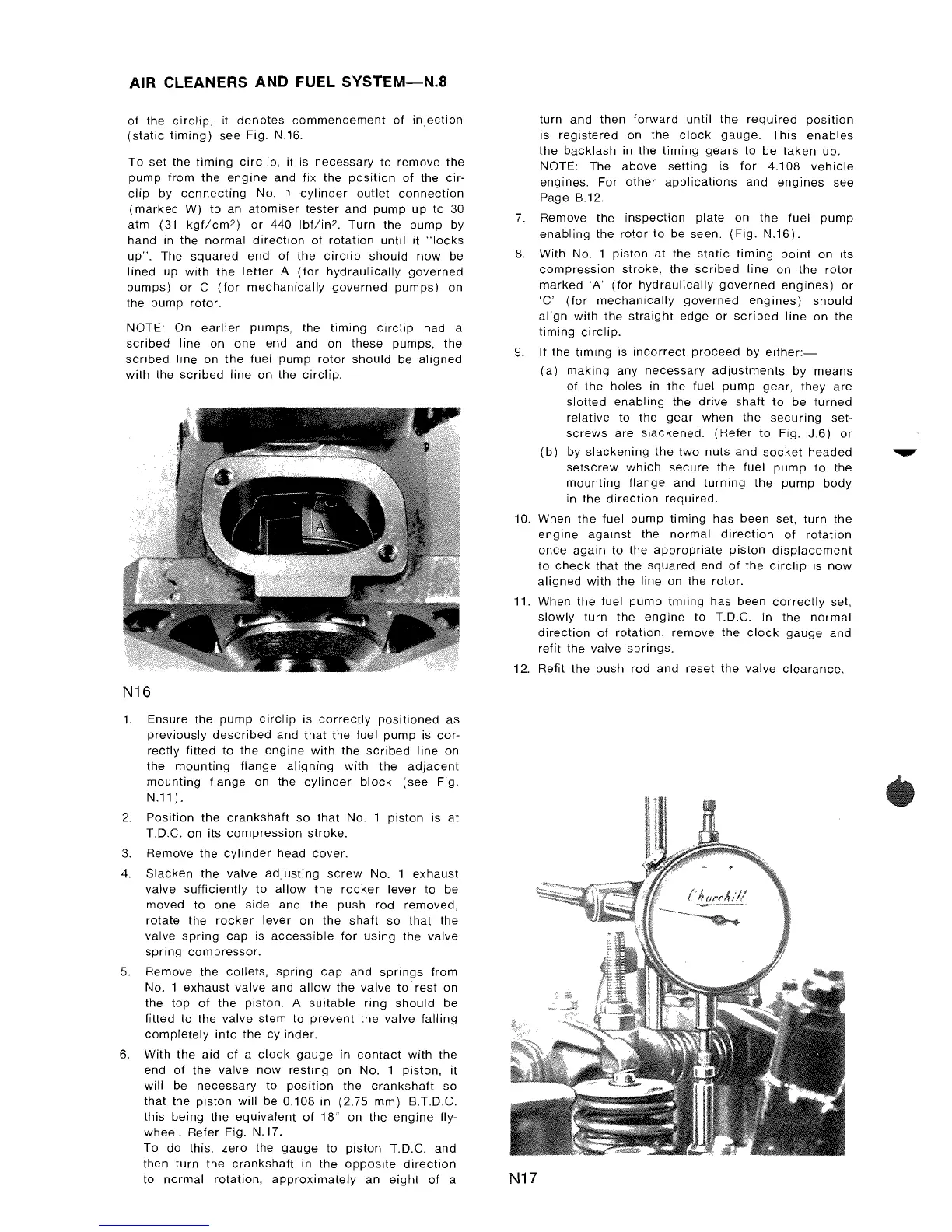
N16
1.
Ensure
the
pump
circlip
is
correctly
positioned
as
previously
described
and
that
the
fuel
pump
is
cor-
rectly
fitted
to
the
engine
with
the
scribed
line
on
the
mounting
flange
aligning
with
the
adjacent
mounting
flange
on
the
cylinder
block
(see
Fig.
N.11)
.
2.
Position
the
crankshaft
so
that
No. 1
piston
is
at
T.O.C. on its
compression
stroke.
3.
Remove
the
cylinder
head
cover.
4.
Slacken
the
valve
adjusting
screw
No. 1
exhaust
valve
sufficiently
to
allow
the
rocker
lever
to
be
moved
to
one
side
and
the
push
rod
removed,
rotate
the
rocker
lever
on
the
shaft
so
that
the
valve
spring
cap
is
accessible
for
using
the
valve
spring
compressor.
5.
Remove
the
collets,
spring
cap
and
springs
from
No.1
exhaust
valve
and
allow
the
valve
to'rest
on
the top
of
the
piston.
A
suitable
ring
should
be
fitted
to
the
valve
stem
to
prevent
the
valve
falling
completely
into
the
cylinder.
6,
With
the
aid
of
a
clock
gauge
in
contact
with
the
end
of
the
valve
now
resting
on
No.
1
piston,
it
will
be
necessary
to
position
the
crankshaft
so
that
the
piston
will
be
0.108 in
(2,75
mm)
B.T.D.C.
this
being
the
equivalent
of
18 C
on
the
engine
fly-
wheel.
Refer
Fig. N.17.
To
do
this,
zero
the
gauge
to
piston
T.O.C.
and
then
turn
the
crankshaft
in
the
opposite
direction
turn
and
then
forward
until
the
required
position
is
registered
on
the
clock
gauge.
This
enables
the
backlash
in
the
timing
gears
to
be
taken
up.
NOTE:
The
above
setting
is
for
4.108
vehicle
engines.
For
other
applications
and
engines
see
Page
B.12.
7.
Remove
the
inspection
plate
on
the
fuel
pump
enabling
the
rotor
to
be seen.
(Fig.
N.16).
8.
With
No. 1
piston
at
the
static
timing
point
on
its
compression
stroke,
the
scribed
line
on
the
rotor
marked
'A'
(for
hydraulically
governed
engines)
or
'c'
(for
mechanically
governed
engines)
should
align
with
the
straight
edge
or
scribed
line
on
the
timing
circlip.
9.
If
the
timing
is
incorrect
proceed
by
either:-
(a)
making
any
necessary
adjustments
by
means
of
the
holes
in
the
fuel
pump
gear,
they
are
slotted
enabling
the
drive
shaft
to
be
turned
relative
to
the
gear
when
the
securing
set-
screws
are
slackened.
(Refer
to
Fig.
J.6)
or
(b)
by
slackening
the
two
nuts
and
socket
headed
setscrew
which
secure
the
fuel
pump
to
the
mounting
flange
and
turning
the
pump
body
in
the
direction
required.
10.
When
the
fuel
pump
timing
has
been
set,
turn
the
engine
against
the
normal
direction
of
rotation
once
again
to
the
appropriate
piston
displacement
to
check
that
the
squared
end
of
the
circlip
is
now
aligned
with
the
line
on
the
rotor.
11.
When
the
fuel
pump
tmiing
has
been
correctly
set,
slowly
turn
the
engine
to
T.O.C. in
the
normal
direction
of
rotation,
remove
the
clock
gauge
and
refit
the
valve
springs.
12.
Refit
the
push
rod
and
reset
the
valve
clearance.
to
normal
rotation,
approximately
an
eight
of
a
Ni7

Table of Contents

Related product manuals