TECHNICAL INFORMATION
1
st
.................................................................. 8.53
2
nd
................................................................. 4.87
3
rd
................................................................. 3.00
4
th
................................................................. 1.90
5
th
................................................................. 1.33
6
th
................................................................. 1.00
Reverse ........................................................ 8.53
Drive axle ratio ............................................. 3.21
Drive axle ratio (optional) ............................. 3.07
BRAKES
The features of the braking system include a
dual system where the front and rear circuits are
completely independent from each other. The
brakes are air operated disc type brakes with
automatic slack adjusters on front, drive and tag
axles The emergency/parking brakes are located
on the drive and tag axles only.
BRAKE CHAMBER EFFECTIVE AREA
Front axle (Rigid front axle) ....................... 22 in
2
Drive axle .......... 24/24 in
2
(service / emergency)
Tag axle............. 16/16 in
2
(service / emergency)
AIR SYSTEM
Compressed air is provided by a 16.5 cfm
Bendix-Westinghouse “Tu-Flo”, two cylinder,
gear-driven, water-cooled and engine oil
lubricated air compressor.
Other features and components of the air
system include an air dryer and nylon color-
coded air lines.
ANTILOCK BRAKING SYSTEM (ABS)
The antilock braking system has one Electronic
Control Unit (ECU) controlling a four channel
system. A wheel slip sensor is mounted at each
front axle and drive axle wheel. The Tag axle
wheels are slave to the drive axle wheels.
The Electronic Control Module (ECM) is
maintenance free. Its operating voltage is 24 ± 6
volts DC. The thermal operating range for the
ECM is from -40 to 167°F (-40 to 75°C).
The solenoid control valves are maintenance
free. Their operating voltage is 24 (+4.8, -2.4)
volts DC. The rated current draw is 1.65 amps.
The thermal operating range of the solenoid
control valves is from -40 to 176°F (-40 to 80°C).
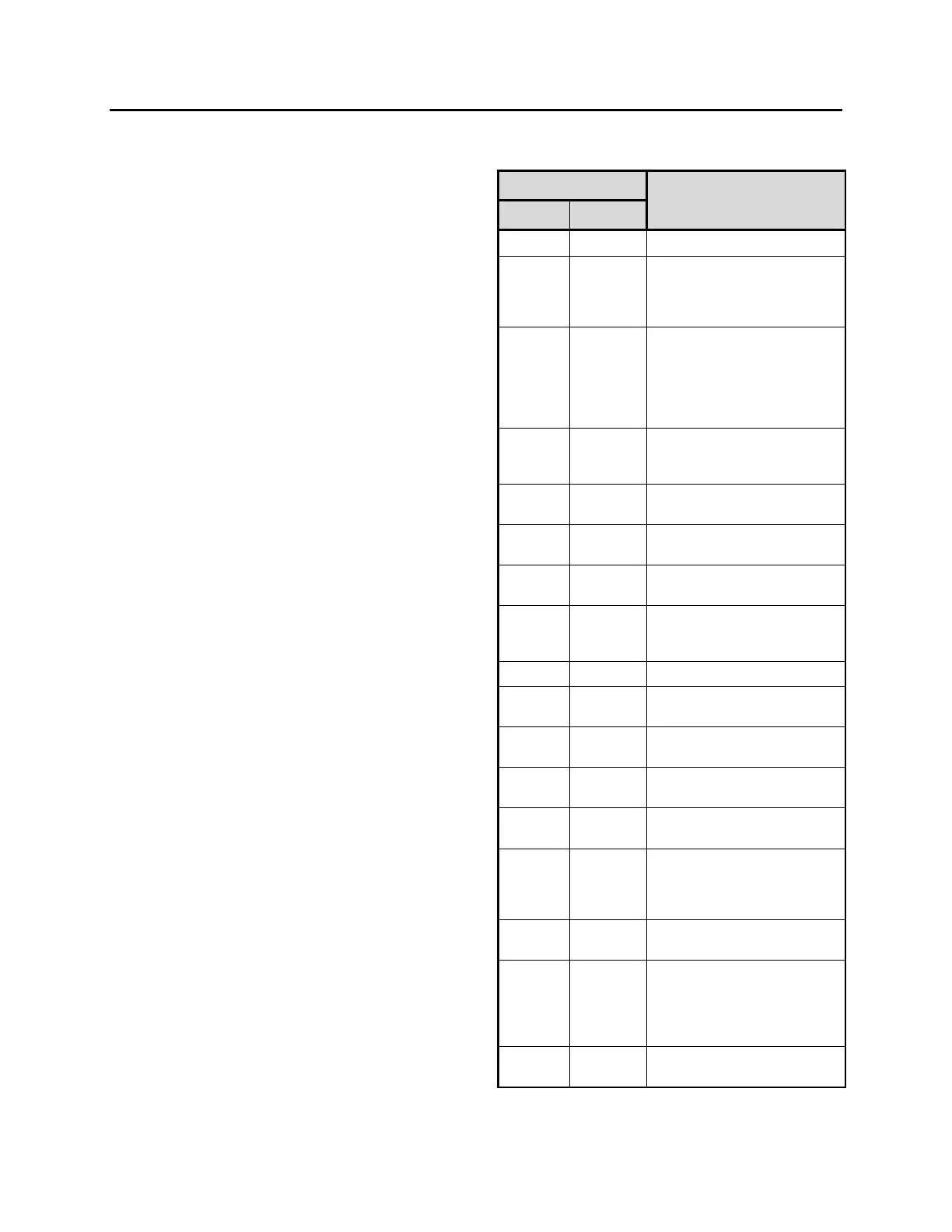
BLINK CODE TROUBLESHOOTING AND
REPAIR
Blink Code
Action required
1
st
Digit 2
nd
Digit
1 1 System Okay
2 1-6*
Check ABS Modulator valve,
valve cable, and connectors.
Verify 4.0-8.0 ohms resistance
(ABS modulator valve).
3 1-6*
Adjust wheel sensor to touch
wheel. Check sensor gap.
Check for loose wheel bearings
or excessive hub runout. Verify
minimum 0.2 volts AC output @
30 RPM.
4 1-6*
Check sensor, sensor cable,
and connectors. Verify 500-
2000 ohms resistance.
5 1-6*
Check for tire size mismatch or
tooth wheel difference.
6 1-6* Check for damaged tooth
wheel.
7 1
Check for proper data link
connection (J1922 and J1939)
7 2
Check ATC Valve, valve
cables, and connectors. Verify
6.4-12.0 ohms resistance.
7 3 Check brake relay connections.
7 4 Check ABS warning light
connections.
7 5
Verify proper ATC set-up.
Reconfigure if required.
7 6
Verify accuracy of blink code
and clear from ECU memory.
8 1
Check vehicle voltage and
supply to ECU (9.5-14 volts).
8 2
Check vehicle voltage (9.5-14
volts). Verify accuracy of blink
code and clear from ECU
memory.
8 3
Verify accuracy of blink code
and clear from ECU memory.
8 4
Verify accuracy of blink code
and clear from ECU memory. If
code does not clear, it may be
necessary to reconfigure or
replace the ECU.
8 5 Check ABS ground
connections.
*1-6 Key
118



 To Next Page