Berthing
Preparations for berthing
• Crew briefed and aware of safety.
• What side to? (port or starboard).
• Have all ropes ready.
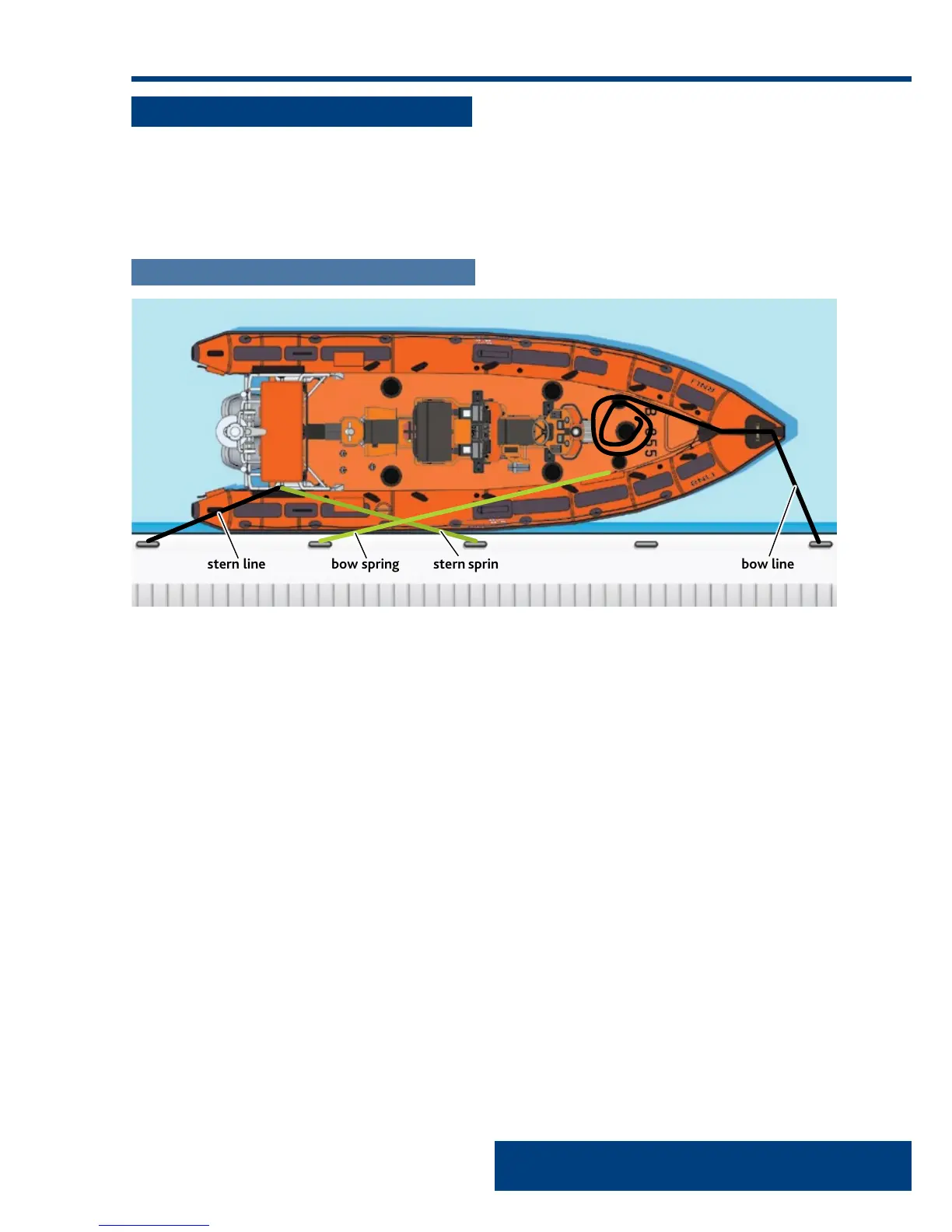
Stern/bow lines
• To stop the stern/bow coming away from the quay.
• Length of line should allow for the rise and fall of
the tide.
Springs
• To stop the forward and aft motion of the vessel.
Berthing and mooring
If a SAR unit is kept afloat when not being used, it will
either be moored up to a mooring buoy or berthed
alongside a pontoon, jetty or wall. To ensure the safety of
the SAR unit, all crew need to know what to do to ensure it
is correctly secured and protected, and the helm will give
a full brief before approaching the berth.
Depending on the weather and tide, the helm may request
for certain ropes to be made fast first as this will enable
the vessel to lie in a safe position while the remainder of
the lines are made fast.
Generally it is possible to berth to two things:
• a wall or quay, which is tidal
• a pontoon, which rises and falls with the tide.
Considerations when berthing
• Rise and fall of tides.
• Direction and strength of wind and tide.
• Depth of water (study charts/depth sounder).
• Proximity of other vessels.
• Suitability of berth/mooring to your vessel.
• Hazards.
• Keep inboard of sponsons on approach, caution of
entrapment between vessel and quay/pontoon.
• Do not disembark until helm gives command.
stern line bow spring stern spring bow line
A-Frame
cleats for
mooring
and berthing
only NOT
towing



 To Next Page