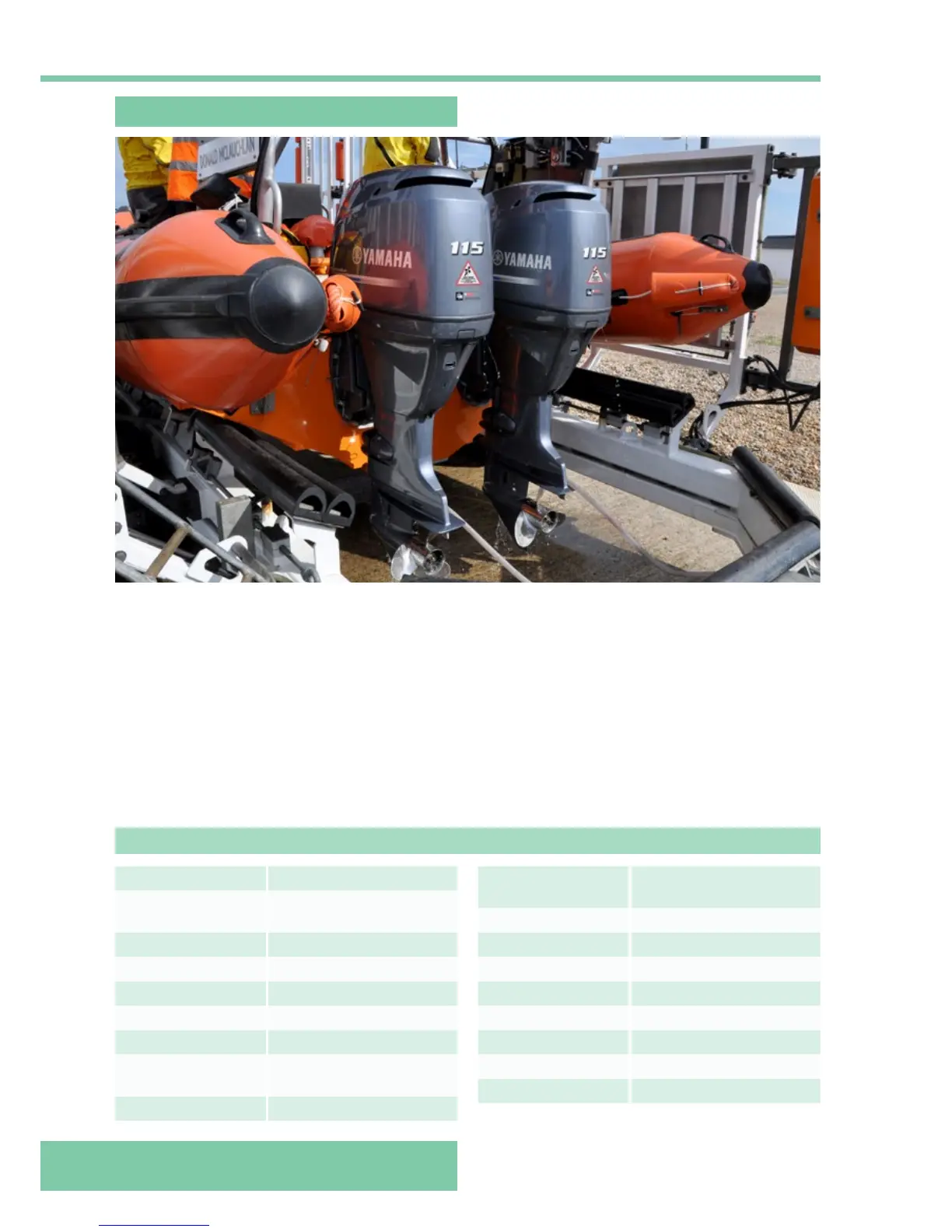
Yamaha F115 outboard engines
Since the Atlantic 85 started its service in 2005, it
has used Yamaha F115 outboard engines to power it.
There are currently two versions of this engine in use
around the coast, the F115 (RNLI code: OE 26) and F115A
(RNLI code: OE 33). A third version, the F115B (RNLI code:
OE 37) is coming into service in mid 2017. An update to
this manual for the OE 37 will be available soon. Before
you start any work or maintenance on your outboard,
please make sure you know which version you have fitted.
The Atlantic 85 is fitted with two Yamaha outboard engines.
Each is a 1.7 litre, four-stroke, in-line four cylinder, DOHC
Engine specification (F115A/OE 33)
Engine type Yamaha 115
Arrangement of
cylinders
4, in-line
Power output 86kW (115 hp)
Capacity 1.741 Litre
Cylinder bore 79.0 mm
Stroke 88.8 mm
Compression ratio 9.5kgf/cm
2
Full throttle operating
range
5000-6000 rpm
Idling speed (in neutral) 750 ± 50 rpm
Weight
(without propeller)
183.0kg
Starting system Electric
Recommended Fuel Regular unleaded
Recommended oil 4-stroke outboard motor oil
Oil grade API SE, SF, SG, SH, SJ, SL
Oil type SAE 10W30 or 10W40
Lubrication Wet sump
Oil quantity (Exc. filter) 4.3 litres
Recommended gear oil Hypoid gear oil SAE #90
and fuel injected. It is capable of producing 86kW (115hp)
at 5500 rpm giving the Atlantic 85 a maximum speed of 35
knots. The engines have been inversion proofed allowing
them to remain operational after a capsize. They also have
a modification to the cooling system which allows a hose
to be attached just above the anti-cavitation plate, this is
primarily so water can be supplied to the engine whilst the
boat is on the carriage, however it can also be used to flush
the engines with fresh water once the boat is recovered.
The trim and tilt mechanism is modified by way of a
butterfly nut which when loosened, allows the engines to
be raised and lowered manually if the hydraulics fail.



 To Next Page