Locate and assist casualty
As a crew member your primary role is to save lives at
sea. All our training and equipment experience is brought
together to achieve this. If we are unable to locate our
casualty in the first instance, we will obviously be unable
to rescue, assist and ultimately save lives.
Lifeboat crew need to be able to assist in the location of
a casualty and then provide suitable assistance. The term
casualty may refer to a person, vessel, vehicle or even
an aircraft depending on the specific circumstances of
the service.
Search methods and equipment
The most important tools you will use during the search
for a casualty, is your eyes and ears. As crew you will
always be keeping a proper lookout by sight and hearing,
and in a search situation this does not change.
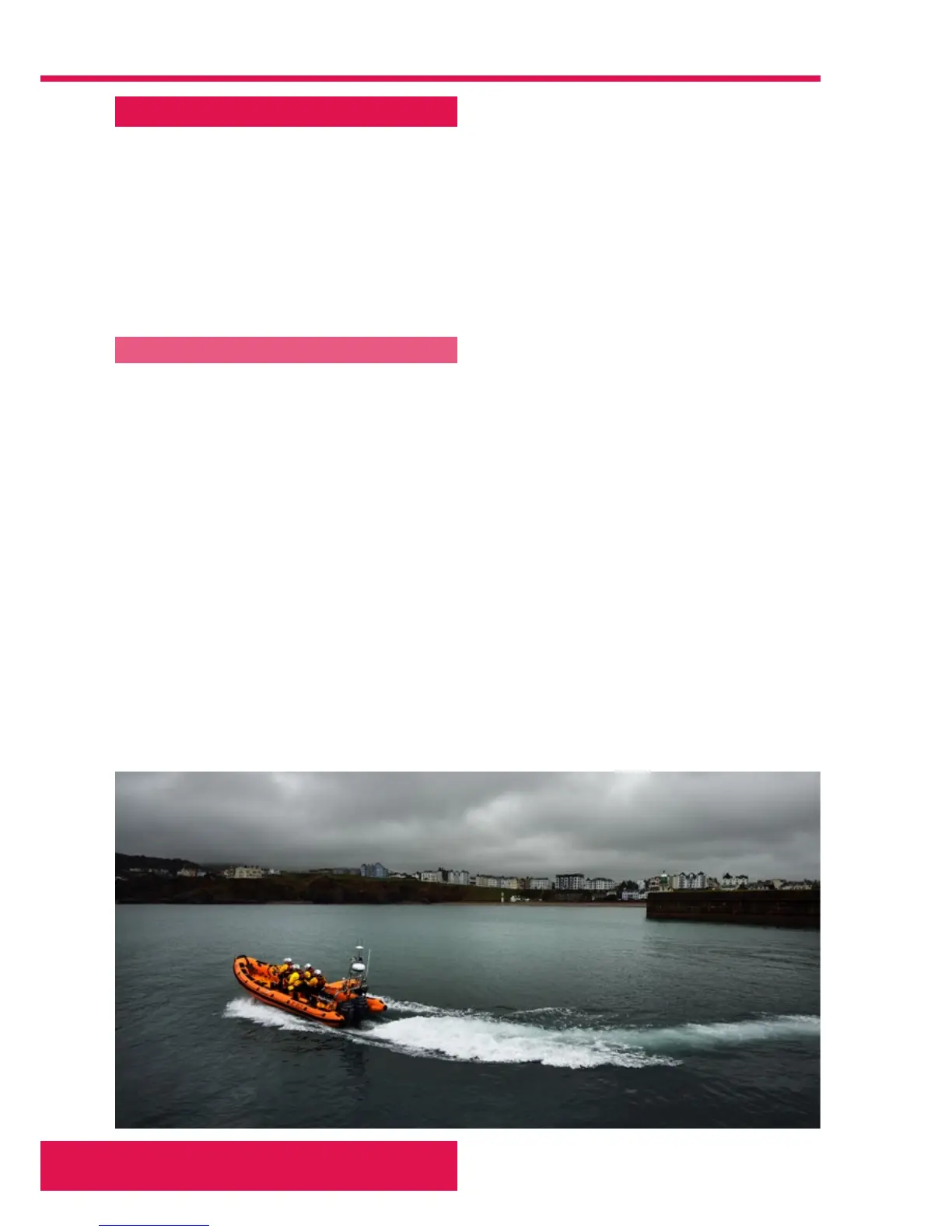
The Atlantic 85 carries various types of search equipment
and aids to a casualty location.
Radar
Primarily used as an aid to navigation, Radar can also be
used in a SAR environment to locate and identify casualties,
assist with multi-search vessel management and also
provide an assessment of visibility. The effectiveness of
radar can be reduced by sea and weather conditions –
particularly when targeting smaller vessels – and these
limitations should be taken into account.
VHF direction finder (DF)
The casualty may have access to a VHF radio and should
use it as a primary means of communicating a distress
and passing its location to would-be rescuers. When a
SAR unit is equipped with a VHF DF, the bearing of the
casualties transmission can be obtained and will therefore
greatly assist in its location. For maximum effect, the
casualty should make extended transmissions, normally
in the form of a countdown from 10. This will enable the
SAR unit to obtain a bearing to the casualties current
position. This is displayed on the DF unit as well as on the
chartplot chart and radar screen when selected. It should
be noted that this bearing does not necessarily provide a
safe course to steer, therefore due regard should be paid
to safe navigation.
Illuminating flares (pyrotechnics)
A SAR unit will carry illuminating flares to assist in the
location of a casualty at night. Generally an illuminating
flare will have a burn time of around 30 seconds. It is
worthwhile notifying the co-ordinating authority of
the intention to use pyrotechnics, as they may wish
to reposition other SAR assets to make best use of the
illumination provided i.e. by moving shore units to high
ground/cliff tops. It should be noted that flares should
not be used in a search situation if there is a helicopter
operating within the area, and due regard should be paid
to the impact on crews night vision when using flares.
Binoculars/image intensifiers
Some 85s’ carry binoculars and image intensifiers -aka
‘nightsights’ or night vision devices (NVDs). These should
be adjusted to suit each operator. Generally, these items
only have a narrow field of vision, and therefore should
only be used to focus in on and identify an object which
has been spotted unaided. The image intensifiers should
be used in conjunction with searchlights or illuminating
flares, as they are designed to intensify whatever ambient
light is available. It should be noted that image intensifiers
are potentially hazardous to the operator if it is directed at
bright lights.



 To Next Page