10
4. Wiring connection
Warning
Turn the power supply to the instrument off before wiring or checking.
Working or touching the terminal with the power switched on may result
in severe injury or death due to Electric Shock.
Moreover, the instrument must be grounded before the power supply to the
instrument is turned on.
Caution
• Do not drop wire chips into the instrument, because they could cause fire,
malfunction or inconvenience.
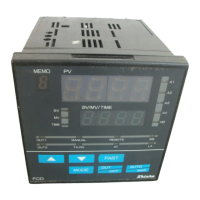
• For the ground terminal of the PCD-33A, use 2mm
2
or greater of thick wire.
However, avoid grounding in conjunction with the power line.
• Use the solderless terminal with an isolation sleeve that fits to the M3 screw
when wiring the PCD-33A terminals.
• The terminal block of the PCD-33A is designed to be wired from the left side.
The lead wire must be inserted from the left side of the terminal, and fastened
with the terminal screw.
• Tighten the terminal screw to the specified torque.
If the screw is tightened too hard, the screw or case may be damaged.
• Use a thermocouple, compensating lead wire and 3-wire system RTD
according to the input specification of this controller.
• In the case of 24V DC for power source, do not confuse the polarity.
• With the relay contact output type, externally use an auxiliary electromagnetic
switch according to the capacity of the load to protect the built-in relay contact.
• When wiring, keep input wire (thermocouple, RTD, etc.) away from AC source
and load wire to avoid external interference.
• This controller has neither a built-in power switch nor a fuse. Therefore, it is
necessary to install them in the circuit near the external controller.
(Recommended fuse: Time-lag fuse, rated voltage 250Vac, rated current 2A)
• Do not apply a commercial power source to the sensor connected to the input
terminal nor allow the power source to come into contact with the sensor, as the
input circuit may be burnt out.



 To Next Page