Page 37 of 92
Chapter: 4. Installation
Location
• The transducer must be install in foreship.
• Optimal system operation is achieved by tting the transducer as deep as possible on the hull.
• The transmitting surface of the transducer must be installed horizontal.
• Do not mount transducers aft of the bow thruster propeller outlets, or aft of other hull installations
(outlets, vents or other protruding details).
• It is necessary to select a part of the hull that is submerged under all load and speed conditions, and
to avoid positions where air is trapped in heavy weather.
• If a at, horizontal section is not available for transducer tting, the shipyard must construct a
suitable bed.
Protect the active element of the transducer and do not paint the surface.
Minimum bending radius of sensor cable is 222mm. During installation, consideration must be taken,
such that the sensor and cable can be removed for service purposes. Filling pipes or tubes is not
recommended unless strictly necessary.
Note: See chapter “10. Appendix 1” on page 36 for more information about connecting transducer to
transceiver cabinet.
Important note: During installation, DO NOT CUT THE TRANSDUCER CABLE. The
transducer, transducer cable and transceiver cabinet are all “balanced parts”. Therefore cutting the cable
may deteriorate performance and will also void the warranty.
Operator Unit Installation
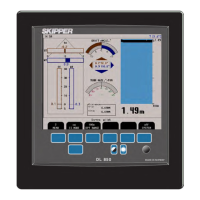
Select a position to provide free view of the panel as well as easy access during operation and service.
The operator unit may be mounted ush in a panel, on a wall or directly onto a bulkhead. For more
information, see “Dimensional Drawing Cabinet” on page 78, that shows the operator unit along with
the main installation drawings. If the unit is to be ush mounted, the shown cut-out and recession depth
dimensions must be observed. Remember to leave room in front of the unit to open the door a full 90°.
Do not perform installation work with system power applied!
Cables are led through the appropriate cable glands as follows:
• The cable from the transceiver unit should normally occupy the left gland.
• The right gland is used for power supply connection.
• The centre ones are used for any interface signals connected.
115/230 V selection on Combo Terminal board inside Display Unit
Power supply may be either 115/230 V AC or 24 V DC. Power consumption is app. 50 W at 24 V DC
and app. 70 W at 115/230 V AC. If the AC power system is 115 V, the system must be prepared for 115
V by re-connecting the connectors J102, J103. Fuses are shown in g. 4.1 for 115/230 V AC and 24 V
DC. These fuses are normal 5 x 20 mm slow blow glass fuses.
When the installation is complete, and power is connected to the operator unit, the appropriate power
switch next to the power terminals is switched on.



 To Next Page