Page 52 of 92
Chapter: 5. Calibration procedure
more aected by this factor than sensors that measure remotely (Doppler). The calibration variation
is usually less on remote sensors.
As the calibration factors can vary at dierent vessel speeds, it is possible to calibrate several speeds.
It is typically necessary with only one high and one low speed. Speed logs with speed over ground can
be compared with GPS speed over ground in stable conditions. However speed through water measures
the inuence of currents on the vessel, which cannot normally be measured on any other system. It is
therefore important that full calibration is performed at least once for speed through water.
Calibration routine:
As previously explained, there are two factors to be calibrated, heading error and speed. Speed over
ground can be calibrated in two ways. Speed through water can be approximated, but should be
calibrated by sailing on opposite courses to get an accurate value.
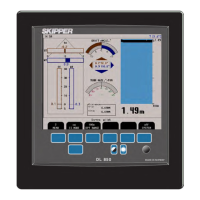
All calibration functions are located on the Calibration screen. In order to select this screen, press
“SCREEN SELECT” button in the lower row of the panel buttons and while keeping it pressed, turn
encoder until desired screen appears on the display.
Enabling of calibration
To avoid accidental access to the internal settings, all calibration functions are disabled during normal
operation. In order to enable them, do the following:
• Open front door of the cabinet and nd a “hidden” key on the component side of the keyboard PCB
(upper/left corner of the PCB).
• Press key mentioned above and keep it pressed for 2-3 seconds, until “Calibration enabled” message
is observed in the right/upper corner of the screen. The text on the soft keys will change colour from
grey to white, which indicates availability of the corresponding functions.
After calibration is nished, disable access to the calibration functions simply by pressing the key again.
Calibration mode is also disabled after a power recycling.
Every vessel will drag some water when it moves. This occurs over the
whole hull. As you move further from the hull, the eect of the ships
movement gets less. As the vessel moves at dierent speeds, the
hydrodynamics of the vessel may change. In most cases the drag is even
over the whole range of the vessel.
Speed logs that measure on the surface of the vessel (such as EML) are



 To Next Page