Page 9 of 92
Chapter: Terminology
Interfacing
The display unit has various interface possibilities.
Outputs
• 3 log pulse outputs 10/100/200/400/1000 pulses per nautical mile, see “Log Pulse Outputs” on
page 46.
• 2 outputs also gives speed direction, see “Log Pulse Outputs” on page 46.
• 3 analogue outputs 0 - 10 V or 4 - 20 mA, see “Analogue interfaces” on page 47.
• IEC 61162-1:2007(E) (NMEA 0183) interface output of speed/distance, temperature and depth
information, see “Softkey” on page 89.
• Power failure alert, see “Power failure relay” on page 45.
• Speed limit, see “Speed Limit function” on page 46.
• External VGA monitor, see “External Interface Ports” on page <?>.
Inputs
• IEC 61162-1:2007(E) (NMEA 0183) interface input for position, rate of turn, heading and UTC
(Coordinated Universal Time), see “Softkey” on page 89
Alarts
A power failure alert is provided on a potential free relay contact. This may be used for interface to
external alert systems.
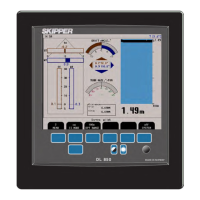
The operator unit contains a graphic LCD display and a keyboard
with xed keys, softkeys and a rotating encoder.
The function of each softkey button depends on the active screen,
and the buttons are labelled on the lower rim of the LCD.
The display is back lit, and back light intensity may be adjusted
by the user. Various user-selectable information layouts adapted
to typical operational situations, may be displayed continuously
on the LCD. The operator unit can be ush mounted, wall
mounted or bracket mounted.
Operator unit power supply options are 115/230 V AC or 24 V
DC. The power consumption is app. 70 Watt at 115/230 V AC or
50 Watt at 24 V DC.
Operator Unit



 To Next Page