DENSITY
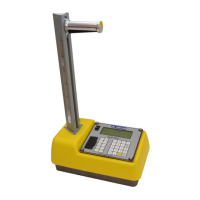
The Troxler Model 3450 RoadReader Plus uses two modes of
operation: direct transmission mode (with the source rod extended
into the material to be measured) and backscatter mode (with the
source rod in the backscatter position). Source rod positions are
described in Chapter 3.
In the direct transmission position, the source rod extends through
the base of the gauge into a pre-drilled hole to a desired depth.
Photons from the cesium-137 (Cs-137) source in the source rod pass
through the test material. While passing through the test material,
the photons collide with electrons and lose energy. A high material
density increases the probability of these photon collisions. This
decreases the number of photons that reach the Geiger-Mueller
(G-M) detectors in the base of the gauge. Thus, the number of
photons reaching the detectors is inversely related to the density of
the material: the higher the density of the material, the fewer the
photons that reach the detectors. Using the gauge calibration, the
gauge software converts the G-M detector counts to a density value.
In the backscatter position, the source rod is lowered to the first
notch below the SAFE (shielded) position. This places the source
and the detectors in the same plane. Shielding between the source
and detectors greatly reduces the number of photons reaching the
detectors in a direct path from the source. Thus, the photons from
the Cs-137 source must travel into the test material and scatter (or
reflect) at least once to reach the G-M detectors. The detectors in the
gauge base count these scattered photons. For thin layer readings,
the gauge uses two sets of G-M detectors. Refer to the Thin Layer
section on page 2–5.




 To Next Page