59
OPERATING THE TRUCK
BRAKING BY PLUGGING (CONTROLLED REVERSING)
Braking by plugging is a method of braking in which the Multi-functional
Handle is switched to the opposite direction in which the forklift is
traveling. Refer to page 52.
WARNING
!
!
• Do not make sudden stops as the forklift will pitch forward
and this may cause the load to shift.
If the brake pedal is released while traveling at a high speed, the
forklift truck will stop suddenly and the load may shift or fall off or truck
skidding may occur.
When leaving the forklift, adjust the fork to a level position, lower
he mast to the ground and turn off the ignition switch. The brake is
automatically applied when the truck comes to a stop or the ignition is
turned off.
When leaving the operator’s position, be sure the Multi-functional handle
is in the Neutral position and turn the ignition switch OFF. As required by
OSHA in United States, if the operator is more than 7.6 m (25 ft.) from
unit or out of sight of the forklift, the key must be removed.
TRANSPORTING LOADS
• When transporting loads, the forklift should be driven carefully
at slow speed with the load kept low and tilted back. When the
load is so large that it blocks forward visibility, drive the forklift
backward. Follow the safety rules.
• Always ensure that load is within the truck’s permitted lifting
capacity. Refer to trucks dataplate.
FORKS
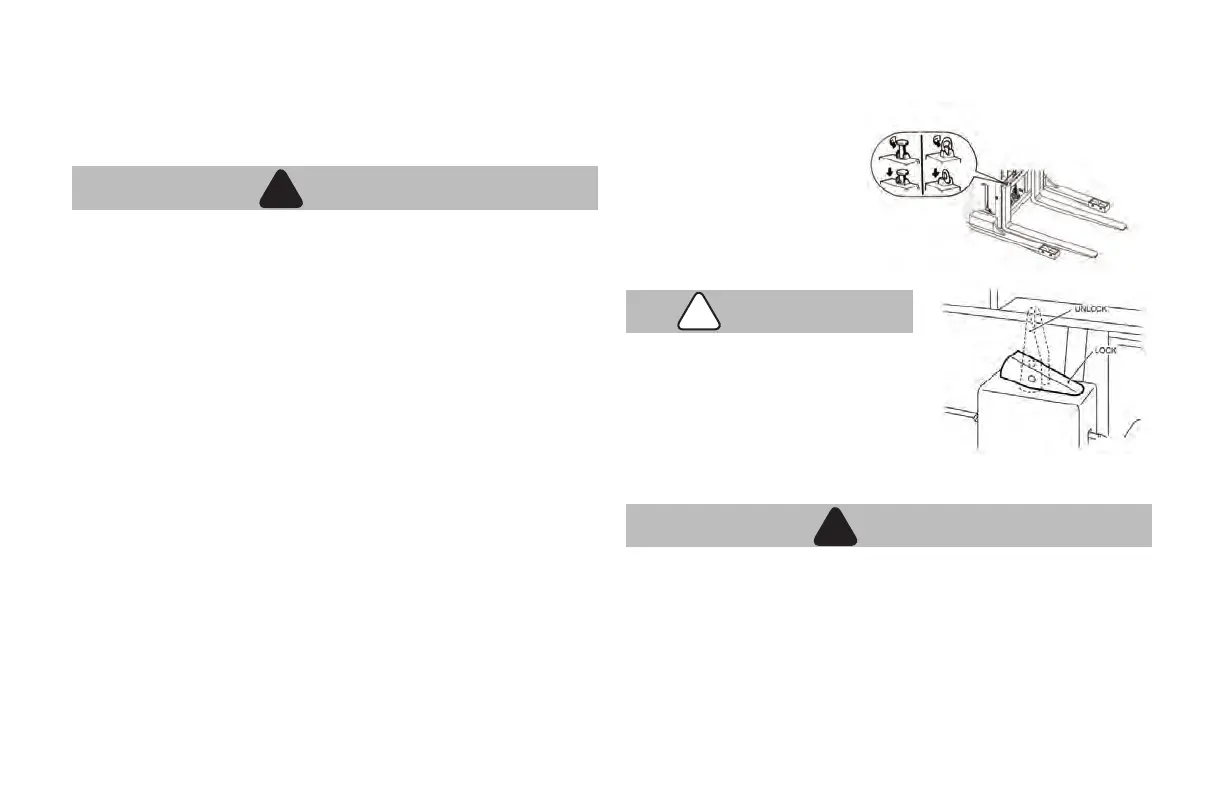
The fork-to-fork distance can be
properly adjusted by unlocking
the lock pins on the forks. These
pins are unlocked by turning
them 90°. Forks must be equally
located from the center of the
forklift. After correct fork-to-fork
distance is obtained, secure the
forks with the lock levers.
CAUTION
!
• Various kinds of forks are
available depending on the lifting
capacity. Select proper forks so
that the specications stamped
on the upper face of them will
meet the lifting capacity of your
forklift. Do not use forks below
the lifting capacity of your forklift.
WARNING
!
!
(in United States)
• Forks should be inspected daily for any damage, bending or
other abnormal conditions. Report any conditions to your
supervisor.
• ANSI/ITSDF & OSHA require that forks be replaced if worn
more than 10% of the starting thickness, this should be
checked during normal P.M. or at minimum, yearly by your
Local Authorized Dealer.



 To Next Page