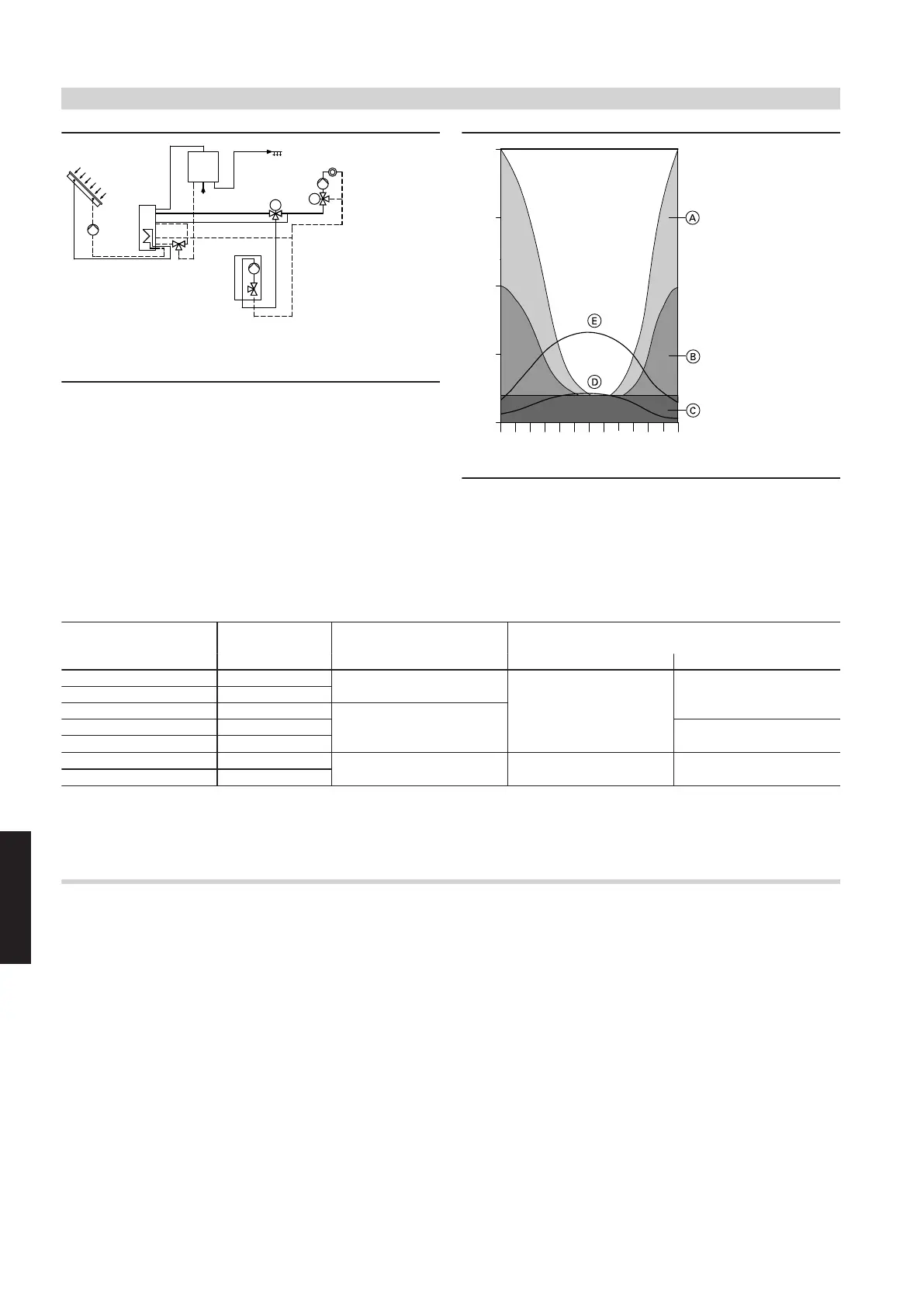
System with Vitocell-E heating water buffer cylinder and
Vitotrans 353
For sizing a system for DHW heating and central heating backup,
the seasonal efficiency of the entire heating system must be taken
into consideration. The summer heat demand is always decisive.
This is a combination of the heat demand for DHW heating and other
project-specific consumers. The collector area must be sized for this
demand. The calculated collector area is multiplied by a factor of 2 to
2.5. The result is the range within which the collector area should be
for solar central heating backup. The precise determination is then
made taking into consideration the building conditions and the
design of an operationally reliable collector array.
Jan.
Feb.
Mar.
Apr.
Aug.
May
Jun.
Jul.
Sep.
Oct.
Nov.
Dec.
Energy demand in %
100
75
50
25
0
A
Central heating demand for a house (built in approx. 1984 or
later)
B
Central heating demand for a low energy house
C
DHW demand
D
Solar yield at 5 m
2
absorber area
E
Solar yield at 15 m
2
absorber area
Occupants Daily DHW de-
mand in l (60 °C)
Buffer cylinder capacity in l Collector
No. of Vitosol-FM/-F Vitosol-TM area
2 60
750
4 x SV
4 x SH
2 x 3.03 m
2
3 90
4 120
750/950
5 150
2 x 3.03 m
2
1 x 1.51 m
2
6 180
7 210
950
6 x SV
6 x SH
3 x 3.03 m
2
8 240
For low energy houses (heat demand less than 50 kWh/(m
2
·p.a.)),
solar coverage of up to 35 %, relative to the total energy demand,
incl. DHW heating, can be achieved according to this sizing. For
buildings with a higher heat demand, the coverage is lower.
The Viessmann "SolCalc Thermie" calculation program can be used
for the exact calculation.
Swimming pool heating system – heat exchanger and collector
Outdoor pools
In central Europe, outdoor pools are used between May and Sep-
tember. Your energy consumption depends primarily on the leakage
rate, evaporation, loss (water must be replenished cold) and trans-
mission heat loss. By using a cover, the evaporation and conse-
quently the energy demand of the pool can be reduced to a mini-
mum. The largest energy input comes directly from the sun, which
shines onto the pool surface. Therefore the pool has a "natural" base
temperature that can be shown in the following diagram as an aver-
age pool temperature over the operating time.
A solar thermal system does not alter this typical temperature pat-
tern. The solar application leads to a definite increase in the base
temperature. Subject to the ratio between the pool surface and the
absorber area, a different temperature increase can be reached.
Information regarding design and operation
(cont.)
120
VIESMANN
VITOSOL
13
5822 440 GB




 To Next Page