xiC - Technical Manual Version 1.16
4.3.2.1. Triggered acquisition - single frame
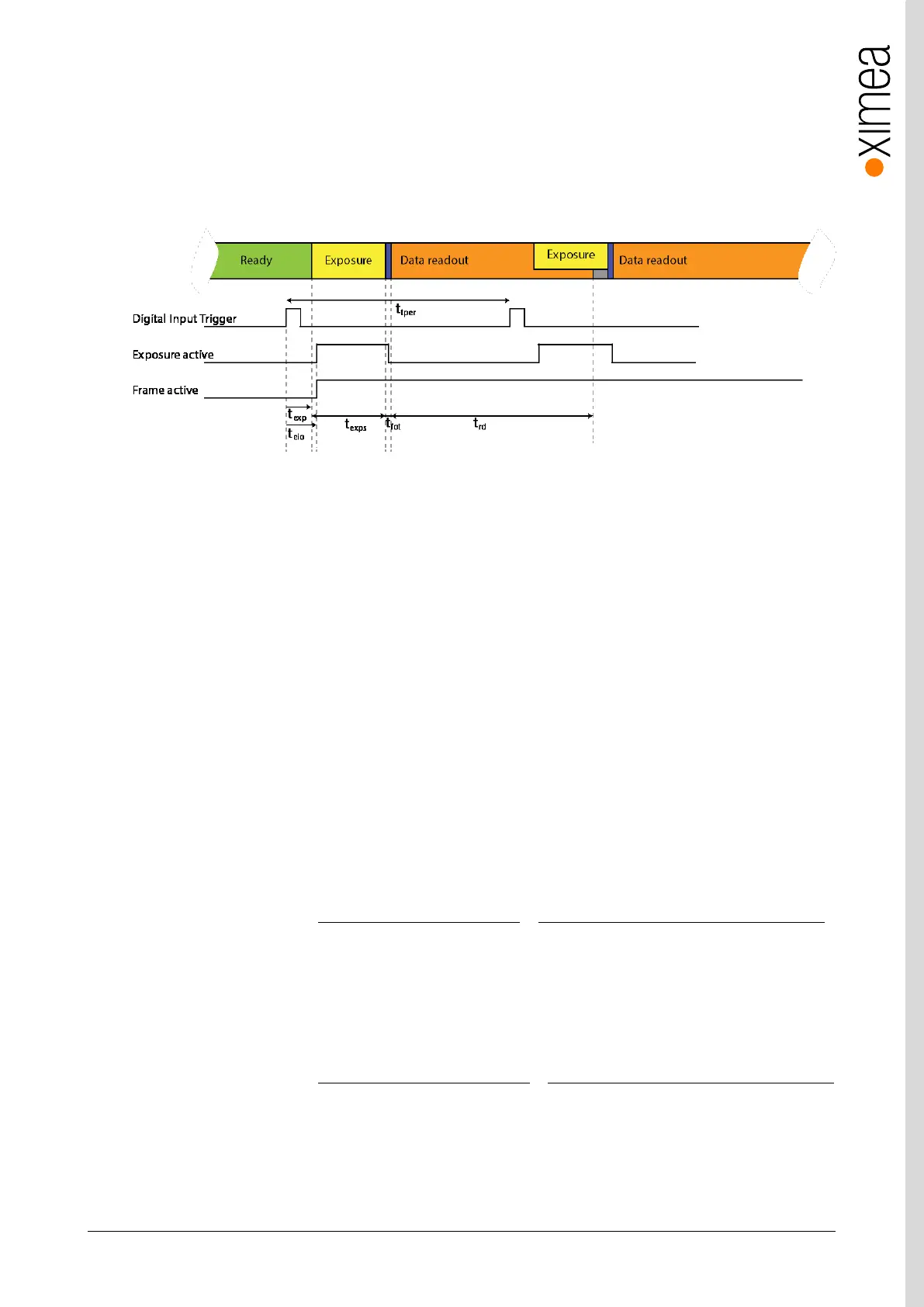
Sensors support exposure overlapped with readout. When the trigger period (t
tper
) is longer than the exposure plus readout time,
exposure is not overlapped with readout. However when the trigger period is decreased, the sensor will expose the images in
overlap mode. In this case, the frame active signal will be constantly active. The trigger period has to be long enough so the
exposure of next frame does not end sooner than readout of previous frame.
Sensor timing in Exposure Overlapped with Data Readout Mode
figure 4-4, acquisition mode – triggered with overlap
Description:
t
eio
– Trigger (Digital Input) to Exposure Active (Digital Output)
t
exp
– Trigger (Digital Input) to start of exposure
t
exps
– Current Exposure Time set (XI_PRM_EXPOSURE)
t
fot
– Frame overhead time (FOT)
t
rd
– readout time (Readout Time)
t
row
– readout time of one row (Line period) depends on sensor settings
Conditions: Debounce on trigger input line and trigger delay are disabled.
The timing strongly depends on camera settings. Most of the times can be calculated using Camera performance calculator.
The delay between trigger input and start of exposure:
Where:
t
jitter
– Jitter introduced by synchronization to row sync signal is less than t
row
t
idelay
– Delay inside camera caused by internal electronics. This depends on input type.
Please refer to: 3.10.3 Optically isolated Digital Input or 3.10.5 Non-isolated Digital Lines (-UB and -TC only)
The output signaling is then delayed the delay introduced from the output electronic.
Where:
t
odelay
– Delay inside camera caused by internal electronics. This depends on output type.
Please refer to: 3.10.4 Optically isolated Digital Output or 3.10.5 Non-isolated Digital Lines (-UB and -TC only)
For minimum trigger period (t
tper
) the following applies. The next trigger after one is processed needs to be applied so the end of
the triggered exposure does not overlap with the readout of the previous frame.


 To Next Page