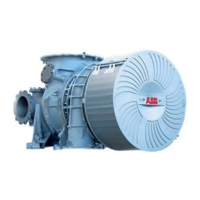
The provided document is an Operation Manual for an ABB Turbocharger, specifically models A145-M65. It covers various aspects of the device, including its function, technical specifications, usage, and maintenance.
Function Description
The ABB turbocharger is a turbomachine designed for turbocharging internal combustion engines. Its primary function is to supply the engine with the required air volume or air/gas mixture and associated charging pressure for operation. The turbocharger consists of a turbine and a compressor, both installed on a common shaft, forming the rotor.
In operation, exhaust gases from the internal combustion engine flow through the turbine casing and nozzle ring onto the turbine. The turbine utilizes the energy from these exhaust gases to drive the rotor, which in turn drives the compressor wheel. The exhaust gases then exit to the atmosphere through the gas outlet flange. The compressor wheel draws fresh air through the air suction branch or filter silencer. This air is compressed by the compressor wheel, further compressed by flowing through the diffuser and compressor casing, and then directed to the engine cylinders.
The rotor operates on two radial plain bearings located in the bearing casing between the compressor and turbine. An axial thrust bearing is situated between these two radial plain bearings. The plain bearings are connected to a central lubricating oil duct, typically supplied by the engine's lubricating oil circuit, with the oil outlet at the deepest point of the bearing casing.
Some turbocharger versions are equipped with compressor wheel cooling. In these versions, after the compressor air is cooled by passing through the charge air cooler on the engine side, it is supplied to the turbocharger for cooling the compressor wheel. This cooling is crucial for ensuring the reliability and replacement intervals under relevant operating conditions. The presence of compressor wheel cooling is indicated by the turbocharger type (M6..) on the rating plate.
The turbocharger is intended to be operated with a clockwise direction of rotation as viewed from the turbine end. It complies with the Machinery Directive 2006/42/EC and is classified as partly completed machinery.
Important Technical Specifications
The specific operating limits of the turbocharger are determined based on information from the engine builder and are provided on the rating plate. These limits include:
- Turbocharger operating limits at engine overload (110%): These apply only during test rig operation unless otherwise agreed with the engine builder.
- Turbocharger operating limits during operation: These are the standard operating limits.
- Lubricating oil pressure at oil inlet:
- Normal operation: 2.0 < p_oil ≤ 4.5 bar
- Engine start (cold oil, max 15 minutes): < 8.0 bar
- Engine idling (max 1 hour): 0.5 < p_oil ≤ 2.5 bar
- Pre-lubrication and post-lubrication (engine stopped): 0.5 < p_oil ≤ 1.0 bar
- Warning signal (n ≥ 0.5 x n_Bmax): < 1.25 bar
- Alarm signal (stop engine immediately): < 0.6 bar
An oil orifice is mandatory at the oil inlet if the oil inlet pressure is > 3 bar (with engine under load) to limit the oil flow rate.
- Lubricating oil temperature at oil inlet:
- Admissible: 30 … 105 °C
- Temporarily admissible (< 1 h) → alarm: > 105 °C
- Not admissible → stop engine: > 110 °C
- Not admissible → do not start engine (before start: preheat oil): < 30 °C
- Lubricating oil temperature at oil outlet:
- Admissible: ≤ 160 °C
- Temporarily admissible → alarm: > 160 °C
- Not admissible → stop engine: > 180 °C
- Admissible: ≤ T_oil,inlet + 55 K
- Temporarily admissible → alarm: > T_oil,inlet + 55 K
- Oil filtering: Filtering the lubricating oil with a filter mesh width of ≤ 0.034 mm is sufficient.
- Speed differences with several turbochargers per engine: The difference between the highest and lowest turbocharger speed must not exceed 3% relative to the speed limit n_Bmax.
- Deflagration tolerance: ABB turbochargers can tolerate a deflagration with a transient pressure increase of 12 bar.
Usage Features
- Safe Operation: The turbocharger must only be used when in technically flawless condition and operated in compliance with its intended use. Any operation outside its operating limits can be hazardous.
- Personnel Competence: Only trained and authorized personnel should operate and service the turbocharger. They must be familiar with safety regulations, equipped with personal protective equipment, and have read and understood the Operation Manual.
- Warning Plates: Warning plates are affixed to the turbocharger and must always be present and legible. If not, they must be replaced.
- Pre-lubrication: Before starting the engine, pre-lubrication is required, involving switching on the oil pump, building up oil pressure, and not exceeding a pre-lubrication time of 2 minutes.
- Commissioning Checks: Before and during commissioning, visual controls, monitoring, and measuring work are performed to detect changes and prevent engine damage. This includes checking the filter mat, lubricating system, and warning plates.
- Engine Start-up Checks: During engine start-up, speed, oil pressure, charging pressure, exhaust gas temperature (before and after turbine), and air temperature (before and after compressor) should be measured and compared with acceptance certificate values.
- Stopping the Engine: Before stopping, the engine should run at idling speed for 5-10 minutes. Post-lubrication is required for water-cooled bearing casings until rotors stop, and for oil-cooled bearing casings for 20 minutes if turbine inlet temperature exceeds specified values.
- Burst Protection and Insulation: The turbocharger must always be operated with fitted burst protection and insulation in one of the permitted variants to prevent serious injuries or fatal accidents.
Maintenance Features
- Service Work: Includes visual inspections, monitoring, measuring, and function checks to ensure full operability.
- Service Intervals:
- Every 25-50 hours: Visual check for air, exhaust gas, water, and oil leaks. Record operating data.
- 100 hours after commissioning: Clean or replace the oil filter in the supply pipe to the turbocharger.
- According to rating plate data (usually 8000-12000 operating hours): Rotor and bearing parts must be checked and assessed by an ABB Turbocharging Service Station. This may involve removing the turbocharger, disassembling it, measuring clearances, and cleaning components.
- Every 500 hours (for filter ring): Clean or replace the filter ring. Replace after the fifth cleaning process at the latest.
- 5-year service inspection: Recommended to prevent machine damage caused by aging and downtime.
- Compressor Cleaning (Wet Cleaning):
- Performed during operation at an engine load of 50-85%.
- Uses pure water (never salt water) injected into the filter silencer or air suction branch.
- Multiple short injection periods are recommended, coordinated with ABB Turbo Systems.
- Engine must continue to operate for at least five minutes after cleaning to flush out water.
- Not more than three cleaning cycles consecutively.
- Turbine Cleaning (Wet Cleaning):
- Performed during operation at an engine load of 20-40%.
- Water is injected before the nozzle ring.
- Injection phase of 10 minutes.
- Engine must continue to operate for 10 minutes after cleaning to prevent corrosion.
- Mechanical Cleaning of Components:
- Recommended for heavily contaminated components that cannot be cleaned by wet methods.
- Requires disassembly of the turbocharger and cartridge group.
- Only pH-neutral cleaning agents that do not attack metals should be used.
- Soft tools (rags, brushes) are recommended; avoid needle descalers or striking tools.
- Components should be dried completely and lightly sprayed with penetrating oil after cleaning.
- Long-term Storage:
- For up to 6 months: Store in closed packages with VCI label in dry rooms (40-70% atmospheric humidity).
- For more than 6 months: Replace VCI corrosion protection emitters every 6 months.
- Every 3 years: Components must be checked, desiccant replaced, and repackaged by an ABB Turbocharging Service Station.
- If removed from service: Seal all openings with paraffin paper and wooden lids. Check annually for corrosion.
- Spare Parts: Only original parts from ABB Turbo Systems should be used. A customer spare part set (97070) is required for operations described in the manual.
- Disposal: Disposal of turbocharger components (metals, non-metallic materials, lubricants, electronic parts, thermal insulation) must be environmentally compatible and comply with local regulations.

 Need help?
 General

 To Next Page